
Skincare
Internet In Real Life: Italian Village Turned Into Web 0.0 By Biancoshock
Jun
What would Facebook look like without screens, servers, targeted advertising, or a distant cousin posting suspicious health advice? Italian artist Biancoshock offered a wonderfully simple answer: it would look a lot like a village noticeboard.
In 2016, the artist transformed Civitacampomarano, a small hilltop community in Italy’s Molise region, into Web 0.0. Instead of installing faster broadband or covering the medieval streets with futuristic gadgets, he matched familiar internet platforms with the traditional places and behaviors that had performed the same jobs for generations.
A public bench became Twitter. A phone booth became WhatsApp. The post office represented Gmail, while a neighborhood shop turned into eBay. Through 12 playful urban interventions, Biancoshock created an internet in real life and reminded viewers that sharing news, buying used goods, finding answers, watching entertainment, and meeting potential partners did not begin in Silicon Valley.
The result was humorous, highly photogenic, and surprisingly thoughtful. Web 0.0 was not merely a collection of oversized technology logos. It was a street-level examination of community, rural connectivity, public space, and the human habits hidden beneath our favorite apps.
What Was Biancoshock’s Web 0.0 Project?
Web 0.0 was created for the first edition of the CVTà Street Fest, held in Civitacampomarano in April 2016. The event brought several international and Italian artists into the historic center under the artistic direction of street artist Alice Pasquini.
Rather than treating the village as an empty outdoor canvas, the festival encouraged artists to work with its architecture, history, residents, and everyday routines. That approach suited Biancoshock, whose public installations often begin with ordinary urban objects and then alter their meaning through a clever visual intervention.
At the time, Civitacampomarano had roughly 400 residents, many of them older adults. Mobile reception was unreliable, and dependable data connections were difficult to obtain. In many places, that situation would sound like the opening scene of a technological disaster movie. In Civitacampomarano, however, people were still communicating, exchanging information, trading objects, and maintaining relationships.
Biancoshock recognized the contradiction. The village appeared disconnected according to digital standards, yet its residents remained connected through physical places and long-established social customs. Web 0.0 translated those customs into the language of apps and online services.
Why Civitacampomarano Was the Perfect Setting
Civitacampomarano is built from stone, memory, and the sort of steep streets that make every grocery trip count as leg day. Its historic center contains narrow lanes, traditional buildings, gathering places, and houses left empty after decades of population decline.
This made the village more than a picturesque background. Its relative isolation was central to the artwork. Web 0.0 would have meant something very different in Milan, Rome, or New York, where a WhatsApp logo painted on a phone booth might seem like a joke about obsolete technology. In Civitacampomarano, the same image connected two working systems of communication: one digital and one physical.
The town also had living traditions that could be matched with online behavior. Residents talked on benches, gathered at the bar, read posted announcements, exchanged household items, and relied on older neighbors for local knowledge. The internet had not invented these activities. It had reorganized them, accelerated them, and placed them behind glass screens.
The 12 Real-Life Platforms of Web 0.0
Twitter Became a Public Bench
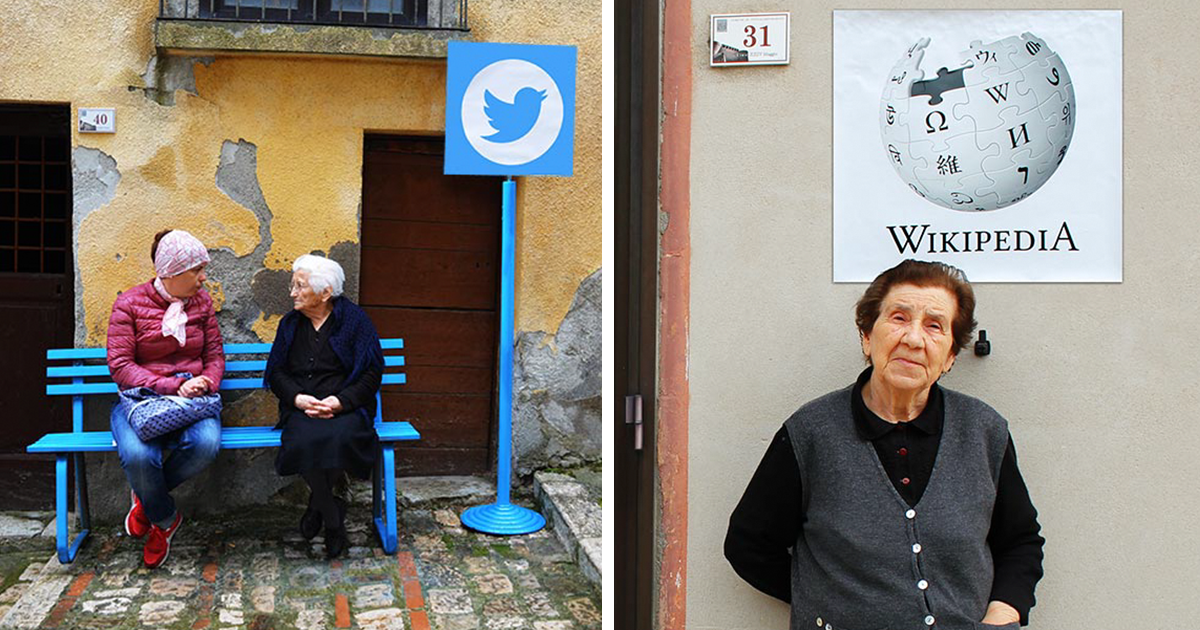
For the project’s version of Twitter, Biancoshock painted a village bench bright blue and placed the platform’s familiar bird symbol nearby. The comparison was immediate: people sitting on a bench exchange brief observations, comment on local events, repeat rumors, and occasionally deliver opinions nobody requested.
The major difference is that a bench conversation comes with eye contact and natural limits. When the other person leaves to make lunch, the thread is officially closed.
Facebook Became the Community Noticeboard
A public bulletin board was labeled as Facebook. Long before digital timelines, community boards displayed announcements, invitations, public notices, lost-and-found messages, and information about local events.
Both systems organize social life through posted updates. The analog version has fewer vacation photos, although it may contain an impressive number of flyers for village celebrations.
WhatsApp Became a Phone Booth
Biancoshock transformed a traditional telephone booth with WhatsApp’s green visual identity. The installation linked an older communication tool with a modern messaging service designed around instant personal contact.
A phone booth may not offer group chats, voice notes, stickers, or the ability to watch someone type for three minutes and then send “OK.” Still, it served the same essential purpose: helping one person reach another across a distance.
Gmail Became the Postal Service
The village’s physical mail system became Gmail. This was one of the project’s clearest comparisons because electronic mail openly borrowed its language from postal communication. We still speak of inboxes, addresses, messages, attachments, and delivery.
Biancoshock simply returned the metaphor to its original home. The result suggested that email is not a completely new behavior but a faster version of an old human desire: sending words to someone who is not standing nearby.
eBay Became a Local Store
A shop selling used or affordable goods was presented as the village’s version of eBay. Before online marketplaces allowed strangers to trade objects across continents, local stores, markets, and neighbors helped unwanted items find new owners.
The analog marketplace was smaller, but it had one feature online shopping still struggles to reproduce: customers could inspect an item before discovering that “excellent condition” apparently meant “survived a minor landslide.”
WeTransfer Became a Delivery Vehicle
A small transport vehicle represented WeTransfer. Online, the service moves large digital files. In Web 0.0, a local vehicle moved physical objects through the village.
The joke depended on the double meaning of transfer. Whether the cargo is a video file or a wooden chair, something begins in one place and ends up somewhere else. One process requires cloud storage; the other may require strong arms and careful driving.
RSS Became the Newspaper Stand
A newspaper shop served as the physical equivalent of an RSS feed. Both gather updates from multiple sources and present them in one accessible location.
The village newsstand offered information without passwords, notifications, or an algorithm deciding that after reading one gardening article, a person must want nothing but tomatoes for the next six months.
YouTube Became Television at the Bar
Biancoshock associated YouTube with residents gathering at a bar to watch televised entertainment, including sports. The screen was not personalized, and viewers could not skip an advertisement after five seconds. However, watching together transformed media consumption into a social event.
The audience reacted in the same room, argued over what happened, and shared the emotional rhythm of the program. It was streaming with snacks, commentary, and no recommendation engine.
Wikipedia Became a Village Elder
One of the warmest interventions presented an older resident as the village’s Wikipedia. In traditional communities, experienced residents preserve family histories, local events, practical knowledge, recipes, legends, and details that may never appear in an official archive.
The comparison was affectionate rather than dismissive. It recognized oral history as a living information system. A village elder may not provide numbered citations, but she may know who owned every house, why a road has its name, and exactly which family started an argument in 1957.
Avast Became the Pharmacy
A pharmacy was labeled as Avast antivirus. The wordplay compared medicine protecting the human body with software protecting a computer from harmful programs.
It was an especially effective visual joke because both places promise diagnosis, prevention, and treatment. Naturally, only one may recommend restarting the patient.
Google Became the Village Bar
The local bar functioned as Google, the place where people could ask questions, collect information, and learn what was happening. A resident looking for a mechanic, a missing neighbor, a local address, or the story behind a family disagreement could begin there.
The answers might not arrive in 0.42 seconds, but they would probably include context, several opinions, and an unrelated story involving somebody’s uncle.
Tinder Became a Meeting Place
The project’s Tinder appeared as a bench near the edge of the village, suggesting an old-fashioned place where young people might meet away from crowded family homes and highly observant neighbors.
Romantic matching existed long before profile cards and swiping. Communities had dances, public squares, festivals, introductions by relatives, and strategic walks taken at extremely predictable times.
The Deeper Meaning Behind the Humor
Web 0.0 worked because it did not require a lecture before the joke became understandable. Viewers recognized the logos and immediately connected each platform with its physical counterpart. That moment of recognition opened the door to a more serious question: are digital platforms truly creating new human behaviors, or are they packaging old behaviors in profitable interfaces?
Facebook did not invent community announcements. Twitter did not invent brief public opinions. Google did not invent asking knowledgeable people for help. Tinder did not invent flirting, and eBay certainly did not invent selling a chair that no longer matches the curtains.
Digital platforms expanded the scale and speed of these activities. They allow communication across enormous distances and make information available almost instantly. Web 0.0 did not argue that a village bench can replace modern connectivity. Instead, it revealed the social foundations on which digital services were built.
Web 0.0 Was Not an Argument Against Internet Access
It would be easy to romanticize Civitacampomarano as a perfect offline paradise where everyone happily chats in the sunshine and nobody receives spam. That interpretation misses an important point.
Reliable internet access affects education, employment, health services, government resources, business development, and communication with relatives who live elsewhere. Rural digital exclusion is a real disadvantage, not a charming lifestyle accessory.
Biancoshock’s project acknowledged the lack of connectivity while asking viewers to notice what remained present. The village possessed social infrastructure even when its digital infrastructure was weak. Its streets, shops, benches, bars, and residents formed a network that could not be measured by signal bars.
The most useful reading of Web 0.0 therefore avoids choosing between technology and tradition. Communities need modern access, but they also need public spaces where people can meet without registering an account or accepting updated terms of service.
Street Art as Creative Placemaking
Web 0.0 also demonstrated how public art can help an overlooked place become visible. CVTà Street Fest was developed in response to population loss and the growing number of empty buildings in Civitacampomarano’s historic center. Residents contributed walls, supported visiting artists, prepared local food, and participated in festival activities.
This community involvement separated the event from a decorative mural campaign imposed on an anonymous location. The work responded directly to the village’s physical environment and social identity.
Biancoshock did not hide Civitacampomarano beneath a generic layer of modern design. He emphasized its existing character. A bench remained a bench. A shop remained a shop. The intervention changed how people interpreted familiar objects without erasing their original functions.
That is one reason photographs of Web 0.0 traveled far beyond Molise. The project was highly shareable online, creating the delicious irony of an artwork about limited internet access becoming an internet sensation.
Why Web 0.0 Still Feels Relevant
The project has become even more meaningful as daily life has moved deeper into digital platforms. People now order groceries through apps, work in virtual offices, attend remote appointments, receive automated recommendations, and ask artificial intelligence to summarize information that a neighbor might once have explained over coffee.
Convenience has increased, but physical community life has often become easier to neglect. A digital network can connect thousands of people while still leaving an individual lonely. An analog network may include only a few dozen people, yet those people can notice when someone has not appeared at the bar for several days.
Web 0.0 encourages viewers to ask whether their online connections are supporting real relationships or merely producing continuous activity. A notification is not the same thing as attention. A follower is not automatically a friend. A timeline can show what happened, but it cannot carry groceries up the stairs.
Conclusion: The Internet Was Human Before It Was Digital
Biancoshock’s Web 0.0 transformed Civitacampomarano into a witty map of the internet’s analog ancestry. Through 12 simple interventions, the artist showed that many supposedly modern services are digital versions of activities people have practiced for centuries.
The project’s lasting appeal comes from its balance. It celebrates traditional community without pretending that rural areas do not need reliable technology. It critiques digital culture without claiming that life would improve if everyone threw a smartphone into the nearest fountain.
Most importantly, Web 0.0 reminds us that technology works best when it strengthens human connection rather than replacing it. Behind every message, search, sale, post, and match is an ordinary need: to communicate, understand, exchange, belong, or be seen.
The apps may change. The logos will eventually look old. The human network underneath them is considerably harder to uninstall.
Experiencing Web 0.0: A Walk Through the Real-Life Internet
Imagine arriving in Civitacampomarano without approaching it as a conventional gallery. There is no ticket desk, climate-controlled exhibition room, or guard politely reminding visitors not to lean on the art. The village itself is the exhibition, and daily life continues inside it.
Your experience begins slowly. Stone walls and narrow streets establish a setting that seems far removed from digital culture. Then a familiar blue bird appears beside a painted bench. The Twitter reference takes only a second to understand, but it changes the way you observe the people sitting there. A casual conversation becomes a public feed, except the participants can read one another’s expressions and immediately detect sarcasm.
Farther along, the Facebook noticeboard reveals how little the basic structure of social media has changed. Announcements compete for attention. Some are urgent; others are promotional. A festival notice serves as an event invitation, while a handwritten message resembles a personal post. You may realize that the modern timeline is essentially a community board capable of following you into the bathroom.
The WhatsApp phone booth produces a different feeling. Its bright green branding is funny, yet the booth also carries a trace of nostalgia. Stepping inside encourages you to remember when communication required choosing a number, waiting for an answer, and giving the conversation your full attention. There was no simultaneous scrolling through recipes, weather reports, and videos of dogs wearing raincoats.
At the bar, the Google comparison becomes especially convincing. Ask one local question and the human search engine activates. One resident offers an answer, another corrects it, and a third provides a detailed historical explanation that began before you were born. The information is not ranked by advertising bids. It is ranked by confidence, memory, and who speaks loudly enough to be heard over the coffee machine.
The village’s Wikipedia may be the most memorable encounter. Speaking with an older resident makes knowledge feel personal rather than abstract. Stories arrive with gestures, pauses, emotion, and details connected to specific streets. You understand that information can be accurate and useful while also carrying the personality of the person who preserved it.
Near the Tinder installation, the humor becomes gentler. The setting suggests that young people have always found ways to meet, even in communities where privacy is rare and every aunt appears to operate an advanced romantic surveillance network. The artwork makes modern dating technology seem less revolutionary and more like an updated tool for an ancient, awkward mission.
By the end of the walk, the logos matter less than the places beneath them. You begin noticing the village as a network of social infrastructure. The bench supports conversation. The shop circulates goods. The bar distributes information. The post office carries messages. The pharmacy protects health. Residents store the community’s memory.
The experience may also change how you view your own neighborhood. Where is its physical Facebook? Who acts as its Wikipedia? Is there still a place where people can sit without being expected to buy something? Would anyone notice if those places disappeared?
That is the quiet power of Web 0.0. It begins as a clever collection of visual jokes and ends as a practical question about how communities function. After walking through Biancoshock’s real-life internet, the digital world no longer looks entirely virtual. It looks like an enormous technological layer built over needs that have always been deeply human.

