
Beauty Tools & Accessories
Top 10 Bizarre Festivals
Jun
Some festivals celebrate harvests. Some honor saints. Some involve fireworks, dancing, costumes, music, and food. And then there are the festivals where people throw tomatoes at strangers, race through peat bogs wearing snorkels, feed monkeys like VIP guests, or cheer on a coffin race inspired by a frozen grandpa. Welcome to the wonderfully weird world of bizarre festivals, where local tradition meets human creativity and occasionally asks, “What if we added fruit projectiles?”
The best bizarre festivals are not merely random spectacles. They usually have history, symbolism, community pride, tourism value, and a strong sense of humor. Many began as local rituals, seasonal celebrations, religious observances, or quirky competitions before becoming international attractions. Others were invented more recently but quickly became beloved because people enjoy stories that sound impossible until the photos prove otherwise.
This guide explores the top 10 bizarre festivals around the world, from Spain’s legendary tomato fight to Colorado’s frosty tribute to cryonics. These unusual festivals are strange, funny, messy, meaningful, and sometimes a little hard to explain at dinner. That is exactly why people love them.
Why Bizarre Festivals Fascinate Travelers
Bizarre festivals give travelers something more memorable than another postcard view. They offer a chance to see how communities express identity in ways that are playful, symbolic, and deeply local. A visitor may arrive thinking, “This is odd,” but often leaves understanding that the oddness is part of the point. Shared laughter breaks down barriers faster than a museum audio guide ever could.
These weird festivals also reveal how traditions evolve. A symbolic food fight may become a global tourism magnet. A local legend may turn into a championship. A strange ritual may survive for centuries because it continues to bring people together. In an age when many travel experiences feel polished and packaged, bizarre festivals still feel delightfully alive.
Top 10 Bizarre Festivals Around the World
1. La Tomatina Buñol, Spain
La Tomatina is the world-famous tomato-throwing festival held in Buñol, Spain. Every year, thousands of participants gather for an enormous tomato fight that turns the streets into a red, slippery, laughing mess. The event began in the 1940s and has grown into one of the most recognizable unusual festivals in the world.
What makes La Tomatina bizarre is not just the tomatoes. It is the scale. Tons of overripe tomatoes are brought in for a controlled battle where everyone knows they will leave looking like they lost an argument with a pasta sauce factory. The festival usually lasts about an hour, which is probably enough time for most people to question their life choices and then immediately want to do it again.
La Tomatina is also a lesson in organized chaos. The event has attendance controls, safety rules, cleaning crews, and strong local identity behind it. What looks like a free-for-all is actually a carefully managed celebration that has helped put a small Spanish town on the global travel map.
2. Cooper’s Hill Cheese-Rolling Gloucestershire, England
At Cooper’s Hill Cheese-Rolling, competitors chase a wheel of Double Gloucester cheese down a steep hill. The cheese gets a head start, gravity takes over, and humans follow with a level of commitment usually reserved for Olympic finals or last-minute airport boarding.
The tradition is old, local, and famously chaotic. Participants tumble, slide, roll, and sprint toward the bottom while spectators watch one of Britain’s most peculiar sporting spectacles. The winner gets the cheese, which is both a prize and a punchline. Imagine risking your dignity for dairy, then realizing that is exactly what makes the story unforgettable.
The festival is bizarre because it turns a simple object into the star of a high-speed contest. The cheese is not merely food; it is destiny wrapped in a rind. For visitors, the safest and smartest way to enjoy the event is as a spectator, appreciating the tradition without assuming that knees are replaceable accessories.
3. Monkey Buffet Festival Lopburi, Thailand
In Lopburi, Thailand, monkeys are not just local residents. During the Monkey Buffet Festival, they become honored banquet guests. Towers of fruit, vegetables, sweets, and colorful displays are prepared for macaques, who approach the feast with the grace and table manners of tiny furry tornadoes.
The festival began as a tourism-boosting event and became one of Thailand’s most unusual attractions. It celebrates the city’s relationship with its monkey population, especially around ancient temple ruins where macaques are a familiar presence. The sight of monkeys climbing fruit pyramids and grabbing snacks with total confidence is both hilarious and oddly impressive.
What makes the Monkey Buffet Festival special is its reversal of roles. Humans prepare the party, monkeys enjoy it, and everyone else documents the moment. It is a rare event where the guests of honor do not care about speeches, schedules, or photo angles. They care about watermelon.
4. El Colacho Castrillo de Murcia, Spain
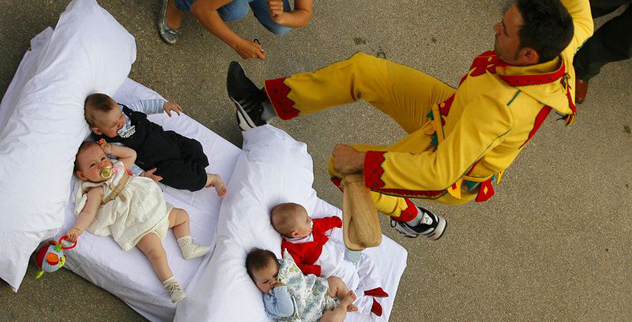
El Colacho, often called the baby-jumping festival, is one of Spain’s strangest traditional rituals. Held in Castrillo de Murcia, it dates back centuries and blends religious symbolism, folklore, and local custom. During the festival, costumed figures representing evil leap over infants placed safely on mattresses as part of a ritual associated with protection and purification.
To outsiders, the event can sound unbelievable. Yet for the community, El Colacho is not a stunt invented for social media. It is a long-standing cultural tradition connected to Corpus Christi celebrations and local identity. The costumes, processions, music, and symbolism all form part of a larger ritual landscape.
Its bizarre appeal comes from the contrast between spectacle and seriousness. Visitors may first notice the shocking visual, but the deeper story is about belief, continuity, and communal blessing. It is a reminder that unusual festivals often make the most sense when seen through the culture that created them.
5. Wife Carrying World Championship Sonkajärvi, Finland
The Wife Carrying World Championship in Sonkajärvi, Finland, is exactly as odd as it sounds. Competitors carry a partner through an obstacle course, racing for glory, laughs, and traditionally a prize connected to the carried partner’s weight in beer. The name is old-fashioned, but modern events often emphasize teamwork, consent, fitness, and comedy.
The festival is linked to Finnish folklore and local legends, but its modern version has become an international competition. Participants use different carrying techniques, including the famous “Estonian carry,” which looks like a gym exercise designed by a mischievous forest spirit.
Why does it belong on a list of top bizarre festivals? Because it transforms partnership into a sport. It is athletic, ridiculous, and strangely sweet. The best teams do not just rely on strength; they need balance, communication, trust, and the ability to keep going while everyone nearby is laughing.
6. Battle of the Oranges Ivrea, Italy
The Battle of the Oranges takes place during the historic Carnival of Ivrea in northern Italy. For several days, organized teams throw oranges in a dramatic reenactment tied to local legends of rebellion against tyranny. If La Tomatina is a tomato splash party, Ivrea’s orange battle is a citrus-flavored history lesson with helmets.
The event is not random fruit violence. It is structured around teams, costumes, symbolic roles, and civic tradition. Foot soldiers represent the people, while orange throwers on horse-drawn carts represent opposing forces. The result is part parade, part theater, part food fight, and part “please protect your face.”
What makes the festival fascinating is how strongly it connects messiness with memory. The oranges symbolize conflict, resistance, and collective identity. By the end, the streets are covered in pulp, but the community has retold its story in the loudest and juiciest way possible.
7. World Bog Snorkelling Championships Llanwrtyd Wells, Wales
In Wales, the World Bog Snorkelling Championships challenge competitors to swim through a water-filled trench cut into a peat bog. Participants wear snorkels, masks, and flippers, but traditional swimming strokes are not allowed. The result is a muddy, flipper-powered struggle that looks like aquatic exercise in a cup of strong tea.
The event takes place near Llanwrtyd Wells, a town known for embracing wonderfully eccentric competitions. Bog snorkelling is bizarre because it combines endurance sport with a setting that most people would normally try very hard not to fall into.
Yet the championship has genuine appeal. It attracts adventurous participants, curious spectators, and fans of offbeat travel. It also proves that a festival does not need fireworks or celebrity performers to be memorable. Sometimes all it needs is a trench, some flippers, and a community willing to say, “Yes, this counts as fun.”
8. Naki Sumo Crying Baby Festival Japan
The Naki Sumo Crying Baby Festival is a Japanese tradition in which babies are held by sumo wrestlers in a ceremonial contest where crying is considered a sign of health, strength, and protection from negative spirits. It is held at various shrines and temples, often around spring celebrations for children.
For visitors unfamiliar with the custom, the idea of cheering for a crying baby may seem upside down. In many places, a crying baby means someone is leaving the restaurant early. At Naki Sumo, the cry carries positive symbolism. It represents vitality and growth, and the event is surrounded by ritual prayers and family celebration.
The festival is bizarre in the most culturally revealing way. It shows how the same sound can mean completely different things depending on context. At home, a baby’s cry may trigger panic. In this festival, it can trigger applause, blessings, and proud parents with cameras ready.
9. Frozen Dead Guy Days Colorado, United States
Frozen Dead Guy Days is one of America’s quirkiest festivals, inspired by the story of Bredo Morstøl, often called “Grandpa Bredo,” whose body was preserved in a cryonic state in Colorado. What began as an unusual local story became a winter festival featuring coffin races, costumes, music, themed contests, and frosty humor.
The festival has been associated with Colorado mountain towns and is now celebrated in Estes Park. Its charm lies in how it turns a strange story into a playful community event. Rather than treating the legend with gloom, the festival leans into absurdity. Coffin races? Naturally. Frozen-themed games? Of course. A crowd willing to celebrate the weirdness? Absolutely.
Frozen Dead Guy Days belongs on this list because it captures a uniquely American style of eccentric festival-making: take a bizarre local legend, add live music and costumes, invite everyone, and somehow create a tradition that feels both ridiculous and heartfelt.
10. Lower Keys Underwater Music Festival Florida, United States
The Lower Keys Underwater Music Festival in Florida may be the only music festival where “good acoustics” requires a snorkel. Held near the Florida Keys reef environment, the event invites divers and snorkelers to listen to music broadcast underwater while promoting coral reef awareness and marine conservation.
Participants often wear costumes and pose with playful underwater instruments. The festival’s humor is obvious, but its purpose is serious. It uses novelty to draw attention to reef protection, reminding visitors that the ocean is not just a backdrop for vacation photos but a living ecosystem that needs care.
This festival is bizarre in a refreshing way. It combines music, environmental education, diving culture, and aquatic silliness. Where else can a person attend a concert, look at fish, think about coral conservation, and wonder whether a lobster has better rhythm than expected?
What These Weird Festivals Have in Common
Although these festivals look wildly different, they share several themes. First, they transform ordinary objects into symbols: tomatoes, oranges, cheese, mud, fruit, and even music become tools for storytelling. Second, they turn spectators into participants, even if only emotionally. Watching a cheese roll down a hill is not passive; it is a full-body suspense experience.
Third, bizarre festivals strengthen local identity. Buñol is inseparable from La Tomatina. Ivrea is known for its orange battle. Lopburi’s monkeys are part of the city’s image. These events may seem strange, but they help communities stand out in a crowded tourism world.
Finally, the best bizarre festivals balance humor with respect. It is easy to laugh at something unfamiliar. It is better to laugh with the community while understanding the history behind the spectacle. The weirdness may attract attention, but the meaning keeps the festival alive.
How to Appreciate Bizarre Festivals as a Respectful Traveler
Travelers should approach unusual festivals with curiosity rather than judgment. A tradition that looks strange from the outside may carry deep religious, historical, or social meaning. Before attending, it helps to learn the background, understand local expectations, and remember that not every festival exists for tourist entertainment alone.
Respect also means knowing when to participate and when to simply observe. Some events involve physical risk, sacred rituals, or strict community rules. Being a good visitor is not about getting the most dramatic selfie. It is about enjoying the experience without disrupting the people who keep the tradition alive.
The smartest travelers also think about sustainability. Food fight festivals often use produce that would otherwise be discarded, and conservation-focused events may raise awareness for fragile ecosystems. Still, visitors should support responsible organizers, follow local guidance, and avoid treating cultural events like disposable amusement parks.
Personal Experiences and Reflections on Bizarre Festivals
Experiencing bizarre festivals, even through research and traveler stories, teaches one clear lesson: people are far more creative than any travel brochure can capture. Standard tourism often sells beauty, comfort, and convenience. Bizarre festivals sell surprise. They remind us that a destination is not only its landmarks but also its collective sense of humor.
Imagine arriving in a town where everyone is preparing for an event that sounds impossible. In Buñol, shopfronts are covered, streets are prepared, and visitors wear clothes they have emotionally said goodbye to. The atmosphere before La Tomatina is half carnival, half countdown. People know they are about to be drenched in tomato pulp, and that shared anticipation creates instant friendship. No one looks elegant afterward, which may be the secret. When everyone looks equally ridiculous, social pressure melts faster than tomatoes in August.
The same kind of communal energy appears in events like the Battle of the Oranges. At first, it may seem like pure chaos. But once you understand the teams, costumes, symbols, and historic storyline, the festival becomes a living performance. The streets are not just messy; they are theatrical. The oranges are not just fruit; they are memory in motion. That shift from “weird activity” to “cultural expression” is what makes bizarre festivals worth studying.
Some festivals are funny because they exaggerate normal life. Wife carrying turns partnership into a race. Bog snorkelling turns outdoor sport into muddy comedy. Cheese rolling turns the simple act of chasing food into an international spectacle. These festivals succeed because they are easy to understand in one sentence, but hard to forget after seeing them. They have the perfect recipe for viral attention: a simple concept, a strong visual, and a generous serving of absurdity.
Others are memorable because they challenge expectations. The Naki Sumo Crying Baby Festival asks outsiders to rethink the meaning of crying. The Monkey Buffet Festival asks humans to serve animals as honored guests. The Underwater Music Festival asks whether a concert can happen below the surface of the sea. Each one flips a familiar idea upside down and invites people to see the world from a different angle.
For writers, photographers, and travelers, bizarre festivals are storytelling gold. They provide vivid scenes, unusual characters, strong emotions, and instant curiosity. A headline about “people gathering for a local annual celebration” may be accurate, but a headline about “hundreds racing through a bog with snorkels” demands attention. That is why these events perform so well in travel writing and search content. They naturally answer the reader’s first question: “Wait, this is real?”
The deeper experience, however, is not just amusement. Bizarre festivals show how communities protect identity in a globalized world. Anyone can build a shopping mall. Not everyone can maintain a centuries-old ritual, a fruit battle, or a winter festival about a frozen Norwegian grandfather. These events are cultural fingerprints. They are strange because they are specific, and that specificity is valuable.
The best way to experience bizarre festivals is with an open mind, comfortable shoes, and a willingness to be confused before being delighted. You may not understand everything at first. You may wonder why the cheese matters, why the monkeys get a buffet, or why anyone thought snorkelling through a bog was a good idea. But by the end, you may also realize that joy does not always need to be polished. Sometimes it is muddy, noisy, pulpy, icy, underwater, or wearing a costume.
Conclusion
The top 10 bizarre festivals prove that human celebration has no single formula. Around the world, communities use tomatoes, oranges, cheese, monkeys, music, mud, folklore, and frozen legends to create events that are unforgettable precisely because they are unusual. These festivals may look strange from a distance, but up close they reveal history, humor, resilience, and local pride.
For travelers, bizarre festivals offer more than entertainment. They offer a chance to understand how culture survives through play. A weird festival is often a serious tradition wearing a funny hat. It invites people to laugh, learn, and remember that the world is bigger and more imaginative than everyday routine suggests.
Whether you prefer watching from a safe distance or joining the crowd at a messy celebration, these unusual festivals deserve a place on any curious traveler’s bucket list. Just pack wisely. If tomatoes, oranges, bog water, or monkey mischief are involved, your outfit may not return home with its dignity intact.
SEO Tags

