
Skincare
10 Fast Facts About Three Billboards Outside Ebbing, Missouri
Jun
Three Billboards Outside Ebbing, Missouri is not the kind of movie that politely knocks on the door. It kicks the door open, drops a gallon of grief on the carpet, cracks a joke at the worst possible moment, and somehow leaves you thinking about justice, anger, forgiveness, and whether roadside advertising has ever been this emotionally aggressive.
Released in 2017 and written and directed by Martin McDonagh, the film follows Mildred Hayes, a grieving mother who rents three abandoned billboards to shame the local police for failing to solve her daughter’s murder. The result is a dark comedy crime drama that became a major awards-season force, earned Oscar wins for Frances McDormand and Sam Rockwell, and inspired debates that still follow the movie like a suspicious pickup truck on a rural road.
Below are 10 fast facts about Three Billboards Outside Ebbing, Missouri, from its real-life inspiration and filming locations to its awards triumphs, cultural impact, and the reason its title sounds like it escaped from a very dramatic highway map.
1. Ebbing, Missouri Is Not a Real Town
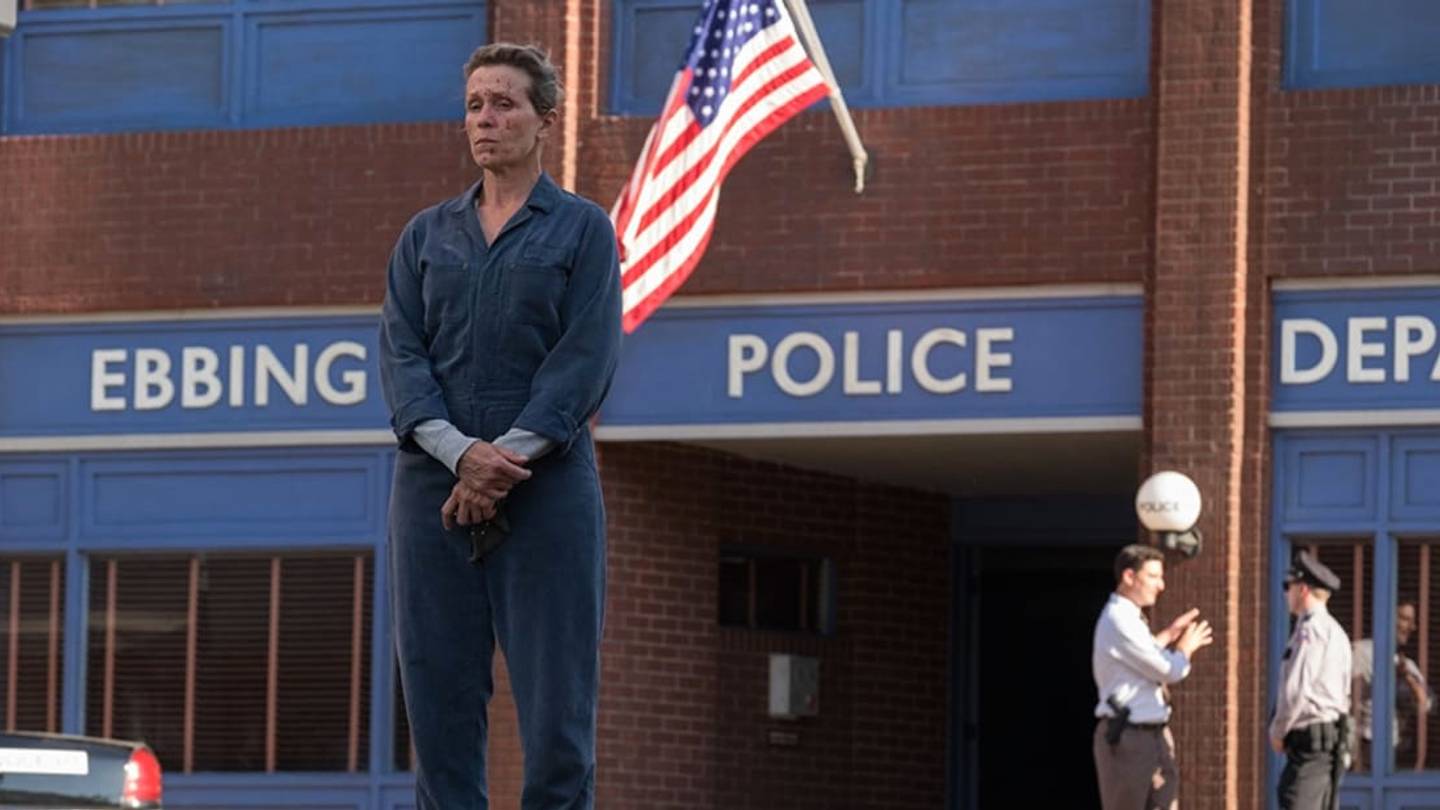
The first twist arrives before the plot even starts: Ebbing, Missouri does not exist. Martin McDonagh created the fictional town as a pressure cooker for grief, anger, gossip, and moral chaos. It feels specific enough to have a diner with regulars, a police station with bad coffee, and at least one person who knows everyone else’s business before breakfast. But Ebbing is imaginary.
This fictional setting gives the movie freedom. The story can feel Southern, Midwestern, rural, and mythic all at once without becoming a documentary about one actual community. Ebbing is less a pinpoint on a map than a state of mind: a place where everyone is close enough to hurt each other, judge each other, and still end up sharing the same hospital room.
2. The Movie Was Inspired by Real Roadside Billboards
Martin McDonagh has said the spark for the film came from seeing real billboards during a trip through the American South years before he made the movie. Those signs, reportedly connected to a family’s frustration over an unsolved killing, lodged in his imagination. He later transformed that image into the fictional story of Mildred Hayes.
That origin matters because the movie’s central idea is painfully simple: when official channels fail, a person may turn to public shame as a weapon. The billboards are not subtle. They are loud, red, blunt, and impossible to ignore. In a world of legal language and carefully worded statements, Mildred’s signs are basically grief with a megaphone.
3. Frances McDormand Turned Mildred Hayes Into an Icon
Frances McDormand plays Mildred Hayes with the kind of force that makes you sit up straighter, even if you are only watching from your couch with snacks balanced on your chest. Mildred is not written as a saint. She is furious, stubborn, wounded, sarcastic, reckless, and sometimes cruel. That complexity is the point.
McDormand’s performance won the Academy Award for Best Actress, and it is easy to see why. She does not soften Mildred to make her more “likable.” Instead, she makes her human. Mildred’s grief has sharp edges. Her humor is dry enough to qualify as a weather condition. Her pain is visible even when she hides it behind a bandana and a stare that could stop traffic.
4. Sam Rockwell’s Dixon Became the Film’s Most Debated Character
Sam Rockwell won the Oscar for Best Supporting Actor for playing Officer Jason Dixon, a racist, violent, immature police officer who becomes one of the film’s most controversial figures. Dixon is not introduced as a misunderstood sweetheart. He is dangerous, ignorant, and protected by a small-town system that lets him keep failing upward.
The debate comes from the film’s handling of Dixon’s arc. Some viewers see his journey as an attempt to explore whether hateful people can change. Others argue that the movie gives him too much sympathy too quickly, especially considering the harm he causes. Either way, Rockwell’s performance is a major reason people still argue about the film long after the credits roll. That is not bad for a character whose emotional development begins somewhere below basement level.
5. Woody Harrelson Gives the Story Its Moral Complication
Woody Harrelson plays Chief Bill Willoughby, the police chief targeted by Mildred’s billboards. A simpler movie might have made him purely corrupt or purely heroic. Three Billboards Outside Ebbing, Missouri does neither. Willoughby is respected by the town, loved by his family, and clearly not indifferent to Angela Hayes’s murder. At the same time, he represents the institution Mildred believes has failed her.
This tension is one of the film’s smartest moves. Mildred’s anger is understandable, but Willoughby is not a cardboard villain. He is a dying man, a public servant, a flawed leader, and a symbol of everything Mildred cannot forgive. The movie keeps pressing on that uncomfortable bruise: what happens when righteous anger lands on a complicated target?
6. It Was Filmed Mostly in North Carolina, Not Missouri
Despite the title, much of the movie was filmed in North Carolina. The town of Sylva, with its sloping streets and mountain backdrop, helped become the fictional Ebbing. Other locations in western North Carolina also appear throughout the film, giving the story its distinctive visual texture.
This is one of those Hollywood facts that sounds like a geography teacher’s trick question. A movie with Missouri in the title, inspired partly by Texas billboards, was filmed largely in North Carolina by a British-Irish playwright. Cinema: where the map goes to have an identity crisis.
7. The Billboards Are More Than Props
The three red billboards are the film’s visual engine. They are not just background objects; they are the loudest characters in the movie without ever moving. Their messages accuse, provoke, and reopen a wound the town would prefer to cover with politeness and routine.
They also represent the central theme of public grief. Mildred does not mourn quietly because quiet has gotten her nowhere. By placing her pain on the roadside, she forces everyone else to participate in it. The billboards turn private loss into public pressure. They ask whether visibility can become justice, or at least make injustice harder to ignore.
8. The Film Became an Awards-Season Heavyweight
Three Billboards Outside Ebbing, Missouri became one of the dominant films of the 2017 awards season. It won major Golden Globe prizes, including Best Motion Picture – Drama, Best Actress for Frances McDormand, Best Supporting Actor for Sam Rockwell, and Best Screenplay for Martin McDonagh.
At the Academy Awards, the film earned seven nominations, including Best Picture, Best Actress, Best Supporting Actor, and Best Original Screenplay. McDormand and Rockwell both won Oscars for their performances. The film also performed strongly at BAFTA, where it won major awards including Best Film, Outstanding British Film, Best Actress, Best Supporting Actor, and Best Original Screenplay.
9. It Was a Box Office Success for a Dark Adult Drama
For a film about murder, grief, police failure, guilt, racism, suicide, and revenge, Three Billboards Outside Ebbing, Missouri did surprisingly well at the box office. It earned more than $160 million worldwide, a strong result for a character-driven dark comedy drama with no superheroes, dinosaurs, or talking raccoons.
Its success shows how powerful word of mouth can be when audiences feel a movie gives them something to chew on. The film was not designed as easy comfort viewing. It is funny, but not cozy. It is dramatic, but not tidy. It is the kind of movie people recommend with a warning label: “It’s great, but maybe don’t watch it when you’re already having a delicate Tuesday.”
10. The Movie Inspired Real-World Protest Imagery
One of the most fascinating afterlives of Three Billboards Outside Ebbing, Missouri is how its imagery moved beyond cinema. Activists around the world borrowed the format of three bold red signs to call attention to political, social, and legal issues. The movie’s visual language became a protest template: short messages, huge letters, impossible-to-ignore public placement.
That influence proves how clean the film’s central image is. You do not need a long explanation to understand three signs demanding accountability. The format is direct, emotional, and media-friendly. In the movie, Mildred uses billboards because she feels unheard. In real life, activists used similar imagery for the same reason: sometimes a message needs to stand by the road and shout.
Why Three Billboards Outside Ebbing, Missouri Still Matters
The lasting power of Three Billboards Outside Ebbing, Missouri comes from its refusal to behave neatly. It does not offer a clean mystery, a perfect hero, or a satisfying legal resolution. Instead, it explores what people do when justice is delayed, grief curdles into rage, and forgiveness feels like an insult.
The film’s humor is another reason it stays memorable. Martin McDonagh is known for mixing violence, profanity, absurdity, and emotional pain in ways that should not work but often do. In this movie, jokes arrive at moments when polite storytelling would usually dim the lights and cue the sad piano. The effect can be shocking, but it also feels true to how people often survive terrible things: badly, awkwardly, and with jokes that would get them uninvited from a support group.
Character Analysis: Mildred, Dixon, and Willoughby
Mildred Hayes: Grief With Work Boots
Mildred is the emotional center of the film, but she is not a traditional audience surrogate. She is too fierce, too wounded, and too morally messy for that. Her campaign begins as a demand for justice, but it also becomes a way to keep her daughter’s memory from being buried under local routine. Mildred cannot solve the case herself, so she attacks the silence around it.
Jason Dixon: The Problem of Redemption
Dixon is where the movie becomes most uncomfortable. His story asks whether change is possible for someone who has caused real harm. But the film also leaves viewers to decide whether possibility is the same as redemption. That distinction matters. A character can begin to change without being absolved. The movie’s ambiguity is either brave or frustrating, depending on whom you ask.
Bill Willoughby: Decency Inside a Failed System
Willoughby complicates Mildred’s anger because he is not heartless. He is a decent man inside an imperfect institution, and the film never lets that be simple. His presence asks a painful question: when a system fails, how much blame belongs to the individual faces of that system?
Experiences Related to Three Billboards Outside Ebbing, Missouri
Watching Three Billboards Outside Ebbing, Missouri feels less like sitting through a standard crime drama and more like being trapped at a town meeting where everyone has brought emotional explosives instead of notes. The first viewing can be startling because the movie does not tell you how to feel. One minute you are laughing at a line so dry it practically needs moisturizer; the next, you are staring at Mildred’s face and remembering that the whole story is built on the worst loss a parent can imagine.
One experience many viewers share is the feeling of being pulled in two directions at once. Mildred’s anger is easy to understand. Her daughter is dead, the investigation has gone nowhere, and the town seems more offended by the billboards than by the unsolved crime behind them. At the same time, Mildred’s actions can be reckless and cruel. That tension makes the movie linger. It refuses to give the audience the simple pleasure of cheering without thinking.
The film also changes how you look at ordinary roadside signs. After seeing it, even a boring billboard for discount mattresses can start to feel strangely dramatic. The movie understands something powerful about public messages: location matters. A sign beside a road catches people when they are moving, thinking, commuting, escaping, or returning home. Mildred’s billboards interrupt that daily flow. They make private tragedy part of the landscape.
Another memorable experience is noticing how the movie uses silence. For all its profanity and verbal fireworks, some of its strongest moments happen when characters absorb what cannot be fixed. Mildred looking at the billboards, Willoughby facing his illness, Dixon reading a letter, Robbie living under the weight of his mother’s war with the townthese moments show that pain does not always announce itself with speeches. Sometimes it sits in the room like an extra character nobody invited.
The movie also creates strong post-watch conversations. Some viewers praise it as a fierce story about grief and accountability. Others criticize how it handles race, police violence, and redemption. Both reactions are part of the film’s cultural footprint. Three Billboards Outside Ebbing, Missouri is not a movie that politely disappears after viewing. It follows you into the kitchen, opens the fridge, and asks what you really think about justice.
For writers and filmmakers, the experience of studying the movie is especially useful. The premise is simple enough to explain in one sentence: a mother rents billboards to shame the police into solving her daughter’s murder. But from that premise, McDonagh builds a web of conflict involving family, law enforcement, reputation, guilt, illness, violence, and possible forgiveness. It is a reminder that strong storytelling often begins with one clear action that forces everyone else to reveal who they are.
In the end, the most lasting experience connected to the film may be discomfort. Not cheap discomfort, but the productive kindthe kind that makes viewers question why they want revenge stories to feel satisfying, why public anger can be both necessary and dangerous, and why forgiveness is so much easier to admire from a distance than practice up close. The movie does not hand out answers like candy. It gives you three billboards, several broken people, and a long road ahead.
Conclusion
Three Billboards Outside Ebbing, Missouri remains one of the most talked-about films of the 2010s because it combines a razor-sharp premise with unforgettable performances and moral questions that refuse to sit still. Its fictional town, real-world inspiration, North Carolina filming locations, awards success, and protest-ready imagery all contribute to its unusual legacy.
The film is funny, brutal, moving, flawed, and fearless. It is a story about a mother demanding answers, but it is also about what anger does when it has nowhere healthy to go. Like the billboards themselves, the movie stands in the landscape and refuses to be ignored.

