
Makeup
40+ Ways to Say “Thank You for Your Consideration” in Emails
Jun
Some email phrases work so hard they deserve a tiny office chair and a retirement plan. “Thank you for your consideration” is one of them. It is polite, professional, and safe enough to send to a hiring manager, a client, a professor, a recruiter, or the mysterious person in procurement who controls your destiny.
But because the phrase is used everywhere, it can start to sound a little automatic. When every email ends with the same sentence, your message may feel like it came from a template wearing a blazer. The good news: you can express the same appreciation in warmer, clearer, and more specific ways.
This guide gives you more than 40 polished alternatives to “Thank you for your consideration,” plus examples for job applications, interviews, proposals, networking, sales emails, academic requests, and follow-ups. You will also learn when to use the classic phrase, when to replace it, and how to avoid sounding pushy, vague, or overly dramatic. Gratitude is great; sounding like you are accepting an Oscar for an email attachment is usually not necessary.
What Does “Thank You for Your Consideration” Mean?
“Thank you for your consideration” means you appreciate someone taking the time to review your request, application, proposal, idea, resume, pitch, or message. It is commonly used when the recipient has some decision-making power. You may be asking them to hire you, approve a proposal, review your work, schedule a meeting, provide a reference, or respond to an opportunity.
The phrase works because it acknowledges two things: the recipient’s time and their judgment. You are not just saying, “Thanks for reading.” You are saying, “I understand you are weighing this, and I appreciate the effort.” That small difference matters in professional communication.
When Should You Use This Phrase?
Use “Thank you for your consideration” when your email involves a request, application, proposal, or decision. It is especially appropriate in formal or semi-formal situations where you want to sound respectful but not overly familiar.
Best situations for the phrase
- Cover letters and job applications
- Interview follow-up emails
- Grant, scholarship, or admission requests
- Business proposals and partnership pitches
- Requests for references or recommendations
- Networking emails to someone you do not know well
- Client emails asking for approval, feedback, or a decision
However, it is not always the best choice. In a casual team chat, it may sound stiff. In a close colleague’s email, it may feel distant. In a high-stakes follow-up, it may be too generic. The best professional email endings are specific, concise, and matched to the relationship.
How to Choose the Right Alternative
Before choosing an alternative, ask three quick questions:
- What am I thanking them for? Their time, feedback, review, support, patience, opportunity, or decision?
- How formal is the relationship? A hiring manager needs a different tone than a teammate you message daily.
- What should happen next? A reply, a meeting, a decision, a document review, or simply goodwill?
The more specific your thanks, the more human your email feels. “Thank you for reviewing my application” is stronger than “Thank you” because it names the action. “I appreciate your time and look forward to the next steps” is stronger than “Thanks in advance” because it is polite without sounding like you have already assigned homework.
40+ Ways to Say “Thank You for Your Consideration” in Emails
Below are professional alternatives organized by tone and situation. Feel free to copy, customize, and gently rescue your inbox from sounding like a corporate greeting card factory.
Formal alternatives
- Thank you for taking the time to review my application.
- I sincerely appreciate your time and consideration.
- Thank you for reviewing my request.
- I appreciate your thoughtful consideration of this opportunity.
- Thank you for considering my qualifications.
- I am grateful for your time and attention.
- Thank you for your careful review.
- I appreciate the opportunity to be considered.
- Thank you for evaluating my proposal.
- I greatly appreciate your consideration and look forward to your response.
Warm and professional alternatives
- Thank you for your timeI really appreciate it.
- I appreciate you taking a look at this.
- Thanks so much for considering my request.
- I am grateful for the opportunity to share this with you.
- Thank you for taking the time to connect with me.
- I appreciate your attention to this matter.
- Thanks again for your time and support.
- I appreciate your openness to reviewing this.
- Thank you for giving this your attention.
- I appreciate your time and hope to speak soon.
Job application and cover letter alternatives
- Thank you for considering my application for this role.
- I appreciate the opportunity to apply and share my background.
- Thank you for reviewing my resume and cover letter.
- I would be grateful for the opportunity to discuss how my experience aligns with your team’s needs.
- Thank you for considering me for this position.
- I appreciate your time and look forward to the possibility of speaking with you.
- Thank you for your review of my qualifications.
- I am excited about the opportunity and appreciate your consideration.
- Thank you for taking the time to evaluate my candidacy.
- I appreciate the chance to be considered for this opportunity.
Interview follow-up alternatives
- Thank you for speaking with me today.
- I appreciate the time you spent discussing the role with me.
- Thank you for sharing more about the team and the position.
- I enjoyed our conversation and appreciate your time.
- Thank you for the opportunity to learn more about your organization.
- I appreciate your insights into the role and next steps.
- Thank you again for meeting with meI enjoyed learning more about the team’s goals.
- I appreciate your time and remain very interested in the opportunity.
- Thank you for a thoughtful and informative conversation.
- I appreciate the chance to discuss how I could contribute to your team.
Business proposal and client email alternatives
- Thank you for reviewing this proposal.
- I appreciate your time and welcome any questions.
- Thank you for considering this recommendation.
- I appreciate the opportunity to present this idea.
- Thank you for taking the time to evaluate these options.
- I appreciate your feedback and consideration.
- Thank you for your attention to this proposal.
- I appreciate the opportunity to support your goals.
- Thank you for considering how this approach may benefit your team.
- I look forward to hearing your thoughts and appreciate your time.
Email Examples You Can Use
Example 1: Job application email
Subject: Application for Marketing Coordinator Role
Dear Ms. Johnson,
I am excited to apply for the Marketing Coordinator position at Brightline Media. My background in campaign reporting, content planning, and email marketing aligns closely with the responsibilities listed in the job description.
I have attached my resume and cover letter for your review. Thank you for considering my application. I appreciate your time and would welcome the opportunity to discuss how my experience could support your team.
Sincerely,
Alex Carter
Example 2: Interview thank-you email
Subject: Thank You for Meeting With Me
Dear Mr. Ramirez,
Thank you for speaking with me today about the Operations Analyst position. I enjoyed learning more about your team’s upcoming process improvement projects, especially the work around reducing fulfillment delays.
Our conversation strengthened my interest in the role. My experience building reporting dashboards and coordinating cross-functional updates would allow me to contribute quickly. I appreciate your time and look forward to the next steps.
Best regards,
Taylor Morgan
Example 3: Business proposal email
Subject: Proposal for Website Content Refresh
Hello Dana,
Thank you for discussing your website goals with me last week. Based on our conversation, I have attached a proposal outlining a refreshed content structure, updated service pages, and a search-friendly blog plan.
I appreciate your time reviewing the proposal and would be happy to answer any questions. Thank you for considering this approach.
Best,
Jordan
Example 4: Networking request email
Subject: Quick Question About Your Product Design Experience
Dear Priya,
I came across your recent panel discussion on product design careers and found your comments about user research especially helpful. I am currently exploring product design roles and would be grateful for 20 minutes of your time if your schedule allows.
Thank you for considering my request. I appreciate any guidance you may be willing to share.
Warmly,
Mia
Best Practices for Writing a Strong Thank-You Email
1. Be specific
Specific gratitude sounds sincere. Instead of writing, “Thanks for your time,” try “Thank you for explaining how the customer success team measures renewals.” That one detail proves you listened. It also helps the recipient remember the conversation, which is useful when they have met seven candidates, answered 43 emails, and possibly forgotten lunch.
2. Keep it concise
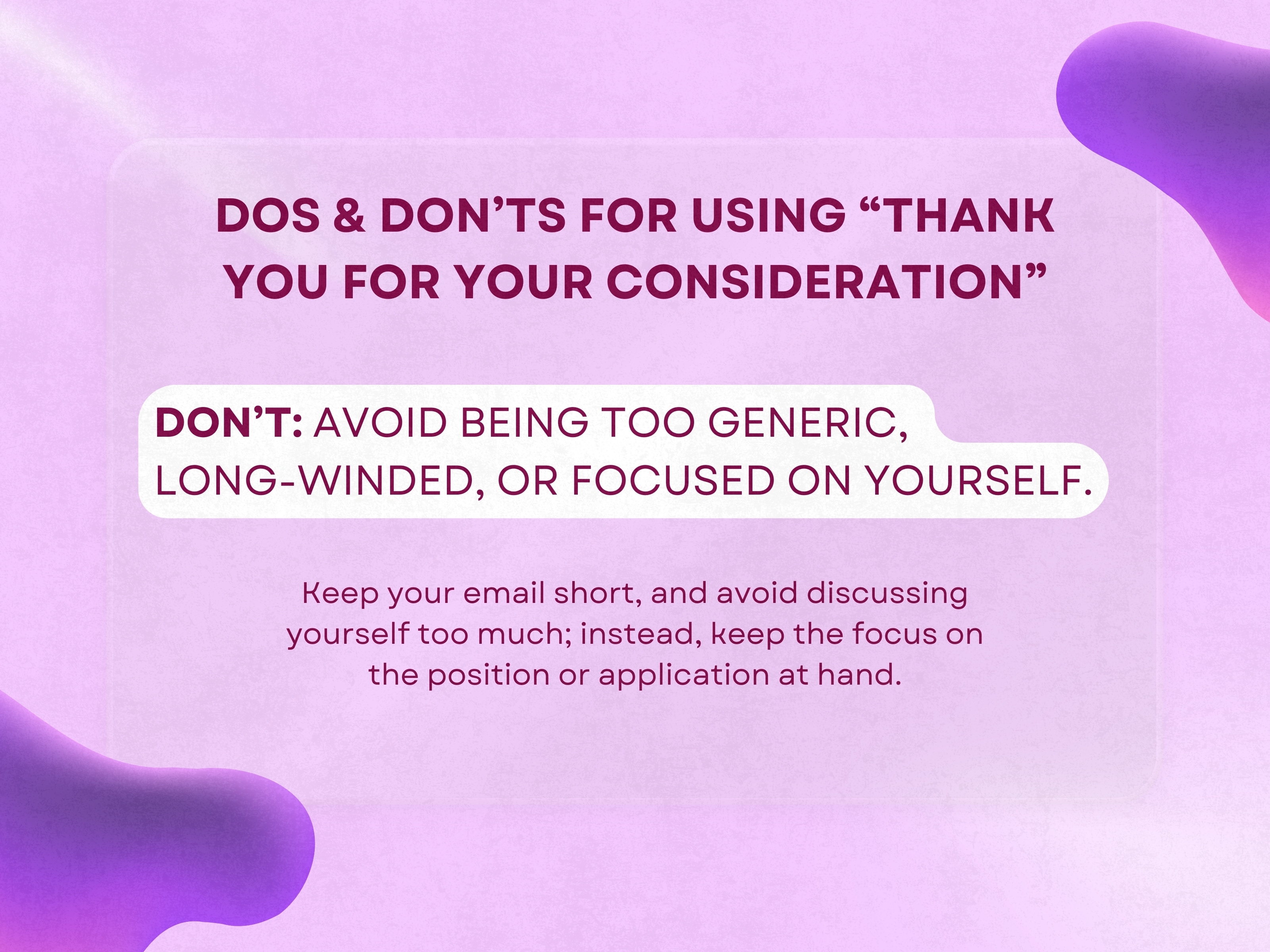
A thank-you email should not become a novel with chapter titles. In most professional situations, three to five short paragraphs are enough. Thank the person, mention one specific detail, restate your interest or request, and close politely.
3. Match the tone
If the recipient writes formally, stay formal. If they use a warm and conversational style, you can sound a little more relaxed. Matching tone does not mean copying their personality. It simply means meeting them in the same communication neighborhood.
4. Avoid pressure
Some phrases can accidentally sound demanding. “Thank you in advance” may be fine in simple requests, but it can feel presumptive when the favor is large or uncertain. Softer options include “I appreciate any guidance you can share” or “Thank you for considering this request.”
5. Proofread before sending
Gratitude loses sparkle when it arrives with spelling mistakes, missing attachments, or the wrong company name. A thank-you email that says “I am excited about the opportunity at Microsoft” while applying to Apple is not a power move. It is a tiny professional fire drill.
Common Mistakes to Avoid
Using the same phrase everywhere
“Thank you for your consideration” is useful, but it should not be your only closing line. A recruiter, mentor, professor, client, and coworker may all deserve different wording. Use the phrase when it fits, not because your brain has placed it on email autopilot.
Sounding too casual in formal situations
“Thanks a bunch!” may be friendly, but it is not ideal for a legal proposal, executive introduction, or graduate school application. Professional warmth is usually safer than full confetti mode.
Forgetting the next step
A strong closing often points gently toward what comes next. For example, “I appreciate your time and look forward to your feedback” is clearer than simply “Thanks.” The recipient should know whether you want a reply, a decision, a meeting, or no action at all.
Overdoing the gratitude
There is such a thing as too much thanking. If every sentence bows politely, your message can feel nervous. One sincere thank-you is better than five dramatic ones wearing tap shoes.
Quick Formula for Better Thank-You Closings
Use this simple formula:
Thank you + specific action + optional next step.
Examples:
- Thank you for reviewing my application. I look forward to the possibility of speaking with you.
- I appreciate your feedback on the proposal and would be happy to revise the timeline if helpful.
- Thank you for meeting with me today. I enjoyed learning more about the team’s goals.
- I appreciate your time and welcome any questions about the attached materials.
This formula works because it is polite, direct, and easy to personalize. It also prevents your closing from drifting into vague territory, where emails go to wear beige sweaters and disappear.
of Real-World Experience: What Actually Works in Professional Emails
In real email communication, the best thank-you lines rarely win because they are fancy. They win because they feel timely, specific, and natural. Over the years, the most effective professional emails I have seen share a simple quality: they respect the recipient’s time while still sounding like a real person wrote them.
For example, after a job interview, a generic closing such as “Thank you for your consideration” is acceptable. It will not ruin your chances. But a more personalized line can do more work: “Thank you for discussing the customer onboarding project with me today. I enjoyed learning how the team is improving the first 30 days of the client experience.” That sentence proves attention. It gives the interviewer a memory hook. It says, “I was present,” which is far more persuasive than “I own a keyboard.”
In client communication, appreciation works best when paired with clarity. A client reviewing a proposal does not only need warmth; they need to know what to do next. “Thank you for reviewing this proposal. I would be happy to walk through the timeline on a quick call next week” is stronger than a vague sign-off because it reduces friction. Busy people appreciate emails that make the next step obvious. Nobody wants to play detective in their inbox before coffee.
Networking emails are another place where specificity matters. If you are reaching out to someone for advice, do not make the person feel like they were selected by a spreadsheet with Wi-Fi. Mention what prompted the email: a talk they gave, an article they wrote, a career path you admire, or a shared professional interest. Then close with a gracious, low-pressure line such as, “Thank you for considering my request. I appreciate any insight you may be willing to share.” This keeps the tone respectful without making the recipient feel trapped.
One useful habit is writing the thank-you line last, after the rest of the email is complete. By then, you know exactly what you are thanking the person for. If the email is about a resume, thank them for reviewing your application. If it is about a meeting, thank them for their time and insight. If it is about a proposal, thank them for evaluating the recommendation. This small adjustment can instantly make your message more polished.
Another lesson: shorter is usually better. Many professionals are reading email between meetings, on phones, or while pretending not to eat lunch at their desks. A concise thank-you respects that reality. You can be warm without writing a paragraph that requires emotional hydration.
Finally, sincerity matters more than vocabulary. “I appreciate your time” can be excellent when it is honest and supported by the rest of the message. “I am profoundly grateful for your esteemed consideration of my humble request” may technically express thanks, but it also sounds like you are applying to become royal candle manager. Choose words that fit the relationship, the situation, and your natural voice.
Conclusion
“Thank you for your consideration” is a reliable professional phrase, but it is not your only option. The best alternative depends on context. For job applications, focus on the opportunity and your qualifications. For interviews, thank the person for the conversation and mention a specific detail. For proposals, show appreciation while making the next step clear. For networking, keep the tone gracious and low-pressure.
Professional gratitude does not need to be complicated. Be specific, be concise, match the tone, and proofread before sending. Do that, and your email will sound polished without feeling robotic. In a world full of crowded inboxes, a thoughtful thank-you is still a small gesture with surprisingly large power.
SEO Tags

