
Hair Care
What’s the Difference? Identifying Termite vs. Carpenter Ant Damage
Aug
Finding damaged wood in your home can trigger a very specific the next, you are mentally replacing the entire house and wondering whether the couch can live in the yard.
Before declaring your home an insect buffet, take a closer look. Termites and carpenter ants can both damage wooden structures, but they do it for different reasons and leave behind noticeably different evidence. Termites consume wood as food. Carpenter ants do not eat wood; they remove it to create nesting galleries.
That difference affects the appearance of the tunnels, the debris found nearby, the locations most likely to be infested, and the treatment required. Learning how to recognize these clues can help you explain the problem accurately, avoid ineffective do-it-yourself treatments, and know when to call a licensed pest professional.
Termites vs. Carpenter Ants: The Basic Difference
Termites are wood-feeding insects. Their digestive systems allow them to obtain nutrients from cellulose, the material found in wood, paper, cardboard, and other plant-based products. A termite colony may remain hidden behind walls, under flooring, inside framing, or beneath a building for a long time before obvious damage appears.
Carpenter ants are excavators rather than wood eaters. They chew through wood and carry the loosened material away to make room for a nest. Their actual diet includes insects, sweets, proteins, plant secretions, and honeydew produced by other insects. Think of termites as diners and carpenter ants as tiny contractors who never applied for a permit.
Carpenter ant damage generally develops more slowly than serious termite damage, although a large, established ant colony can still weaken structural wood. Carpenter ant nests are especially associated with damp, decayed, or previously water-damaged wood, while termites vary by species and may attack wood under different moisture conditions.
How to Identify Termite Damage
Look for Mud Tubes
Subterranean termites normally live in soil and build protected travel routes between the colony and a food source. These shelter tubes, commonly called mud tubes, may appear on foundation walls, crawl-space supports, plumbing penetrations, concrete piers, sill plates, or other surfaces connecting the soil to wooden parts of the building.
A typical tube looks like a narrow line of dried mud. It may be straight, branching, or irregular. The presence of a mud tube does not automatically confirm that termites are currently active, but it is strong evidence that termites have used the area.
Do not tear apart every tube you find. A pest professional may need intact evidence to determine where the termites are traveling and whether treatment is necessary.
Inspect the Interior of Damaged Wood
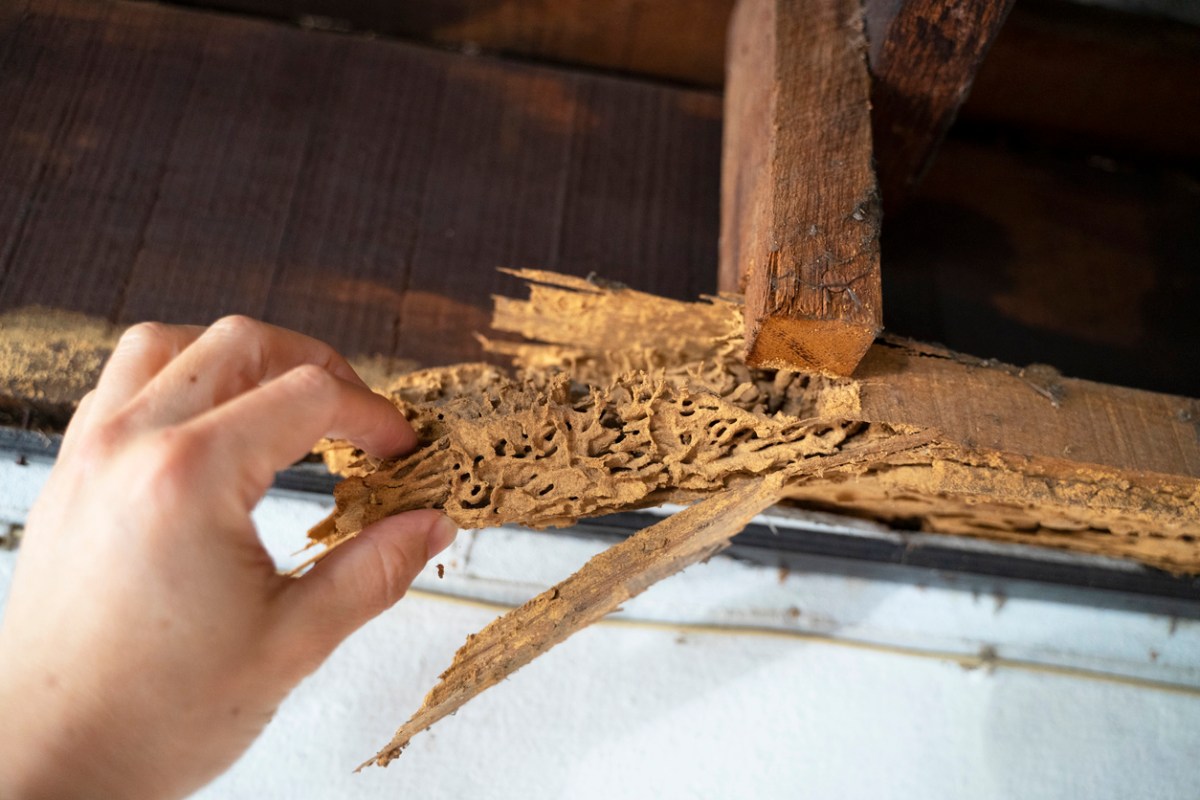
Termite galleries often look rougher than carpenter ant galleries. Subterranean termite tunnels may contain soil, mud, fecal material, or a damp-looking residue. The insects commonly consume softer portions of the wood while leaving thin layers or sections of harder material behind.
Severely damaged wood may sound hollow when tapped or may be easily punctured with a screwdriver. Painted or finished surfaces can remain intact even when the wood underneath has been extensively eaten. This creates the unpleasant experience of touching what appears to be a normal board and discovering that it has the structural confidence of a cracker.
Watch for Blistering or Papery Surfaces
Termite activity beneath flooring, paneling, trim, or painted wood may create blistered, sunken, or unusually thin surfaces. Floors can feel soft or slightly spongy. Paint may bubble, although bubbling paint alone is not proof of termites because plumbing leaks and ordinary moisture damage can create similar symptoms.
Recognize Drywood Termite Pellets
Drywood termites do not need a direct connection to soil. They live inside relatively dry wood and push fecal pellets out through small openings. These pellets are hard, dry, similarly sized, and often resemble coarse sand, pepper, or tiny seeds.
Under magnification, drywood termite pellets typically have distinct ridges and a fairly uniform shape. Small piles may appear beneath wooden window frames, furniture, beams, attic timbers, or trim. Cleaning the pellets without addressing the colony usually results in a fresh pile laterthe insect equivalent of receiving an unwanted subscription.
Mud tubes are most strongly associated with subterranean termites, while drywood termite infestations are more likely to produce hard fecal pellets. Regional species vary, which is one reason professional identification matters.
How to Identify Carpenter Ant Damage
Look for Smooth, Clean Galleries
Carpenter ants use their jaws to cut and remove wood. When damaged wood is opened, their nesting galleries typically have smooth walls with a sanded or polished appearance. The tunnels are usually clean because the ants carry loose material out of the nest.
This cleanliness is one of the most helpful differences between carpenter ant and subterranean termite damage. Termite galleries often contain mud or soil. Carpenter ant galleries generally do not.
Search for Sawdust-Like Frass
As carpenter ants expand their nest, they push excavated material through small openings. The resulting piles are commonly called frass. Carpenter ant frass may contain irregular wood shavings, coarse sawdust, fragments of dead ants, pieces of other insects, and bits of nest debris.
This material is different from the small, consistently shaped pellets produced by drywood termites. Carpenter ant debris looks more like the sweepings from a miniature woodworking shop. Drywood termite pellets look more uniform and granular.
Check Moisture-Prone Areas
Carpenter ants often begin nesting in wood softened by water, decay, or prolonged humidity. Common locations include:
- Window and door frames affected by leaks
- Roof edges, fascia boards, and damaged eaves
- Walls near showers, tubs, sinks, and dishwashers
- Crawl spaces with poor ventilation
- Porch columns and deck supports
- Wood beneath leaking gutters or downspouts
- Areas around plumbing penetrations
- Hollow doors, wall voids, and insulation
Once established in softened wood, a colony may expand into nearby sound wood. Eliminating the ants without correcting the leak or moisture problem can invite a repeat performance.
Listen and Observe at Night
Carpenter ants are frequently more active after sunset. A quiet room may reveal faint rustling inside a wall, ceiling, door, or window frame. You may also see workers traveling along baseboards, plumbing lines, tree branches, utility cables, fences, or foundation edges.
Large numbers of ants appearing indoors during cold weather may indicate a nest within the heated structure. During warmer months, however, individual ants may simply be foraging indoors from an outdoor colony.
Carpenter ant galleries are characteristically smooth and free of soil, while their discarded frass is irregular and may include wood fibers and insect fragments. Moisture-damaged wood is a particularly common nesting site.
Identifying the Insects Themselves
Winged termites and winged ants are often mistaken for one another, especially when a swarm appears near a window. Three body features provide the fastest comparison.
Antennae
Termite swarmers have relatively straight, bead-like antennae. Ant antennae are distinctly elbowed.
Waist
Termites have a broad body without a sharply pinched waist. Ants have a narrow, constricted waist between the middle and rear sections of the body.
Wings
A termite swarmer has two pairs of wings that are approximately equal in length. A winged ant has front wings that are noticeably larger than its rear wings.
Color is less reliable. Termite swarmers can be dark, and carpenter ants can vary from black to reddish brown or mixed colors. Body shape, antennae, and wing proportions provide better evidence than color alone.
Finding swarmers indoors is more concerning than seeing them outside. Indoor swarmers emerging from walls, floors, trim, or window frames may indicate that a mature colony is located in or directly beneath the building. Save several insects in a sealed container or clear plastic bag for identification instead of immediately vacuuming away every clue.
Termite Frass vs. Carpenter Ant Frass
The word frass is used broadly for insect waste and debris, so the label alone does not identify the pest. The texture and contents matter.
Carpenter Ant Frass
- Irregular in size and shape
- Often resembles coarse sawdust or wood shavings
- May contain insect legs, wings, body parts, and nest debris
- Usually found below a crack, gap, or small disposal opening
Drywood Termite Pellets
- Hard and dry
- Relatively uniform in size
- Granular rather than fluffy
- Often ridged along the sides
- May collect in neat piles beneath small kick-out holes
Subterranean Termite Material
- More likely to involve mud, soil, or moist material
- Frequently found inside galleries or shelter tubes
- Usually does not form the same dry pellet piles associated with drywood termites
Wood-boring beetles can also leave powder or pellets, so debris should not be diagnosed from a description alone. Exit-hole size, tunnel shape, wood species, moisture level, and insect specimens may all be needed for a reliable identification.
Which Pest Causes More Serious Damage?
Termites generally present the greater structural threat because they consume wood continuously and may maintain large colonies with hidden access to a building. Damage can spread through framing, subfloors, sill plates, joists, wall studs, and other structural components before the insects are noticed.
Carpenter ants can also cause meaningful damage, particularly when a colony remains undetected for years. However, they often occupy localized areas associated with moisture problems, and their damage usually progresses more slowly.
Neither pest should be ignored. The visible damage may represent only a portion of the affected area, and weakened structural wood may require evaluation by a qualified contractor or structural professional after the insects have been controlled.
A Safe Home Inspection Checklist
You do not need to dismantle the house to gather useful information. Begin with a careful visual inspection.
- Use a flashlight. Examine foundation walls, crawl-space supports, basement framing, window sills, plumbing areas, attic edges, and exterior trim.
- Look for moisture. Check for roof leaks, plumbing drips, condensation, damaged flashing, overflowing gutters, and soil that remains wet against the foundation.
- Photograph the evidence. Include close-up images and wider photographs showing the location.
- Preserve specimens. Save insects, wings, pellets, or frass in a sealed container when practical.
- Note the time and conditions. Swarming behavior may be associated with season, temperature, rainfall, and time of day.
- Avoid excessive probing. Do not puncture electrical wiring, plumbing, finished flooring, or potentially load-bearing components.
- Do not spray first and investigate later. A surface insecticide may kill visible insects while making the colony more difficult to locate.
Why Correct Identification Matters
Termites and carpenter ants require different management strategies. Even termite treatments vary depending on whether the infestation involves subterranean, drywood, or dampwood termites.
Subterranean termite management may involve soil treatments, baiting systems, localized applications, construction corrections, or combinations of these methods. Drywood termite treatment may require localized wood treatment or whole-structure methods, depending on the distribution of the infestation.
Carpenter ant management focuses on locating the main nest and any satellite nests, correcting moisture conditions, removing damaged wood when necessary, trimming access routes, sealing openings, and using an appropriate treatment for the identified ant species.
Randomly spraying ants along a kitchen counter rarely solves a carpenter ant infestation. Similarly, applying a household product to visible termite damage does not create a complete protective barrier or eliminate a hidden colony.
EPA and university guidance consistently emphasizes accurate identification, moisture correction, careful inspection, and professional assistance for active termite problems or extensive structural damage. Treatment rules and approved products can also differ by state.
How to Reduce the Risk of Future Damage
- Repair plumbing, roof, gutter, and flashing leaks promptly.
- Improve ventilation in crawl spaces, attics, and other humid areas.
- Keep wooden siding, trim, and framing from direct soil contact.
- Store firewood away from the house and above the ground.
- Remove decaying stumps, buried boards, and unnecessary wood debris near the foundation.
- Trim branches that touch the roof or siding and may provide ant travel routes.
- Direct downspouts and grading away from the foundation.
- Maintain an inspection gap where practical instead of covering foundation areas with dense vegetation or insulation.
- Seal gaps around utility lines, windows, doors, and exterior penetrations.
- Schedule professional wood-destroying insect inspections when buying a home or when suspicious evidence appears.
Moisture control deserves special attention. It will not prevent every termite species or every carpenter ant colony, but it removes conditions that support wood decay and makes the structure less inviting to many wood-associated pests.
Practical Experiences: What Common Inspection Scenarios Teach Us
The following composite scenarios reflect common situations described in pest-management and extension guidance. They are not presented as personal inspections, but they show how small details can change the diagnosis.
Scenario 1: The Mysterious Pile Beneath a Window
A homeowner notices a small pile of tan material beneath a wooden window frame. Because the material looks like sawdust, carpenter ants become the first suspect. A closer inspection reveals that the particles are hard, consistently sized, and shaped more like coarse grains than fluffy wood shavings.
There is no obvious ant trail, no mixed insect debris, and no sign of damp or softened wood. After the area is cleaned, a new pile appears in the same location several days later. Those clues are more consistent with drywood termite pellets than carpenter ant frass.
The practical lesson is simple: “sawdust” is not a precise diagnosis. Texture, uniformity, location, and whether the pile returns are more useful than the homeowner’s first impression.
Scenario 2: Ants Near a Leaking Dishwasher
Another homeowner repeatedly sees large dark ants in the kitchen at night. A few ants near a sink might simply be searching for food, but these insects emerge from a gap beside the dishwasher and disappear behind the cabinets.
Inspection reveals a slow plumbing leak that has dampened the subfloor and the lower portion of the wall. Coarse wood fragments and dead insect parts are found beneath a small opening. Inside the affected wood, the galleries are clean and smooth.
This combination strongly favors carpenter ants. Treating only the visible workers would miss the underlying moisture problem and potentially leave the nest intact. The lasting solution requires repairing the leak, locating the colony, removing badly damaged material when appropriate, and preventing future moisture accumulation.
Scenario 3: A Mud Line in the Garage
A homeowner finds a narrow brown line extending from a crack in the garage slab toward a wooden wall plate. It initially looks like dried dirt tracked in during a storm. When examined more closely, the line forms a raised, enclosed tube.
Nearby wood sounds hollow and contains soil-like material when a damaged edge is exposed. No sawdust pile is visible. These clues point toward subterranean termite activity rather than carpenter ants.
The experience demonstrates why mud tubes should not be dismissed as ordinary dirt. It also shows why crushing the tube and spraying the area is not a complete treatment. The visible tube may represent only one route in a much larger underground foraging network.
Scenario 4: Winged Insects at the Patio Door
A cluster of winged insects gathers near a glass patio door after warm, wet weather. At first glance, they all look alike. One specimen has a narrow waist, bent antennae, and front wings larger than the rear wings. It is a winged ant.
Another specimen has a broad waist, straight antennae, and four wings of nearly equal length. It is a termite swarmer. Without examining these features, it would be easy to reach the wrong conclusion based only on the presence of wings.
The lesson is that swarming insects should be collected, not crushed into an unidentifiable smudge. A clear photograph or intact specimen can save time, prevent unnecessary treatment, and help a professional determine whether the swarm originated indoors or outside.
Scenario 5: Damage That Is No Longer Active
During remodeling, a contractor opens a wall and finds old galleries in a water-stained stud. The wood is damaged, but no insects, fresh debris, live mud tubes, or recent moisture are present. The home may have had a previous infestation that was treated or naturally abandoned after conditions changed.
Visual damage alone does not reliably reveal when the infestation occurred. The wood may still need repair, but treatment decisions should be based on evidence of current activity, the building’s treatment history, and a professional inspectionnot on dramatic sales claims about exactly how old the damage supposedly is.
Across these scenarios, the most valuable habit is patient observation. Look at the gallery surface, debris shape, moisture conditions, insect anatomy, and location before choosing a solution. Homes rarely benefit from panic, and insects are famously unwilling to reimburse homeowners for products purchased under emotional distress.
Conclusion
Termites and carpenter ants can both leave wood weakened, hollow, or visibly damaged, but their evidence tells different stories. Termites eat wood and may leave muddy galleries, shelter tubes, hollow structural members, or uniform drywood pellets. Carpenter ants excavate nesting space, creating smooth, clean tunnels and pushing irregular sawdust-like frass outside the nest.
Use the clues together rather than relying on a single symptom. Mud tubes strongly suggest subterranean termites. Hard, uniform pellets suggest drywood termites. Smooth galleries, coarse shavings, moisture-damaged wood, and nighttime ant activity point more strongly toward carpenter ants.
When the evidence involves structural components, indoor swarmers, active mud tubes, recurring pellets, extensive galleries, or uncertain identification, contact a licensed pest-management professional. The goal is not merely to identify which insect has moved in. It is to eliminate the colony, correct the conditions that supported it, and make sure your house remains a home rather than an all-you-can-eat lumber special.
Note: This article synthesizes consumer guidance from the U.S. Environmental Protection Agency and pest-management publications from university extension programs across the United States. Regional termite species, treatment regulations, and approved products vary, so local professional guidance should take priority.

