
Beauty Tools & Accessories
The Crow’s Nest Residence
Jun
The Crow’s Nest Residence is the kind of mountain home that makes ordinary cabins look like they forgot to do their homework. Perched high at Sugar Bowl Resort in Norden, California, this 5,600-square-foot ski-in/ski-out residence is not just a vacation house; it is a carefully engineered alpine retreat built for snow, views, family gatherings, and the occasional dramatic entrance through a second-story doorway when winter decides to bury the ground floor. Designed by BCV Architecture + Interiors and built by Mt. Lincoln Construction, the home blends modern mountain architecture with the rugged confidence of an old-world ski chalet.
Set in the Crow’s Nest development at Sugar Bowl, the residence takes its name seriously. Like a lookout above a ship, it sits high, watches the landscape, and gives its occupants 360-degree views of the Sierra Nevada. But instead of a sailor with a telescope, this crow’s nest offers a hot tub, a stone fireplace, a sauna, a ski room, generous glazing, and enough warm wood to make winter feel personally defeated.
A Mountain Home Built for a Serious Site
The site is a major part of the story. Sugar Bowl Resort, founded in 1939, is one of California’s oldest ski areas and has a long tradition of alpine design, heavy snowfall, and ski culture. The Crow’s Nest Residence stands near the top of this snowbound community, close to ski lifts and positioned for direct access to the slopes. In simple terms, this is not a home that merely looks at skiing from a polite distance. It participates.
The home sits at roughly 7,080 feet above sea level on steep terrain, where weather is not a background detail but a design partner with strong opinions. Snow loads, access, drainage, slope stability, and seasonal use all had to be addressed. A delicate little cottage would not survive here. The solution was a strong, layered structure: a board-formed concrete base embedded into the hillside, with steel, glass, and wood rising above the snow line.
That concrete podium gives the residence its grounded presence. It feels rooted, almost like the mountain pushed it upward. The upper levels, by contrast, feel lighter and more open, using cedar, glass, and exposed structural elements to capture views and create warmth. This contrast between mass and transparency is one of the home’s most memorable architectural moves.
Architecture: Modern Lines, Alpine Muscle
The Crow’s Nest Residence is often described as a modern ski cabin, but that phrase undersells the amount of design intelligence packed into the project. The architecture combines the clean geometry of contemporary residential design with the practicality of traditional mountain construction. The result is a house that looks refined without pretending the Sierra Nevada is a spa lobby.
The home’s compact square plan helps minimize site impact while organizing spaces efficiently across three levels. The lower level is built to handle snow burial and rugged daily use. It includes functional mountain-home necessities such as ski access, storage, and a sauna. Above, the primary living spaces open toward the landscape, with large south-facing windows, a double-height living room, and a deck designed for year-round family life.
The roof is one of the home’s most distinctive features. Its butterfly-like form gives the residence a sculptural profile while responding to extreme snow conditions. Beneath that graceful shape is serious structural planning, including radiating glulam beams designed to manage enormous snow loads. Translation: the roof is not just wearing a stylish hat; it is doing the hard work.
Materials That Belong in the Mountains
The best mountain homes do not fight their surroundings. They borrow from them. The Crow’s Nest Residence uses a palette of board-formed concrete, steel, glass, stone, Western Red Cedar, western hemlock, Douglas fir, and hickory. These materials give the house a tactile quality that is difficult to fake. You can almost imagine touching the walls and feeling the story of weather, craft, and timber.
On the exterior, cedar siding softens the sharpness of the modern form. The knotty grade of cedar gives the home a more relaxed, rustic personality, while clear-finished surfaces allow the material to age naturally. Over time, cedar develops a patina that suits the alpine setting. It is the architectural equivalent of a good leather jacket: better after a few seasons.
Inside, western hemlock contributes warmth and visual continuity. The extensive wood surfaces balance the glass and concrete, preventing the interiors from feeling cold or overly polished. Hickory flooring, log-like Douglas fir columns, stonework, and custom details reinforce the feeling of a sophisticated cabin rather than a generic luxury house.
The Living Room: The Social Heart of the Residence
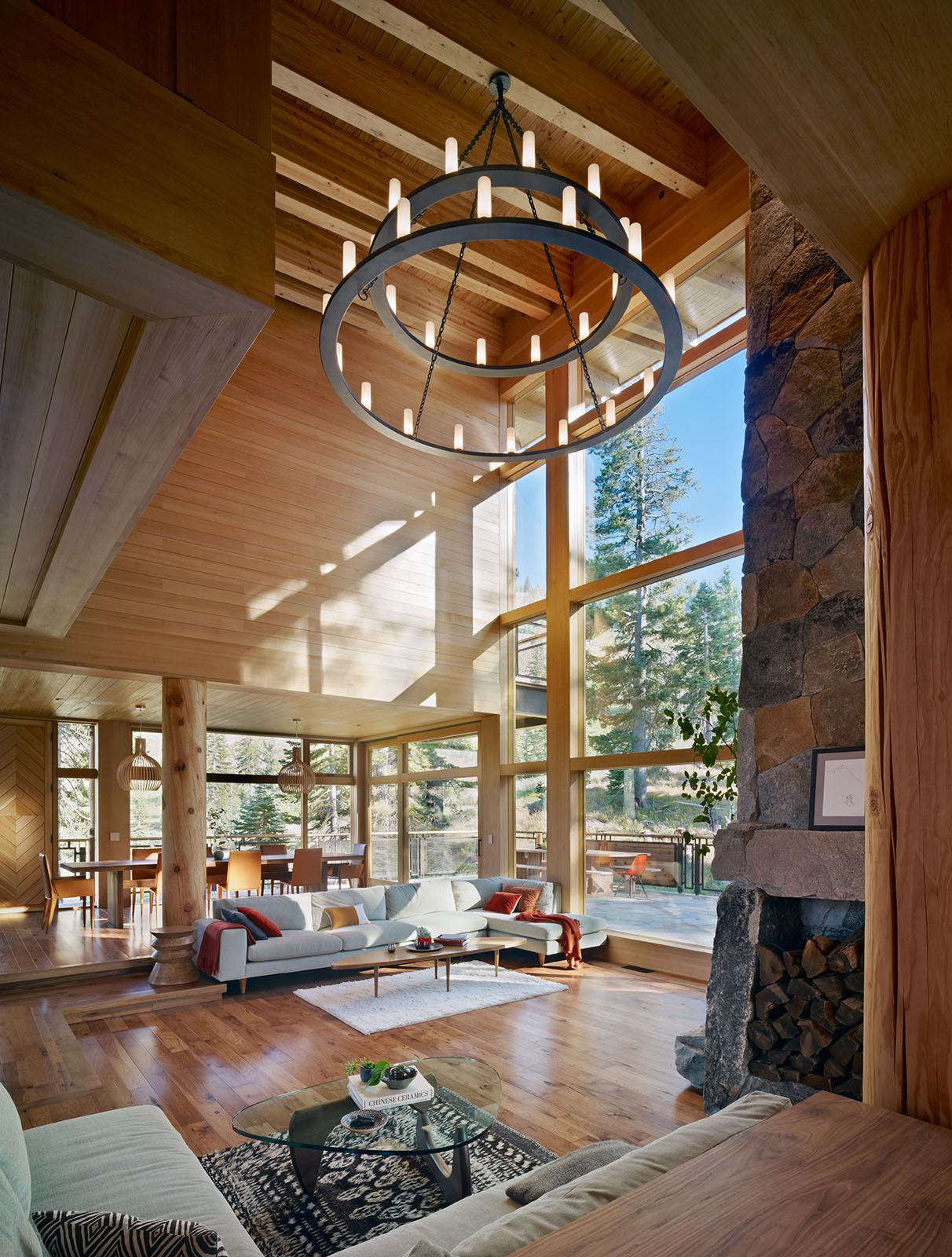
At the center of The Crow’s Nest Residence is a double-height living room that acts as the home’s social anchor. Large south-facing windows frame the forest and mountain scenery, while a grand stone fireplace gives the room a sense of permanence. This is the place where a family can gather after skiing, thaw out, swap stories, and pretend that no one fell getting off the lift.
The living room’s scale is important. Tall windows bring the trees into the experience of the room, making the forest feel immediate rather than distant. Instead of simply offering a postcard view, the design creates the sensation of being surrounded by the landscape. The log columns add to that effect, echoing the vertical rhythm of tree trunks outside.
The fireplace is another defining feature. Stone in a mountain home can easily become decorative wallpaper, but here it works as a strong organizing element. It gives the living area weight, separates spaces, and provides the kind of visual warmth that makes cold weather feel welcome. Snowstorm outside? Perfect. Someone find the blankets.
Designed for Family, Not Just Photography
Many high-end mountain homes photograph well but behave awkwardly in real life. The Crow’s Nest Residence avoids that trap by focusing on family use. It was designed as an all-season retreat for a large family, with social spaces prioritized and circulation treated as part of the experience.
The staircase is a good example. Rather than functioning only as a connector between floors, it becomes a sculptural and social feature. Wide, well-lit, and visually connected to the surrounding views, the stairs encourage lingering. In a family house, that matters. Children sit on steps. Adults pause mid-conversation. Guests stop to look out the window. Architecture succeeds when it makes ordinary behavior feel natural.
The main level includes the living room, kitchen, dining area, and informal gathering spaces. The kitchen captures mountain views and connects easily to the dining room and deck. The dining area, with its substantial table and warm lighting, supports the real rhythm of a ski house: breakfast chaos, slope-side lunch, long dinners, and late-night snacks that everyone insists are “just a small bite.”
Bedrooms With Views and Privacy
The upper level balances openness with shelter. Children’s rooms use corner windows to frame diagonal views of the surrounding topography, while the principal and guest suites open more dramatically toward the forest. This difference in window strategy is subtle but smart. Not every room needs the same level of exposure. Some spaces should feel expansive; others should feel tucked in.
In mountain residential design, privacy is not only about hiding from neighbors. It is about emotional comfort. After a day outside in bright snow, wind, and motion, a bedroom should provide calm. The Crow’s Nest Residence uses wood, framed views, and a clear separation between social and private zones to create that calm without disconnecting occupants from nature.
The Deck: A Four-Season Outdoor Room
The south-facing deck is one of the home’s most appealing features. With a hot tub, fire pit, and outdoor dining area, it extends family life beyond the walls. In winter, it becomes a sunny perch for lunch between ski runs. In summer, it turns into an outdoor living room surrounded by trees and mountain air.
The deck is not simply attached to the house; it is carefully oriented. Its exposure allows it to gather winter sun while providing useful shading in warmer months. A mountain deck has to do more than look pretty in photos. It must handle snow, temperature swings, boots, wet gear, hungry people, and that one guest who insists grilling in cold weather is “character building.”
Engineering for Heavy Snow
Snow is beautiful until it becomes a structural calculation. At Sugar Bowl, heavy annual snowfall is a major design factor. The Crow’s Nest Residence responds with a robust concrete base, a carefully designed roof structure, durable exterior materials, and access strategies that accept snow as a seasonal reality.
Ground-floor areas can be nearly or fully surrounded by snow, with paths dug to access points in the long-standing Sugar Bowl tradition. The second-story entry provides another layer of practicality when winter piles up. Instead of pretending snow will politely stay outside the design conversation, the home plans for it.
This is why the residence feels authentic. It is not a city house wearing a ski sweater. It is a mountain structure built with the knowledge that alpine weather will test every corner, joint, and surface.
Interior Design: Rustic, Modern, and Playful
The interiors, associated with Lisa Staprans and BCV’s design approach, bring color, texture, and personality into the home. The material palette may be grounded in wood, concrete, and stone, but the rooms are not gloomy. Pops of color, modern furnishings, tile, lighting, and mid-century touches prevent the residence from becoming too serious.
This balance matters because mountain homes can easily slide into cliché. Too many antlers, too much plaid, and suddenly everyone feels obligated to speak in a lumberjack voice. The Crow’s Nest Residence avoids that by using rustic materials in a modern way. It feels warm and crafted, not themed.
Custom elements, such as lighting and artisan wood details, reinforce the sense of place. Local craft appears in stonework, turned posts, and carefully selected finishes. The result is a residence that feels designed rather than decorated.
Why The Crow’s Nest Residence Stands Out
The Crow’s Nest Residence stands out because it solves a difficult design problem with elegance. It had to be durable enough for extreme snow, refined enough for modern living, warm enough for family use, and visually connected to one of California’s most storied ski landscapes. That is a long checklist, and the house manages it without looking overworked.
Its most successful quality is integration. The concrete base belongs to the hillside. The cedar exterior belongs to the forest. The glass belongs to the views. The roof belongs to the snow. The interior belongs to the family. Nothing feels random. Every major move responds to site, climate, tradition, or daily life.
For homeowners, architects, and design enthusiasts, the project offers useful lessons. A mountain residence should not be only about luxury. It should be about orientation, durability, daylight, circulation, storage, material honesty, and year-round comfort. The Crow’s Nest Residence proves that practical design can still be breathtaking.
Experience: What It Feels Like to Live With a Home Like The Crow’s Nest Residence
Experiencing a residence like The Crow’s Nest begins before you even open the door. Imagine arriving at Sugar Bowl after a drive through the Sierra Nevada, with snow stacked along the road and the air sharp enough to make your phone battery question its life choices. The house appears not as a delicate object placed on the mountain, but as a structure that has made a deal with the terrain. The concrete base says, “I am staying.” The wood and glass above say, “But I also brought views.”
Stepping inside, the first impression is warmth. Not just temperature, although that matters when your boots are carrying half the mountain with them. The warmth comes from wood surfaces, filtered daylight, and the feeling that the house has been arranged around gathering rather than showing off. You would naturally drop your gear, look around, and immediately understand where everyone will end up: the living room.
After a morning on the slopes, the residence would work like a well-trained host. Ski gear goes where ski gear belongs. Wet layers do not have to migrate through the entire house like soggy little villains. The sauna offers recovery. The kitchen becomes command central. Someone makes soup. Someone else claims they are “just resting their eyes” near the fireplace and then disappears into a nap worthy of architectural applause.
The great room would likely be the emotional center of the day. The height of the ceiling, the stone fireplace, and the large windows create the kind of space where people naturally spread out while still feeling together. Children might drift toward a playroom or bunk area. Adults might gather around the fire or kitchen island. Guests would repeatedly mention the view, because mountain views make everyone slightly repetitive and nobody minds.
In summer, the experience changes but the house still works. The deck becomes the favorite room, even though technically it is outside and therefore cheating. Morning coffee would taste better with trees in front of you. Lunch would stretch longer than planned. The hot tub and fire pit would turn cool evenings into social events. The house is not only a winter retreat; it is a four-season base camp for people who like nature but also appreciate plumbing.
At night, the bedrooms would offer a quieter experience. Framed views, wood-lined interiors, and the separation from the main social spaces would help the home slow down. That is the hidden luxury of The Crow’s Nest Residence: not size, not spectacle, but rhythm. It supports arrival, activity, recovery, gathering, retreat, and rest. A good mountain home does not just impress visitors. It teaches them how to spend time well.
Conclusion
The Crow’s Nest Residence is a standout example of modern mountain architecture in California. It respects Sugar Bowl’s alpine history while bringing contemporary design, thoughtful engineering, and family-centered planning into one cohesive retreat. From its board-formed concrete podium to its cedar exterior, double-height living room, dramatic roof, and year-round deck, the home shows how architecture can respond beautifully to snow, slope, forest, and view.
More than a handsome ski cabin, The Crow’s Nest Residence is a lesson in designing with place rather than simply building on it. It is sturdy without being dull, luxurious without being flashy, and playful without losing discipline. In other words, it is exactly what a great mountain home should be: a nest with altitude, attitude, and a very good fireplace.

