
Beauty Unlocked
"I Can’t Wait To Not Watch It": Here’s What People Have To Say About Melania Trump’s New Documentary
Aug
Melania Trump’s glossy documentary promised unprecedented access to one of America’s most private first ladies. Instead, its trailer triggered jokes, ethical questions, political arguments, surprisingly strong ticket sales, and one of the widest critic-audience divides in recent movie history. Here is what the film shows, why Amazon’s expensive deal attracted scrutiny, and how Melania became much more than another celebrity documentary.
Few movie trailers inspire viewers to announce how enthusiastically they plan to avoid the finished product. Yet that was exactly the mood surrounding Melania, the authorized documentary about First Lady Melania Trump.
After the first trailer arrived in December 2025, social media filled with variations of the same joke: “I can’t wait to not watch it.” Some people questioned why the documentary existed. Others criticized its polished, promotional tone. Supporters, meanwhile, celebrated what they saw as a long-overdue opportunity for Melania Trump to tell her own story without hostile media interpretation.
The reaction was loud, predictable, occasionally funny, and unmistakably American. Even before audiences had seen the movie, the debate had already become a miniature version of the country’s political dividewith better lighting and considerably more designer clothing.
What Is the Melania Trump Documentary About?
Directed by Brett Ratner and produced with Melania Trump, Melania follows the 20 days leading up to Donald Trump’s second presidential inauguration on January 20, 2025. The 104-minute film presents the transition through the first lady’s perspective as she prepares to return to Washington, assembles her staff, coordinates inauguration details, manages family responsibilities, attends meetings, and makes decisions about her public image.
Amazon MGM Studios released the documentary in theaters on January 30, 2026. It later began streaming on Prime Video on March 9, making it available in more than 240 countries and territories. Amazon described the production as an intimate, behind-the-scenes account featuring private conversations, ceremonial preparations, business matters, philanthropy, and rarely seen environments.
The film’s central promise was access. Melania Trump has long maintained a more guarded public presence than many modern first ladies, which naturally created curiosity about what she thinks, how she works, and what her marriage and political role look like away from podiums and carefully posed photographs.
Whether the documentary delivers meaningful access, however, became the argument at the center of nearly every review.
Why the Trailer Immediately Became a Cultural Flashpoint
The trailer begins with Melania saying, “Here we go again,” as she prepares for another Trump administration. That short phrase works as both a statement of purpose and an accidental summary of how many viewers felt about American politics.
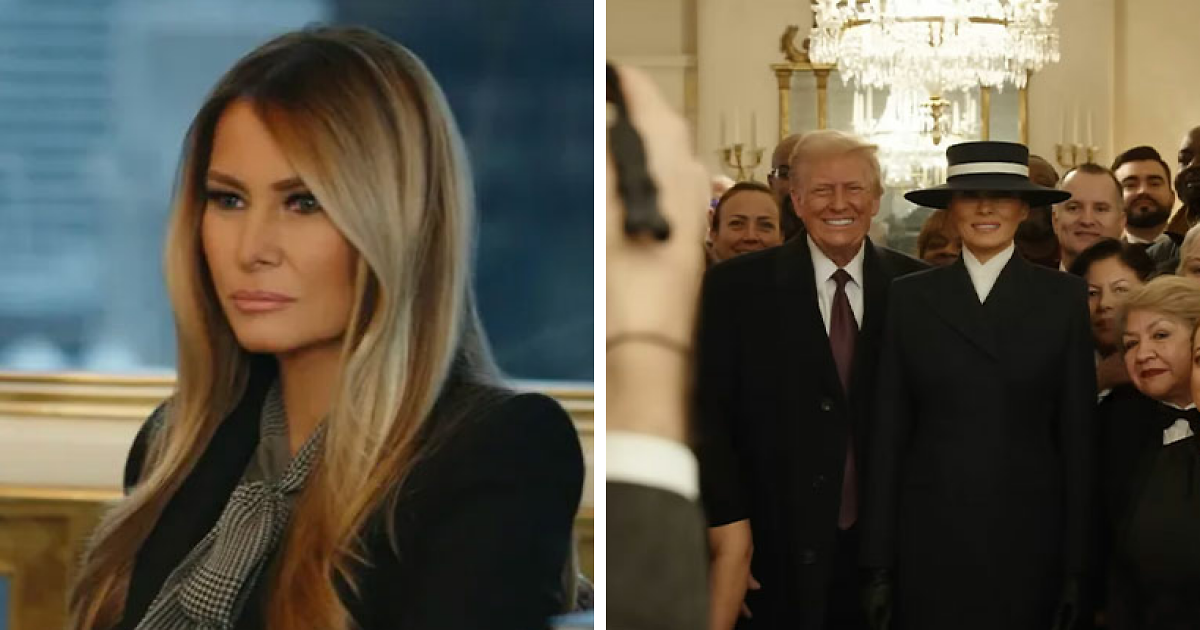
The footage presents sleek motorcades, architectural grandeur, formal meetings, designer wardrobes, security details, inauguration planning, and carefully framed conversations with Donald Trump. Everything appears controlled. There are no shaky cameras, accidental interruptions, or scenes that feel as though someone forgot a microphone was turned on.
To supporters, the presentation looks elegant, disciplined, and appropriately cinematic. To critics, it resembles a luxury-brand commercial that happens to feature the White House.
That difference in interpretation explains why the same images generated completely opposite responses. One viewer sees a poised first lady managing a complicated transition. Another sees political image rehabilitation wrapped in couture. A third mostly wonders who maintains the marble floors.
“I Can’t Wait To Not Watch It”: The Jokes Arrive
Online detractors wasted no time turning the documentary into meme material. Comments included declarations that people planned to skip it, jokes about falling asleep during the trailer, and sarcastic questions about whether the film would include genuinely unscripted moments.
The phrase “I can’t wait to not watch it” captured the most common dismissive response because it combined political opposition with the internet’s favorite activity: announcing disinterest as dramatically as possible.
Other commenters compared the production to an extended campaign advertisement, an expensive fashion reel, or a reality show without enough reality. Some suggested that a truly revealing documentary would require an independent director, tougher questions, and less control from its subject.
Of course, loudly promising not to watch a movie is still a form of promotion. Every joke repeated the title. Every angry repost circulated the trailer. Every argument placed Melania in front of people who might otherwise have remained blissfully unaware of it. The marketing department could hardly complain.
Supporters Saw Something Entirely Different
The negative social media reactions were only one part of the story. Melania Trump’s admirers welcomed the film as a chance to see her without the commentary that usually surrounds her appearances.
Supportive viewers praised her composure, fashion sense, family loyalty, multilingual background, and willingness to remain private in an era when public figures often document every sandwich. They also argued that criticism of the documentary began before anyone had watched it, proving that many opinions were based on politics rather than filmmaking.
That support translated into unusually positive responses from verified theatergoers during the opening weekend. Audiences awarded the film an “A” CinemaScore, while its early verified audience score on Rotten Tomatoes approached 99 percent. Critics, by contrast, produced a single-digit approval rating and an exceptionally low Metacritic score.
The gap was so enormous that the ratings themselves became news. Skeptics questioned whether enthusiastic reviews were coordinated, while Rotten Tomatoes maintained that its verified ratings came from confirmed ticket purchasers rather than automated accounts.
In other words, even the argument about whether people liked the film became an argument about politics. There are quieter family group chats.
The $75 Million Question
Much of the controversy concerned not what appeared onscreen, but what happened behind the deal.
Amazon MGM Studios reportedly paid approximately $40 million for licensing rights connected to the documentary and an accompanying series. The company then spent an estimated $35 million on global marketing, bringing the reported investment to roughly $75 millionan extraordinary amount for a political documentary.
The size of that commitment generated questions about Amazon founder Jeff Bezos, Amazon’s government interests, and the company’s relationship with the Trump administration. Critics argued that such an unusually generous agreement could create the appearance of a powerful corporation seeking favor with a sitting president’s family.
Amazon rejected suggestions that the purchase was improper, saying the company believed there was strong audience interest and commercial value in the project. Bezos later characterized the deal as a wise business decision, while Amazon pointed to the documentary’s theatrical opening, streaming potential, and future related programming.
The ethical debate is unlikely to disappear simply because the film earned money. Presidential families have traditionally been cautious about releasing commercial memoirs or authorized screen projects while occupying the White House. Melania challenged that convention with the subtlety of a limousine arriving on a black carpet.
Why Brett Ratner’s Involvement Drew Criticism
The selection of Brett Ratner as director created another layer of controversy. Ratner, known for commercial films including the Rush Hour series, had been largely absent from major Hollywood directing assignments after multiple women accused him of sexual misconduct in 2017. Ratner denied allegations of nonconsensual sexual activity.
For critics, his return through an intimate film about the first lady raised uncomfortable questions about accountability and access. Some also felt that his glossy, celebrity-focused style made him better suited to creating a flattering profile than an investigative documentary.
Supporters countered that the film was never marketed as an investigation. It was Melania Trump’s story, produced with her involvement and presented from her point of view. From that perspective, expecting a prosecutorial interrogation would be like attending a wedding video and demanding a forensic audit of the seating chart.
That defense is reasonablebut it also explains why many reviewers questioned whether Melania should be treated as a conventional documentary at all.
What Critics Said About Melania
Professional reviewers were remarkably consistent. Many acknowledged that the film was technically polished, attractively photographed, and granted unusual physical access to secure locations. Their main complaint was that the access rarely produced emotional or political insight.
Reviewers described scenes of wardrobe preparation, motorcade travel, ceremonial meetings, staffing decisions, and conversations about inauguration events. The film also touches on Melania’s grief over her mother’s death, her Catholic faith, her relationship with international first ladies, and her meeting with Aviva Siegel, whose husband Keith had been held hostage by Hamas.
Yet critics argued that nearly every moment appeared selected to preserve the subject’s preferred image. Difficult subjects were generally avoided. Viewers learned more about Melania’s schedule, clothing, and presentation than about her private political opinions, marriage, contradictions, or influence on the administration.
The result, according to many reviews, was unprecedented proximity without genuine intimacy. The cameras enter private rooms, but the audience never feels that the film enters private thoughts.
The Box Office Was StrongUntil It Wasn’t
Predictions that nobody would buy a ticket turned out to be incorrect. Melania earned roughly $7 million from 1,778 North American theaters during its opening weekend, finishing third at the domestic box office. It was the strongest opening for a non-concert documentary in approximately a decade and exceeded prerelease projections.
The audience was reportedly dominated by older women, and the film performed particularly well in conservative-leaning markets. Its opening demonstrated that Melania Trump had a committed audience willing to see her story in theaters rather than wait for streaming.
Momentum faded quickly, however. Ticket sales dropped sharply during the second weekend despite the release expanding to additional screens. The film eventually earned about $16.6 million worldwideimpressive for a traditional documentary but far below the reported acquisition and marketing investment if evaluated solely as a theatrical release.
Amazon’s strategy was broader than box-office profit. The theatrical campaign generated attention before the Prime Video release, promoted the planned docuseries, and turned the project into a global political event. Whether that attention was worth tens of millions of dollars depends on whether one is holding a calculator, a streaming subscription, or an invitation to the White House.
Why the Critic-Audience Divide Was So Dramatic
Viewers Were Often Rating Melania Trump, Not the Movie
Many favorable audience reviews focused on Melania Trump’s elegance, strength, or treatment by the press rather than Ratner’s direction, pacing, editing, or storytelling. Likewise, some negative reactions appeared rooted primarily in opposition to the Trump family.
In both directions, the documentary became a proxy ballot. A five-star review could mean “I admire Melania.” A one-star review could mean “I oppose the administration.” The movie itself occasionally seemed to be standing patiently in the hallway while everyone argued.
Critics Expected Discovery
Professional reviewers generally expect a documentary to investigate, complicate, or reveal its subject. Because Melania Trump maintained extensive creative control, many critics believed the production lacked sufficient independence to challenge her self-presentation.
Supporters Valued Representation
Fans did not necessarily want confrontation. Many wanted an attractive, respectful portrait of a public figure they believed had been misrepresented. For those viewers, the qualities critics called controlled or flattering were features, not defects.
What the Documentary Reveals About Melania Trump
Although the film may not provide the psychological excavation some viewers expected, it communicates several things clearly.
Melania is highly conscious of visual presentation. She treats clothing, architecture, ceremony, timing, and physical space as forms of communication. Her public reserve does not appear accidental; it is part of a carefully maintained identity.
The documentary also portrays her as more actively involved in planning and administration than the stereotype of a disengaged first lady would suggest. She discusses staffing, event arrangements, official responsibilities, business interests, and philanthropic projects while moving between Palm Beach, New York, and Washington.
At the same time, her control limits the film’s ability to surprise. The version of Melania shown onscreen is disciplined, elegant, private, and rarely caught off guardwhich is almost exactly the version already familiar to the public.
It is a portrait painted with expensive brushes, but the subject chose the pose.
The Bigger Story: Politics Has Entered the Prestige-Documentary Era
Melania reflects a larger shift in how public figures manage their narratives. Politicians and their families no longer need to rely entirely on traditional interviews, newspaper profiles, or independent filmmakers. They can produce their own books, podcasts, documentaries, social media channels, and streaming series.
These projects offer access while controlling context. They resemble journalism because they contain real footage and real people, but they frequently operate more like branding campaigns. The viewer is invited behind the curtain only after the subject has selected the curtain, approved the lighting, and removed anything inconvenient from the room.
That does not automatically make an authorized documentary worthless. Personal perspective has value, and subjects are entitled to explain themselves. The key is understanding what kind of experience is being offered. Melania is less an investigation of the first lady than a visual statement from her.
The Experience of Following the Melania Documentary Debate
Following the public reaction to Melania feels less like tracking an ordinary movie release and more like walking into a theater where the audience has begun arguing before the lights go down.
The first experience is the comedy cycle. Someone posts a sarcastic comment about refusing to watch. Another person adds a joke about the trailer. Within hours, hundreds of nearly identical remarks appear, each delivered as though it has just been discovered on a stone tablet. The jokes can be clever, but repetition eventually turns them into the online equivalent of a laugh track with a low battery.
Then comes the political sorting. People who admire Melania praise the same qualities that detractors criticize. Her controlled demeanor is either admirable discipline or emotional emptiness. The luxury imagery is either presidential elegance or grotesque excess. Her privacy is either dignified restraint or evidence that the film has nothing meaningful to say.
Next comes the curiosity trap. A person may begin with absolutely no intention of watching the documentary. After reading dozens of claims that it is brilliant, terrible, historic, boring, glamorous, unethical, revealing, and unrevealing, curiosity starts tapping on the window. Could one film really be all those things? Probably notbut now the “play” button is sitting right there.
The viewing experience itself depends heavily on expectations. Anyone hoping for explosive revelations about the Trump marriage, secret policy disputes, or unguarded family conflict will probably leave disappointed. The movie is not built around confrontation. It offers controlled access to logistical preparations and ceremonial life rather than political confession.
Someone interested in first-lady branding, fashion diplomacy, inauguration planning, or the mechanics of image management may find more to examine. Small details become more significant than dramatic disclosures: how Melania speaks to staff, how she evaluates visual arrangements, when she chooses silence, and how consistently she protects the boundary between public access and private emotion.
There is also an unusual experience in comparing professional reviews with audience reactions. Critics overwhelmingly discussed structure, independence, pacing, and lack of insight. Supportive viewers often discussed respect, grace, patriotism, and admiration. The two groups were not merely reaching different conclusions; they appeared to be answering different questions.
Critics asked, “Is this an effective documentary?” Fans often asked, “Does this film treat Melania Trump fairly?” Once that distinction becomes clear, the massive ratings gap makes more sense.
The final experience is realizing that cultural products involving the Trump family are rarely permitted to remain simply cultural products. A ticket purchase becomes a political signal. A negative review becomes evidence of media bias. A positive review becomes evidence of loyalty. Even refusing to watch becomes a public performance.
That may be the documentary’s most revealing achievement, although probably not the one its creators intended. Melania shows how thoroughly entertainment, politics, corporate power, personal branding, and online identity have merged. The film does not need to expose a secret room in the White House. The reaction surrounding it already tells us plenty about the country outside.
Conclusion: A Movie Almost Nobody Could Discuss Neutrally
Melania succeeded at becoming an event. It produced a stronger-than-expected opening weekend, attracted an enthusiastic core audience, generated international headlines, and gave Amazon a highly visible streaming property. It also received devastating reviews, raised ethical questions about corporate influence, revived debate about Brett Ratner, and inspired thousands of people to celebrate their intention not to watch it.
The documentary’s greatest strength and central weakness are the same: Melania Trump controls the story. Supporters receive the poised, elegant portrait they wanted. Critics searching for contradiction, vulnerability, or accountability encounter a beautifully guarded door.
People who expected investigative journalism were unlikely to be satisfied. People who wanted a favorable portrait of the first lady were much happier. Everyone else received a fascinating lesson in how modern political branding worksand how quickly a movie review can turn into a campaign rally with popcorn.
Editorial note: Release information, box-office figures, streaming availability, and reception details in this article are current as of June 30, 2026. Audience and critic scores may change as additional ratings are submitted.

