
Body Care
Experts Found the Site Where George Washington’s Men Shot Each Other
Aug
Long before George Washington became the face on the one-dollar bill, he was a 26-year-old colonel trying to manage exhausted soldiers, unreliable intelligence, thick Pennsylvania woods, and the occasional military catastrophe. On November 12, 1758, those problems collided near Fort Ligonier when two groups of Virginia troops mistook each other for the enemy and opened fire.
Washington rushed into the crossfire and tried to stop the shooting by knocking raised muskets aside with his sword. The event remained one of the most dangerous moments of his life, yet the exact location gradually disappeared from public memory. After years of research and four summers of fieldwork, archaeologists announced in July 2025 that they had identified the battlefield on private land roughly two miles from Fort Ligonier in western Pennsylvania. Hundreds of musket balls, buttons, buckles, coins, firearm parts, and other objects helped turn an old story into a place that could finally be mapped.
A Battlefield That History Misplaced
The newly identified George Washington friendly fire site belongs to the French and Indian War, the North American theater of the wider Seven Years’ War. Britain and France were competing for territory, trade routes, political influence, and control of the Ohio River Valley. Native nations also pursued their own diplomatic, commercial, and territorial interests, forming alliances that were far more complicated than a simple two-team scoreboard.
Washington had been involved in the struggle since 1753. His early missions and campaigns included diplomatic confrontation, ambush, surrender, disease, supply problems, and several occasions on which bullets came uncomfortably close to ending his biography before it became a biography. By 1758, he commanded the Virginia Regiment as part of Brigadier General John Forbes’ expedition against French-held Fort Duquesne at the Forks of the Ohio, the site of present-day Pittsburgh.
Forbes’ army moved westward across difficult terrain while constructing a military road and a chain of supply points. Fort Ligonier, originally associated with the British camp at Loyalhanna, became a crucial staging ground. Progress was slow. Weather, illness, mud, shortages, and long supply lines made the campaign feel less like a heroic march and more like an 18th-century logistics meeting that happened to include muskets.
By November, the army was still dozens of miles from Fort Duquesne. French forces and their Native allies continued to scout and raid around the British position. Reports that an enemy detachment was operating near camp prompted Lieutenant Colonel George Mercer to lead Virginia soldiers out to confront it. Later, when firing could be heard, Washington gathered volunteers and advanced to support Mercer. That decision set the stage for disaster.
How George Washington’s Men Ended Up Shooting Each Other
Fog, darkness, smoke, and bad communication
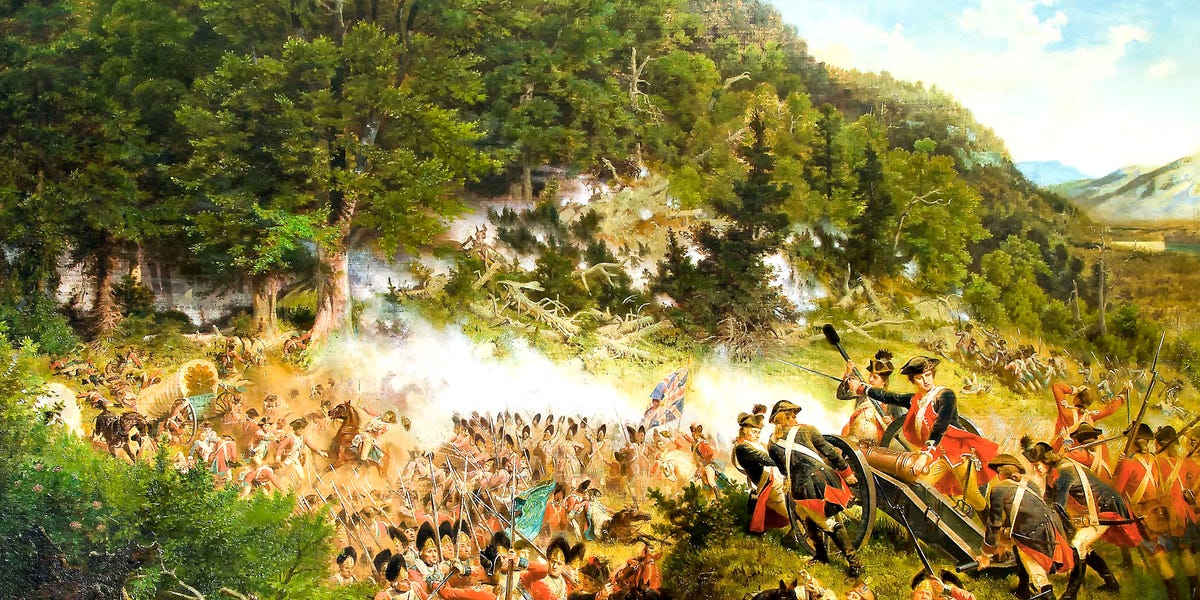
The friendly fire incident unfolded near dusk on November 12, 1758. Visibility was already poor, and fog reportedly covered the wooded valley. Mercer’s soldiers did not all know that Washington’s detachment was approaching. When figures appeared through the dim forest, Mercer’s men believed the enemy had returned from another direction and fired.
Washington’s soldiers fired back. Once the exchange began, musket smoke added another curtain to the darkness. Officers shouted orders, but commands could be drowned out by gunfire, confusion, and the natural acoustics of the forest. There were no radios, GPS markers, reflective unit patches, or emergency group messages reading, “Those are Virginians. Please stop shooting them.”
Washington entered the crossfire
Washington later described the incident in notes prepared for his friend and prospective biographer David Humphreys. Referring to himself as “G.W.,” he wrote that he had never been in more imminent danger. According to his account, he moved between the two fires and used his sword to knock upward the muskets that soldiers were preparing to discharge.
This was not decorative sword waving for a future painting. A loaded musket could not simply be switched off once a frightened soldier believed he saw an enemy. Washington had to move along the line, expose himself to fire from both directions, redirect weapons, and convince men in the middle of chaos that the people shooting at them were their comrades. His intervention helped bring the exchange to an end.
The casualty total remains uncertain
Historical sources do not provide one universally accepted casualty figure. Washington’s later account said that one officer and several enlisted men were killed and many others wounded. Modern estimates range from more than a dozen deaths to approximately 40 soldiers killed, wounded, or missing. Because reports used different categories and were written from different perspectives, it is safer to describe the episode as causing dozens of casualties rather than repeating the dramatic but questionable claim that exactly 40 men died.
How Archaeologists Identified the Lost Friendly Fire Site
Historians knew the event had occurred within a few miles of Fort Ligonier, but knowing that a battle happened “somewhere in the woods” is not the same as identifying its location. Roads change, forests move across old fields, farms reshape the ground, and small military objects can be scattered by plowing, erosion, collectors, animals, and more than two and a half centuries of ordinary human activity.
A team led by Juniata College archaeologist Jonathan Burns worked with Fort Ligonier, students, volunteers, and military veterans to investigate privately owned land west of the fort. Researchers combined documentary evidence with metal detecting, coordinate surveys, drones, ground-penetrating radar, excavation, and computer-assisted mapping. Instead of relying on one spectacular object, they examined where many objects appeared in relation to one another.
The pattern mattered more than a single artifact
A musket ball by itself proves very little. Someone could have fired it while hunting, practicing, fighting in another engagement, or demonstrating an impressive ability to miss a tree. A concentrated distribution of ammunition, uniform pieces, buckles, firearm components, horse equipment, coins, and camp-related materials is much more revealing.
The team recovered more than 325 cataloged objects, including lead balls in multiple calibers, uniform buttons connected with military units, shoe-buckle fragments, nails, horseshoes, wagon components, coins, and a small French-style watch key decorated with a fleur-de-lis. The different ammunition calibers and the spatial pattern of fired or dropped objects were consistent with opposing groups of allied soldiers exchanging fire across the site.
Researchers plotted finds digitally to reconstruct movement and firing positions. The location also matched historical descriptions placing the engagement about two miles from the British camp and along the military landscape associated with Forbes Road. Juniata College’s Cultural Resource Institute additionally worked with geologists on isotopic analysis of geological material connected with artifacts, adding another scientific layer to the identification process.
No battlefield arrives with a certificate reading, “Congratulations, you found George Washington’s worst afternoon.” Archaeological confidence grows when independent clues agree: period documents, terrain, distance, artifact dates, unit-related objects, ammunition patterns, and the physical direction of troop movement. In this case, the combined evidence persuaded the research team that it had located the long-missing battlefield.
Why the Exact Location Is Still Secret
The battlefield lies on private property and is not open to visitors. Fort Ligonier and the archaeological team have therefore withheld its precise coordinates. Keeping the location confidential protects the landowner, prevents unauthorized digging, and preserves material that may still remain beneath the soil. It also recognizes that soldiers were killed there and that possible burial locations deserve respect rather than a weekend visit from souvenir hunters carrying hardware-store metal detectors.
Selected finds are displayed in Fort Ligonier’s George Washington Gallery. Visitors can examine musket balls, uniform items, personal objects, and the documentary evidence surrounding the incident without disturbing the archaeological site. The gallery also includes Washington’s “Remarks,” the manuscript in which he remembered the exchange, and “Flash Point,” Chas Fagan’s painting of Washington riding into the crossfire.
The Military Mistake That Helped the British Campaign
The incident was tragic, but it produced an unexpected intelligence advantage. French prisoners captured during the wider encounter reportedly revealed that Fort Duquesne was short of troops and supplies. The information helped convince Forbes that the French position was weaker than previously believed and that the British advance should continue.
As Forbes’ army approached, the French destroyed and abandoned Fort Duquesne rather than attempt a prolonged defense. British troops occupied the ruins and renamed the position Fort Pitt. The campaign strengthened Britain’s control of the Ohio Valley, accelerated settlement along Forbes Road, and contributed to the development of Pittsburgh. The broader war eventually gave Britain vast territorial gains, although the costs and policies that followed also intensified colonial resentment and helped prepare the ground for the American Revolution.
What the Discovery Reveals About George Washington
The discovery does not turn Washington into either a flawless action hero or an incompetent officer. It makes him more human. He made a serious decision under uncertain conditions, contributed to a deadly misunderstanding, recognized the danger, and personally tried to stop it.
Washington’s later memory of the incident is especially revealing. He wrote about it around 1787, after commanding the Continental Army through the American Revolution and shortly before becoming president. From a lifetime filled with battles, retreats, political crises, and assassination-level hazards, he selected this confused clash between fellow Virginians as a moment of unmatched personal jeopardy.
The episode also highlights the difference between leadership mythology and leadership reality. Historical monuments usually freeze leaders in their best five seconds. Archaeology restores the mud, mistakes, broken equipment, lost buttons, panicked decisions, and consequences. Washington’s courage in stopping the fire matters, but so does the failure that made courage necessary.
His frontier service from 1753 to 1758 gave him practical experience with recruitment, discipline, supply lines, difficult terrain, intercolonial politics, imperial commanders, and irregular warfare. Those lessons later influenced how he managed the Continental Army. The friendly fire incident was not merely an embarrassing footnote; it was part of the costly education of America’s future commander in chief.
Why This Archaeological Discovery Matters
Finding the site transforms the incident from a dramatic paragraph into a measurable landscape. Researchers can now ask where the two detachments stood, how far apart they were, how the road influenced their movement, whether troops fired in organized lines or scattered groups, and where casualties may have fallen. Additional excavation and artifact analysis could refine those answers.
The project also demonstrates the value of battlefield archaeology. Written documents usually emphasize commanders and official outcomes. Objects record what ordinary soldiers carried, lost, fired, repaired, or dropped. A buckle may indicate a unit. A deformed ball may show that it struck something. A cluster of ammunition can identify a firing line. Even a tiny watch key can reveal the presence of an individual whose name may never appear in surviving reports.
The Veterans Archaeology Program adds another dimension. Military veterans participating in the field schools can draw on their understanding of terrain, movement, confusion, and combat behavior while learning archaeological methods alongside college students. Their experience does not replace scientific evidence, but it can generate useful questions about how people behave when visibility collapses and danger arrives from an unexpected direction.
Conclusion: The Pennsylvania Ground Finally Spoke
For more than 260 years, the exact place where George Washington’s troops exchanged friendly fire remained hidden in western Pennsylvania. Historical accounts preserved the event, but archaeology gave it coordinates, physical evidence, and a landscape.
The battlefield tells an uncomfortable but valuable story. Young Washington was ambitious and brave, yet capable of making a disastrous error. His soldiers were trained men, yet fog, darkness, smoke, and poor communication made allies look like enemies. The archaeologists who recovered their ammunition and personal objects did more than solve a geographic mystery. They restored ordinary soldiers to a story too often dominated by one famous name.
History is rarely as polished as a marble monument. Sometimes it is a damaged musket ball, a lost button, or a watch key buried in a field. And sometimes the road to becoming the first president begins with the horrifying realization that your men are shooting at the wrong people.
Experiencing the Story: What Visitors and Archaeology Students Can Learn
Because the battlefield is protected on private property, experiencing this discovery begins at Fort Ligonier rather than at the excavation site. That limitation is not a disappointment; it is part of responsible historical travel. A good museum visit offers the context that an unmarked field cannot provide. Inside the George Washington Gallery, the objects are arranged with documents, maps, artwork, and interpretation that explain why a small piece of metal matters.
A visitor might first notice the musket balls. They look simple, almost disappointingly ordinarysmall lead spheres rather than cinematic relics glowing with historical importance. Their meaning emerges through comparison. Different calibers can be associated with different weapons, while their locations help researchers visualize where soldiers stood and how they moved. Once plotted on a map, a handful of lead becomes evidence of a firing pattern.
Uniform buttons and buckles create a more personal experience. Ammunition belongs to battle, but a shoe buckle belonged to a specific person. Someone fastened it before marching into the woods. Someone may have lost it while running, falling, kneeling to reload, or helping a wounded companion. The owner’s name may be gone, yet the object narrows the emotional distance between a modern museum visitor and a frightened soldier in 1758.
The most effective way to imagine the encounter is not to picture a bright movie set. Picture fading daylight in dense forest. Add low fog, uneven ground, smoke from black-powder weapons, men wearing similar military colors, and orders carried by voice. Then remember that both groups expected to see an enemy. Under those conditions, the first musket flash could cause every shadow to look hostile. The exercise does not excuse the mistake, but it explains how quickly uncertainty can become lethal.
Students participating in battlefield archaeology encounter the story differently. Their experience involves survey grids, careful notes, coordinate systems, artifact bags, laboratory cleaning, and long periods when the ground produces absolutely nothing exciting. Archaeology is less like treasure hunting and more like completing a giant puzzle after someone has removed the box, scattered the pieces across several acres, and waited 260 years.
When an artifact is discovered, its location is often more valuable than its appearance. Removing it without recording the coordinates destroys part of the evidence. That is why unauthorized metal detecting is so damaging. A collector may save an object while erasing the relationship between that object, nearby finds, the terrain, and the historical event.
The participation of military veterans provides another meaningful experience. Veterans may recognize tactical details that other researchers overlook: how troops use a slope, why a road channels movement, where a unit might seek cover, or how rapidly confusion spreads when communication fails. Working beside students also allows knowledge to move in both directions. Veterans contribute practical insight, while archaeologists provide methods for testing whether that insight matches the physical evidence.
For educators, the site offers a powerful leadership exercise. Students can compare Washington’s decision to advance with his decision to enter the crossfire. The first demonstrates the danger of acting on incomplete information; the second shows responsibility after an error has become obvious. Leadership, the incident suggests, is not the absence of mistakes. It is the willingness to confront consequences, protect others, and learn before the next crisis.
The deepest experience may come from recognizing what is missing. Most of the soldiers involved did not become presidents, appear on currency, or leave autobiographical notes. Archaeology helps recover traces of their presence. Their bullets, buttons, tools, and personal belongings remind visitors that famous history is built from the lives of people whose names are often lost.

