
Makeup
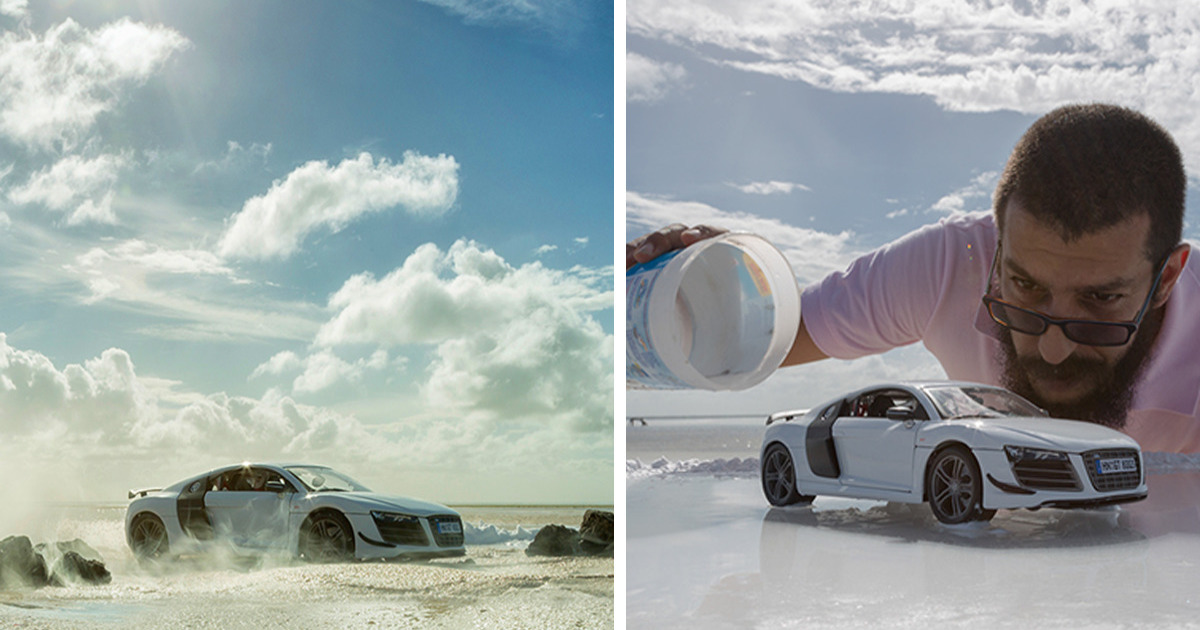
Audi Asks Photographer To Photograph Their $160,000 Sports Car, He Uses $40 Miniature Toy Car Instead
Jul
Some advertising stories begin with a helicopter, a desert road, a convoy of assistants, and a car so expensive that everyone on set starts walking like they are carrying soup. This one begins with a toy car.
When Audi commissioned photographer Felix Hernandez Rodriguez to create images of the Audi R8, the expectation sounded simple: photograph a world-class sports car. The Audi R8 was not exactly a shy little commuter with a coupon for free windshield wiper fluid. It was a dramatic, low-slung, V10-powered supercar with a price tag in the neighborhood of $160,000 and the kind of presence that makes parking lots feel underdressed.
But instead of putting a full-sized R8 on a scenic road and asking the weather to behave, Hernandez took a very different route. He used a scale model that reportedly cost about $40, then built miniature worlds around it with props, lighting, clever angles, and practical effects. The result looked like a luxury automotive campaign shot on location, except the “location” could fit inside a studio and probably did not require a permit, a tow truck, or a nervous insurance agent.
The story went viral because it touched a nerve: how much of what we see in commercial photography is real, and how much is carefully constructed illusion? In this case, the answer is deliciously weird. The car was tiny. The craft was enormous.
The Real Story Behind the $40 Audi R8 Shoot
Felix Hernandez is a Mexican photographer, digital artist, and miniature creator known for building dreamlike scenes with scale models. His studio, Hernandez Dreamphography, specializes in a visual style that mixes commercial photography, practical effects, model-making, and digital finishing. In other words, he is the kind of person who can look at flour, smoke, a toy car, and a camera and think, “Yes, this could become a luxury car ad.”
For the Audi R8 project, Hernandez did not simply place a toy car on a desk and hope the internet would applaud. He created controlled miniature environments that suggested real roads, dramatic weather, dust, snow, and cinematic atmosphere. The trick was not the toy itself. Anyone can buy a toy. The magic was in making the toy forget it was a toy.
That required the same skills used in high-end automotive photography: composition, lens choice, lighting direction, texture, reflections, mood, and timing. The only difference was scale. Instead of managing a roaring supercar on an open road, Hernandez managed a small model in a carefully designed world where every grain of dust had a job interview.
Why the Audi R8 Was the Perfect Subject
The Audi R8 has always looked like a car that arrived from the future but still remembered to wear a suit. Its low stance, wide body, sharp lighting, and mid-engine proportions make it naturally photogenic. The R8 is also closely associated with performance: powerful V10 engines, quick acceleration, quattro all-wheel-drive versions, and a reputation for being both exotic and surprisingly usable.
That visual identity matters. A miniature campaign only works if the subject has recognizable design cues. The R8’s side blades, aggressive front end, sculpted body, and dramatic headlights all help the viewer instantly read the image as “Audi R8,” even when the actual object is a small model. A less distinctive car might have looked like something from a bargain-bin playset called “Fast Vehicle No. 3.” The R8, however, carries its identity at any size.
This is why the project was not just a clever gimmick. It was a design test. The model had to preserve the emotional impact of the real car. If viewers felt speed, luxury, danger, and desire from a tiny replica, that meant the car’s design language was doing its job.
How a Miniature Car Can Look Full Size
Miniature photography depends on one big idea: the camera does not know how large something is unless the photographer gives it clues. Remove the obvious clues, control perspective, and a toy can begin to look real. Add the right lighting and atmosphere, and suddenly the viewer’s brain signs the contract without reading the fine print.
1. Camera angle does the heavy lifting
When photographing a real sports car, photographers often shoot low to emphasize power and presence. The same principle applies to a model. A low angle makes the miniature feel larger, more heroic, and less like something that should be stuck to the bottom of a child’s backpack.
2. Lighting creates scale
Lighting is where many miniature images succeed or collapse. If the light is too soft, too broad, or too obviously close, the model looks small. Hernandez’s work often uses carefully placed light to mimic the way sunlight, headlights, street lamps, or studio strobes would hit a real vehicle. The reflection on the body panels must feel believable. The shadows must behave. Tiny lies require excellent discipline.
3. Texture sells the environment
A miniature road cannot look like a craft table. Sand, snow, dust, water, smoke, and surface scratches help create the illusion of a real setting. Hernandez is known for using practical materials such as flour for snow-like scenes, corn flour for desert effects, water spray for rain, smoke for atmosphere, and syrup-like substances for droplets. These are humble materials, but in the camera’s eye, they can become weather, terrain, and drama.
4. Depth of field must be managed carefully
Small objects are hard to photograph realistically because close-up images often create shallow depth of field. That blurry miniature look can immediately reveal the trick. To fight that, a photographer may use wider lenses, careful focus, smaller apertures, or focus stacking. The goal is to make the miniature scene feel as if it has real spatial depth.
Why This Was Brilliant Advertising
Luxury car advertising often leans on spectacle. Empty mountain roads. Golden-hour desert curves. Rain-slick city streets. Wind machines. Drone shots. A mysterious driver who apparently has no job, no errands, and unlimited access to scenic highways. Hernandez’s Audi R8 project flipped that formula inside out.
The campaign became interesting not only because the images looked good, but because the process became part of the story. Viewers love behind-the-scenes reveals. They enjoy discovering that the “snowstorm” was flour, the “epic landscape” was a tabletop, and the “supercar” was small enough to misplace under a couch. The reveal adds a second layer of entertainment, and in the attention economy, that second layer is gold.
This is also a smart brand move. Audi is known for precision, engineering, and design. A miniature shoot built on precision, engineering, and design echoes those values in a playful way. The method becomes a metaphor for the brand: tiny details, carefully controlled, producing a powerful impression.
The Funny Truth: It Was Cheaper, But Not Easier
It is tempting to say, “A $40 toy car saved the day!” But that makes the project sound like a budget hack, and it was much more than that. The scale model was cheap compared with a real R8, but the skill required was not cheap at all.
A normal car shoot has challenges: weather, location scouting, vehicle transport, road safety, reflections, permits, and scheduling. A miniature shoot trades those problems for different ones. The photographer must build a believable world from scratch. Every pebble can look like a boulder. Every water droplet can look like a beach ball. Every dust particle can become a villain. The camera is ruthless when scale is wrong.
In other words, Hernandez did not avoid complexity. He miniaturized it, which may be even more dangerous. When something is tiny, mistakes do not disappear. They become adorable little disasters.
Miniature Photography and the Art of Believable Illusion
The Audi R8 shoot is part of a broader tradition in visual storytelling. Long before digital effects became common, filmmakers and photographers used miniatures to create cities, spaceships, landscapes, explosions, and dream worlds. Miniature work appears in classic cinema, product photography, stop-motion animation, and advertising. It is a reminder that realism is not always about reality. Sometimes realism is about controlling perception.
That is why Hernandez’s work feels refreshing. In an era when people assume every surreal image is generated or heavily edited, practical effects still carry a handmade charm. There is something satisfying about knowing that the atmosphere in a scene came from smoke, the snow came from pantry materials, and the road was built by human hands.
Digital editing may still play a role in polishing color, contrast, motion, and mood. But the foundation is physical. The model exists. The light exists. The set exists. That gives the final image a tactile quality viewers can feel, even if they cannot immediately explain it.
What Creators Can Learn From Felix Hernandez
The biggest lesson from this Audi story is not “buy a toy car and wait for a German automaker to call.” That strategy is bold, but your inbox may remain quiet. The real lesson is that creative constraints can produce better ideas than unlimited resources.
When you cannot rely on a full-sized car, a giant crew, and a dramatic location, you have to solve problems differently. You must think in layers: subject, environment, mood, camera, light, texture, and story. That kind of thinking is valuable for photographers, designers, marketers, content creators, and anyone who has ever tried to make something impressive with a budget that looks like it just got out of a small financial argument.
Hernandez also proves that signature style matters. Brands do not hire artists only because they can operate equipment. They hire them because they see the world differently. The camera is the tool. The imagination is the engine.
Why the Internet Loved the Story
The viral appeal was simple: the reveal was irresistible. People saw polished car images, then learned the star of the shoot was a miniature. It was the visual equivalent of finding out a five-star dessert was made in a dorm room microwave. Surprise makes content travel.
The story also arrived with a satisfying contrast: $160,000 sports car versus $40 toy. That contrast is headline candy. It makes people click, share, and say, “Wait, what?” But the staying power came from the quality of the work. If the photos had looked like a toy car, the story would have been mildly funny and then vanished. Because they looked convincingly real, the story became a case study in creative problem-solving.
Experience Notes: What This Story Teaches About Creativity, Marketing, and Making Small Things Feel Big
There is a practical lesson here for anyone who creates content: your idea matters more than your equipment list. That does not mean equipment is irrelevant. A good camera, lighting tools, lenses, editing software, and technical knowledge all help. But they are multipliers, not substitutes for imagination. A boring idea shot on expensive gear is still a boring idea. It just has better resolution.
The Audi R8 miniature shoot shows that strong concepts can turn limitations into advantages. A real sports car gives you authenticity, but it also gives you constraints. You need locations, safety planning, transport, cleaning, insurance, weather cooperation, and enough space to move around. A scale model gives you control. You can create snow in a warm studio. You can create a desert without getting sand in places sand should never be. You can shoot at night, during the day, or during whatever emotional weather your story requires.
For photographers, the experience lesson is to practice seeing like a magician and working like an engineer. The magician asks, “What do I want the audience to believe?” The engineer asks, “What exact conditions make that belief possible?” Hernandez’s images work because both questions are answered. The viewer believes the car is real because the light, angle, reflections, and environment cooperate.
For marketers, the lesson is even bigger. Audiences do not only respond to finished images; they respond to stories about how things are made. Behind-the-scenes content can transform a campaign from a static advertisement into a conversation. People may admire a beautiful car photo, but they share the revelation that it was created with a toy model, flour, smoke, and careful staging. Process creates personality.
For small businesses and independent creators, this story is encouraging. You may not have the budget of a global automaker, but you can still build something memorable. A jewelry brand can use miniature sets. A food brand can create theatrical tabletop scenes. A tech startup can show its product in a tiny handmade world that expresses a big idea. The point is not to copy Hernandez directly. The point is to ask, “What can I control creatively that others are trying to buy expensively?”
There is also a humility lesson hidden under the hood. Viewers are smart. They enjoy being fooled when the trick is artistic, not dishonest. The miniature Audi images are not deceptive in a harmful way; they are playful illusions. Once the behind-the-scenes truth appears, the work becomes more impressive, not less. That is a useful distinction for advertising. Audiences forgive illusion when it adds wonder. They reject deception when it breaks trust.
Finally, this project reminds us that play is serious business. Hernandez’s style grew from curiosity, toys, imagination, and a willingness to experiment. In a professional world obsessed with speed and efficiency, play can look unproductive right up until it creates something unforgettable. Sometimes the path to a world-class image begins with a tiny car, a messy table, and the confidence to ask, “What if?”
Conclusion: The Tiny Audi That Made a Huge Point
The story of Audi asking Felix Hernandez to photograph an R8, only for him to use a $40 miniature model, is more than a viral creative stunt. It is a reminder that photography is not just about documenting what is in front of the lens. It is about shaping what the viewer feels.
Hernandez did not need a full-sized supercar to communicate speed, luxury, and drama. He needed vision, patience, craft, and a deep understanding of how cameras interpret scale. The Audi R8 may have been tiny in the studio, but the idea behind it was enormous.
In the end, the project proves something every creator should remember: great work is not measured only by the size of the subject or the cost of the tools. Sometimes a $40 model, placed in the right hands, can make a $160,000 car look even more legendary. Not bad for something that could technically fit in a shoebox.

