
Hair Care
Jupiter Is a Jerk
Aug
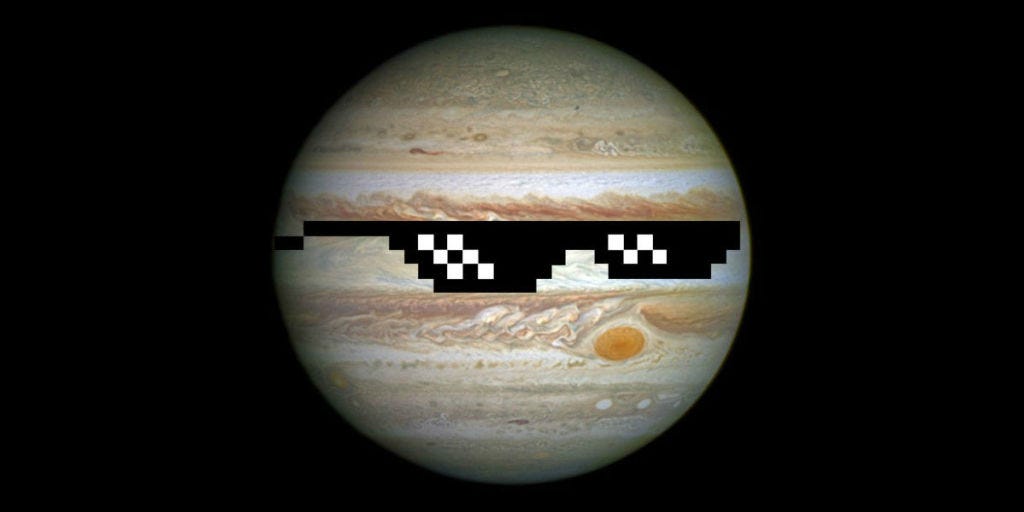
Jupiter has a great publicist. It gets called the King of Planets, the giant guardian of the solar system, the majestic striped world with a storm so famous it has its own merch energy. And sure, from a distance, Jupiter looks impressive in a “very expensive tuxedo at a science gala” kind of way. But the more you learn about it, the more one thing becomes painfully clear: Jupiter is kind of a jerk.
This planet is enormous, loud, pushy, violent, and gravitationally invasive. It spins faster than any other planet, whips up monstrous storms, bathes its neighborhood in brutal radiation, and has spent billions of years tossing rocks, sculpting orbits, and generally acting like the overpowered boss character of the solar system. Even its moons do not get a peaceful existence. If Jupiter ran a homeowners association, everyone would receive daily violation notices and at least one volcano.
Still, that is exactly what makes Jupiter fascinating. The same features that make it feel like the cosmic bully on the block also make it one of the most scientifically important worlds in our planetary neighborhood. To understand why Jupiter is such a menace, you have to look at what it is, what it does, and how much chaos one giant gas ball can cause simply by existing.
Why Jupiter Earns Its Bad Reputation
It is ridiculously oversized
Jupiter is the largest planet in the solar system by a landslide. More than 1,000 Earths could fit inside it, and it holds more than twice as much mass as all the other planets combined. That is not just big. That is “ruins the group project by doing everything with brute force” big.
Because it is so massive, Jupiter’s gravity has huge influence. It does not politely orbit the Sun and mind its own business. It pulls on asteroids, nudges comets, traps small bodies, and shapes the architecture of the solar system in ways that scientists are still sorting out. In other words, Jupiter is not merely a planet. It is a gravitational opinion.
It spins like it had three espressos and bad ideas
Jupiter has the shortest day of any planet in the solar system, taking roughly 10 hours to rotate once. That rapid spin helps drive its dramatic banded appearance and fuels complex atmospheric behavior. Its dark belts and lighter zones race in opposite directions, giving the planet a permanent look of being slightly annoyed and extremely busy.
Fast rotation also means Jupiter is not a neat, calm sphere. It bulges at the equator and behaves more like a restless fluid machine than a tidy planet. The result is a world of jet streams, vortices, turbulence, and storms that seem determined to prove weather can absolutely have main-character syndrome.
The Atmosphere: Beautiful, Violent, and Deeply Unwelcoming
The Great Red Spot is basically a centuries-old tantrum
Jupiter’s most famous feature, the Great Red Spot, is a giant storm bigger than Earth that has raged for hundreds of years. Scientists have watched it shrink over time, and recent Hubble observations suggest it is not the stable oval it once seemed from textbook diagrams. It actually behaves more like a stressed-out blob, wobbling and changing in subtle ways.
That makes Jupiter feel even more rude somehow. Most planets would be content with ordinary clouds. Jupiter said, “What if my weather pattern became a historical landmark?” and then let it spin for centuries. The Great Red Spot is not charming. It is what happens when meteorology stops being reasonable.
Its polar cyclones look like a science-fiction board meeting
NASA’s Juno mission has shown that Jupiter’s poles are crowded with tightly packed cyclones. These storms cluster in geometric arrangements that look eerily organized, as if Jupiter hired an evil interior designer. Juno’s data also revealed that these cyclones have different structures at different depths, with cyclones warmer at the top and colder below, while anticyclones show the opposite pattern.
That matters because it tells scientists Jupiter’s atmosphere is not just wild on the surface. It is a layered, dynamic system with deep roots and complicated behavior. Jupiter is not simply stormy. It is professionally stormy.
There is no nice place to stand, because there is no place to stand
Jupiter is made mostly of hydrogen and helium, with clouds of ammonia and water high in the atmosphere. Beneath those clouds, pressure and temperature increase dramatically. There is no solid surface waiting beneath the weather, no reassuring patch of ground where an astronaut could set down and say, “Well, this seems manageable.”
Instead, the deeper you go, the worse the planet gets. Stronger pressure, stranger chemistry, and eventually exotic states of matter dominate the interior. Jupiter is the kind of world that responds to curiosity with crushing force.
Jupiter’s Magnetic Field Is an Absolute Menace
Its magnetosphere is huge
After the Sun, Jupiter has the largest and strongest magnetic field in the solar system. Its magnetosphere stretches millions of miles toward the Sun and trails out so far behind the planet that it reaches past huge portions of the outer solar system. If it were visible from Earth, it would look absurdly large.
That magnetic field is not just impressive. It is hostile. It traps and accelerates charged particles, creating intense radiation belts that can damage spacecraft and punish anything orbiting too close. Jupiter does not merely have space weather. Jupiter weaponizes the neighborhood.
The radiation is so bad NASA has to build armored spacecraft
One of the clearest examples of Jupiter’s jerky behavior is how much engineering it takes to survive near it. NASA’s Juno spacecraft was designed with a protective radiation vault to shield sensitive electronics. Europa Clipper, launched to study Jupiter’s moon Europa, also has to contend with the giant planet’s ferocious radiation environment.
That tells you everything you need to know. Scientists want to study Jupiter and its moons so badly that they build robot tanks and still treat the trip with caution. Jupiter is not merely dangerous in theory. It is dangerous enough to shape mission design from the first blueprint.
Jupiter Bullies Its Moons Too
Io lives in a permanent stress fracture
Jupiter has 95 officially recognized moons, and several of them are extraordinary. They are also, in different ways, victims of Jupiter’s influence. The most dramatic case is Io, the most volcanically active world in the solar system. Jupiter’s immense gravity, along with orbital resonances involving Europa and Ganymede, stretches and squeezes Io so intensely that its interior heats up and erupts.
Imagine having a landlord so difficult that your entire moon turns into a nonstop lava show. That is Io’s reality. Jupiter’s magnetic field also strips material from Io and feeds a plasma torus around the planet. Even by moon standards, that is an unhealthy relationship.
Europa may be promising for life, but Jupiter makes the commute terrible
Europa is one of the most intriguing worlds in the solar system because it likely hides a salty ocean beneath its icy shell. It may even hold ingredients necessary for life. But Jupiter makes Europa’s environment incredibly harsh by bathing it in radiation trapped in the giant planet’s magnetic field.
So while Europa is scientifically exciting, the broader picture is classic Jupiter: take a moon with possible habitability, then surround it with a radiation nightmare. That is not support. That is sabotage with a scenic backdrop.
Ganymede and Callisto get dragged into the drama too
Ganymede is the largest moon in the solar system and has its own magnetic field, which is unusual and scientifically rich. Callisto, meanwhile, preserves ancient scars that help researchers understand impact history in the outer solar system. Both are compelling worlds. But neither gets to exist outside Jupiter’s influence. In the Jovian system, everything happens under the shadow of the giant.
Jupiter Rearranges the Solar System Like It Owns the Place
It can protect Earth, but it can also send trouble our way
Jupiter often gets cast as Earth’s bodyguard because its gravity can deflect or capture some comets and asteroids that might otherwise head inward. That idea is not entirely wrong. The planet has absolutely intercepted impacts, and the 1994 collision of Comet Shoemaker-Levy 9 with Jupiter gave humanity a spectacular reminder that giant worlds can take hits.
But the story is messier than the “cosmic vacuum cleaner” nickname suggests. Jupiter’s gravity can also perturb objects and redirect them into new orbits, including some that cross the inner solar system. In other words, Jupiter is the kind of security guard who occasionally tackles the burglar, but sometimes also throws folding chairs into the parking lot just to keep things interesting.
It likely helped carve the asteroid belt
Jupiter’s gravity strongly influences the asteroid belt between Mars and Jupiter. It helps create orbital gaps and shapes the long-term evolution of countless rocky bodies. That means the planet did not simply show up after the solar system formed and take a nice corner office. It participated in the layout, and possibly in a fairly aggressive way.
Planetary scientists have also explored ideas such as Jupiter’s early migration, including the “Grand Tack” scenario, in which the giant planet may have moved inward and then back outward during the solar system’s youth. If versions of that story are correct, Jupiter did not merely influence the furniture arrangement. It dragged the couch across the room and knocked over several smaller planets on the way.
It may have helped Earth and still been obnoxious about it
Some research suggests giant planets like Jupiter may have played a role in moving water-rich material toward the inner solar system, potentially contributing to Earth’s early inventory of water. So yes, it is possible Jupiter helped create conditions that eventually mattered for life here.
But that does not make Jupiter nice. It just makes it complicated. Plenty of difficult people occasionally do one useful thing. That does not erase the rest of the résumé.
Why Scientists Love This Planet Anyway
For all the jokes, Jupiter is one of the most important objects in planetary science. It preserves clues about the early solar system, because giant planets formed from the material left over from the Sun’s birth environment. Studying Jupiter helps scientists understand how planets form, how atmospheres behave under extreme conditions, how magnetic fields work, and how giant planets influence the architecture of planetary systems around other stars.
Jupiter is also a laboratory for extremes. Its storms, lightning, auroras, radiation belts, and moon interactions provide natural experiments that would be impossible to reproduce on Earth. Juno’s close passes have transformed our view of the planet, revealing complex polar dynamics, deep atmospheric flows, and a world more intricate than the old classroom image of “big striped gas ball” ever suggested.
So yes, Jupiter is a jerk. But it is an educational jerk. It is the kind of cosmic menace that keeps planetary scientists employed, spacecraft designers humble, and astronomy fans permanently intrigued.
Final Verdict: A Magnificent Bully
Jupiter earns its bad attitude label honestly. It dominates the solar system by mass, flings its gravity around, hosts storms that outlive empires, creates radiation zones that force engineers to armor spacecraft, and puts its moons through tidal and magnetic torment. Even when it helps, it does so in the least chill way possible.
And yet, calling Jupiter a jerk is also a backhanded compliment. The planet is not boring. It is dramatic, consequential, and central to the story of how our solar system became what it is. If Mars is the dusty dream date and Saturn is the elegant one with accessories, Jupiter is the loud giant at the center of the room, rewriting the mood just by stepping in.
So the next time someone says Jupiter is beautiful, agree with them. Then add the important second half of the sentence: beautiful, yes, but absolutely a jerk.
Related Experiences: What “Jupiter Is a Jerk” Feels Like in Real Life
If you want to understand this topic on a human level, the experience usually starts with wonder. You look through binoculars or a modest backyard telescope and see a bright disk with tiny points lined up beside it. Those points are moons, and the moment feels calm, elegant, almost gentle. Jupiter looks polished from far away. It is the astronomy equivalent of meeting someone in perfect lighting before learning they create chaos in every group chat.
Then you start reading more. You find out that one of those little points, Io, is being flexed by gravity so hard that it erupts constantly. Another, Europa, may hide an ocean but has to live inside a punishing radiation environment. Suddenly the serene telescope view becomes weirdly dramatic. The system is not peaceful. It is tense. You are no longer looking at a pretty planet. You are looking at a whole neighborhood shaped by one giant overachiever with boundary issues.
Following Jupiter missions adds another layer to the experience. Juno’s images are gorgeous, full of cream, rust, gold, and blue swirls that look like oil paint in motion. But the beauty comes with a running side note from engineers and scientists that basically says, “Yes, this is stunning, and yes, it is also trying to fry our spacecraft.” That contrast changes how you think about exploration. Jupiter becomes the place where elegance and danger are locked in a very committed relationship.
There is also the strange emotional effect of learning how much influence Jupiter may have had on Earth’s history. It may have redirected material, shaped the asteroid belt, and altered the solar system’s early layout. That can make you feel small in the best and worst ways at once. On one hand, it is thrilling to realize our planet’s story may be partly tied to the behavior of a giant world hundreds of millions of miles away. On the other hand, it is humbling to recognize that cosmic history is not neat, and Earth’s good fortune may have depended on a planet that behaves like a gravitational wrecking ball.
Even casual skywatching can turn Jupiter into an experience rather than a fact. It rises bright and obvious, impossible to miss when conditions are right. You can show it to a kid, a friend, or someone who claims they are “not really into space,” and it almost always gets a reaction. People do not need a lecture to be impressed. But once the questions start, the polite version of Jupiter lasts about five minutes. Then come the storms, the radiation belts, the moon torture, the comet impacts, and the giant magnetic field. The conversation shifts from “That’s pretty” to “Wait, this planet is insane.”
That may be the most relatable part of the whole topic. Jupiter teaches you that beauty and bad behavior are not opposites in astronomy. Some of the most visually stunning things in the universe are also the most violent. The experience of learning about Jupiter is the experience of watching admiration turn into amused suspicion. You still love looking at it. You still want every new mission to send back more data and more images. You still feel that ancient pull of curiosity when it shines in the night sky. But now you know the truth. Jupiter is magnificent, memorable, scientifically priceless, and, with all due respect to the largest planet in the solar system, a complete jerk.

