
Hair Care
5 Ways to Write About Yourself
Jun
Writing about yourself sounds simple until you actually sit down to do it. Suddenly, the keyboard becomes a courtroom, every sentence feels suspicious, and the phrase “I am passionate about…” starts pacing outside your window like a tired ghost. Whether you are writing a personal essay, an About Me page, a professional bio, a college application, a cover letter, or a short self-introduction, the challenge is the same: how do you sound confident without sounding like you hired a marching band to announce your greatness?
The good news is that writing about yourself is not about bragging, confessing your entire life story, or turning your personality into a corporate brochure. It is about choosing the right details, shaping them for the right audience, and telling the truth with clarity, warmth, and purpose. The best self-writing helps readers understand who you are, what you value, what you have done, and why any of it matters.
This guide breaks the process into five practical ways to write about yourself. Each method works for different situations, but they all share one rule: be specific. A vague sentence says, “I am hardworking.” A strong sentence says, “I learned to manage inventory, train two new team members, and close weekend shifts during my first retail job.” One sounds like a fortune cookie with a LinkedIn account. The other gives readers something real.
1. Start With Your Audience and Purpose
Before you write a single sentence about yourself, ask two questions: who will read this, and what do they need from me? Your answer changes everything. A personal statement for college should not sound like a dating profile. A professional bio should not wander into your childhood fear of geese unless, somehow, you are applying to be a goose psychologist. Context matters.
Writing about yourself becomes easier when you stop trying to include your entire identity and start selecting what fits the moment. A hiring manager wants to know your skills, achievements, and fit for the role. A scholarship committee wants to understand your goals, background, motivation, and potential. A website visitor wants to know what you do, why you do it, and whether they can trust you. Your best friend already knows you are funny. The admissions officer does not, so show it carefully.
Match the Tone to the Situation
Tone is the personality of your writing. For a professional bio, keep it polished and concise. For an About Me page, you can be warmer and more conversational. For a personal essay, you can be reflective, emotional, and vivid. For a resume summary, you need to be direct and results-focused.
For example, instead of using the same introduction everywhere, adapt it:
Professional bio: “Jordan Lee is a digital marketing specialist who helps small businesses improve search visibility through content strategy, analytics, and practical SEO planning.”
About Me page: “I help small businesses make sense of SEO without needing a dictionary, a panic button, or three emergency coffees.”
Personal essay: “The first time I built a website for my mother’s bakery, I accidentally broke the menu page, learned what a redirect was, and discovered that problem-solving could feel like a treasure hunt.”
Same person. Different audience. Different purpose. Better results.
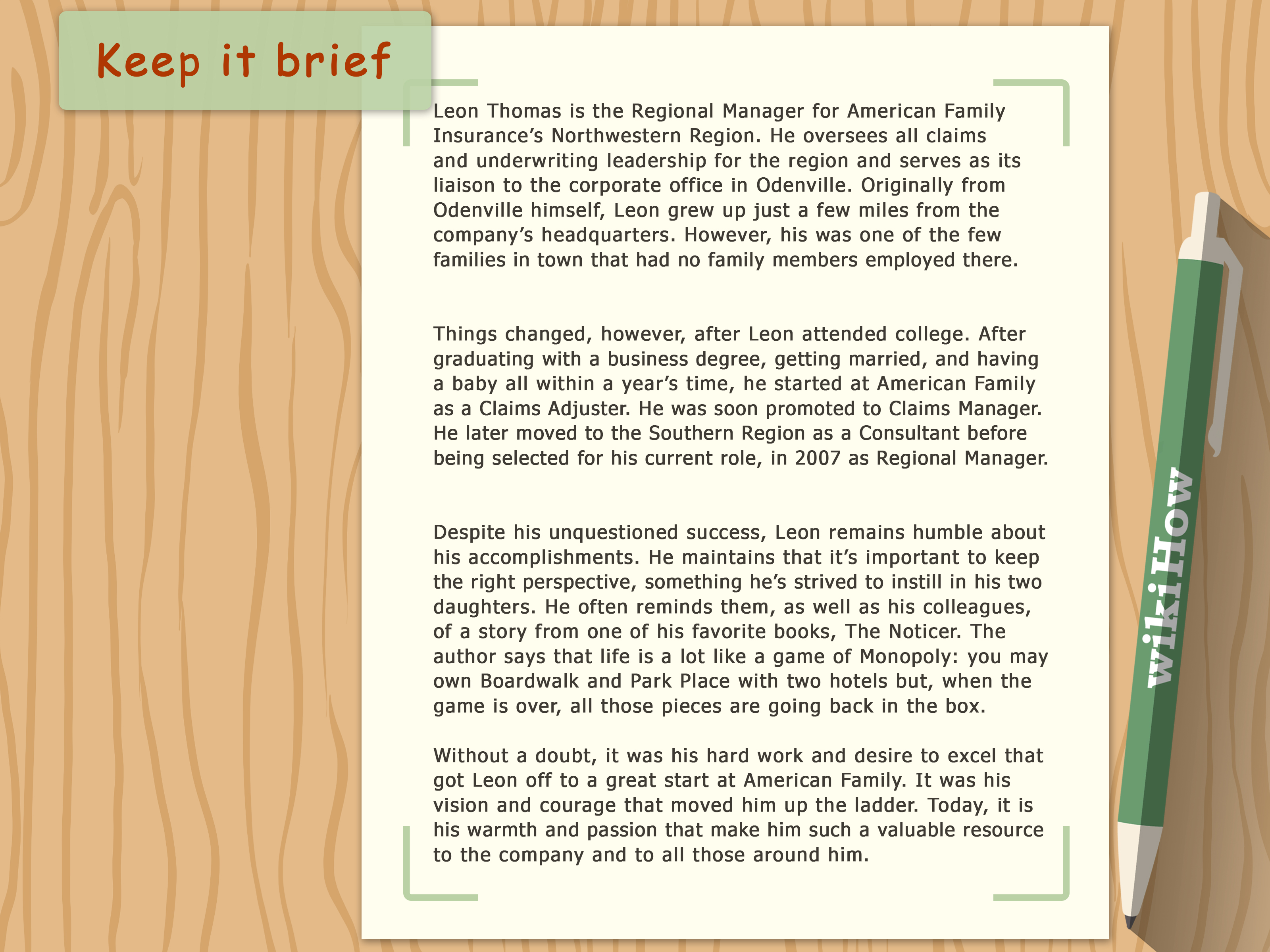
2. Choose a Focused Story Instead of a Life Summary
One of the biggest mistakes in personal writing is trying to cover everything. You were born, you went to school, you liked books, you worked hard, you faced challenges, you learned lessons, you now seek opportunity. That may be true, but it can read like a documentary narrated by a sleep-deprived toaster.
Strong writing about yourself usually focuses on one or two meaningful experiences. The goal is depth, not a buffet of disconnected facts. A focused story gives readers a way to remember you. It also helps you avoid generic claims because the story provides evidence.
Use the “Moment, Meaning, Movement” Method
A useful structure for personal storytelling is moment, meaning, movement. First, describe a specific moment. Next, explain what it meant. Finally, show how it moved you forward.
Moment: “During my junior year, I volunteered at a community garden and was assigned to repair the irrigation system.”
Meaning: “What looked like a simple maintenance task became my first lesson in systems thinking: one blocked line affected every plant downstream.”
Movement: “That experience shaped my interest in environmental engineering and taught me to solve problems by looking at the whole system, not just the obvious leak.”
This method works because it turns an experience into a narrative. Readers do not just learn what happened; they learn how you think. That is the real magic. Anyone can list activities. Fewer people can explain why those activities changed them.
3. Show Your Qualities Through Specific Evidence
When writing about yourself, adjectives are cheap. Evidence is expensivein the best way. Words like motivated, creative, responsible, passionate, and dedicated are not bad, but they are overused. If you rely on them alone, your writing starts sounding like every other personal statement in the pile, all wearing the same navy blazer.
Instead of telling readers your qualities, show those qualities through examples. If you are creative, describe what you made. If you are resilient, show the obstacle and the action you took. If you are organized, mention the system you built, the project you managed, or the outcome you improved.
Turn Claims Into Proof
Weak sentence: “I am a natural leader.”
Stronger sentence: “When our debate club lost its faculty sponsor two weeks before regionals, I coordinated practice schedules, contacted alumni judges, and helped the team keep preparing until a new sponsor was approved.”
Weak sentence: “I love helping people.”
Stronger sentence: “As a peer tutor, I learned to explain algebra three different ways because not every student thinks in straight linesand honestly, neither does algebra.”
Weak sentence: “I am interested in design.”
Stronger sentence: “I redesigned the homepage for a student club, reducing clutter, organizing event information, and making sign-ups easier for new members.”
Specific examples make your writing believable. They also make it more memorable. A reader may forget that you are “hardworking,” but they will remember the person who rebuilt a club website, repaired garden irrigation, or taught algebra with patience and humor.
4. Balance Confidence With Humility
Writing about yourself often feels awkward because you are trying to walk a narrow bridge between “Please notice my strengths” and “I am the chosen one, bring me a crown.” The trick is to be honest, not inflated. Confidence means owning your accomplishments. Humility means acknowledging growth, context, and the fact that you did not descend from the clouds holding a perfect resume.
A confident writer says what they did. A humble writer explains what they learned. A strong self-description usually includes both.
Use Reflection to Avoid Bragging
Reflection is what turns an achievement into insight. Without reflection, writing about yourself can feel like a trophy shelf. With reflection, it becomes a story of development.
For example, consider this sentence:
“I won first place in the science fair.”
That is fine, but it stops too soon. Add reflection:
“Winning first place in the science fair was exciting, but the more valuable lesson came from the three failed prototypes before it. I learned that research is less about being instantly right and more about staying curious when the first answer collapses like a folding chair.”
Now the achievement has personality, depth, and meaning. The reader sees not only the result but also the mindset behind it. That is what good self-writing does: it gives readers evidence of character.
Humility also means avoiding exaggeration. Do not describe a two-week group project as “transforming the future of global innovation.” Unless your project actually did that, in which case, congratulations, please fix printer technology next. Be accurate. Being specific is more impressive than being dramatic.
5. Revise Until It Sounds Like a Real Person Wrote It
The first draft of writing about yourself is often messy. That is normal. In fact, if your first draft is perfect, check the room for wizards. Most strong personal writing comes from revision. You write too much, discover the real point, cut the fog, sharpen the examples, and replace stiff phrases with language that sounds natural.
Revision is not just proofreading. Proofreading catches typos. Revision asks bigger questions: Does this answer the prompt? Is the focus clear? Do the examples prove the main point? Does the tone fit the audience? Are there clichés hiding in the corners? Does this sound like me, or like a motivational poster wearing business shoes?
Use a Simple Revision Checklist
After drafting, review your writing with these questions:
- Does the opening make the reader want to continue?
- Is the main idea clear within the first few sentences?
- Have I included specific stories, examples, or results?
- Do I explain why the experience matters?
- Have I removed clichés such as “ever since I was young” or “I want to make a difference” unless I made them fresh and specific?
- Does the final paragraph leave the reader with a strong impression?
- Can I cut any sentence that repeats an idea?
Reading your work aloud is also surprisingly effective. Your ears catch awkward sentences your eyes politely ignored. If a sentence makes you run out of breath, it probably needs trimming. If it sounds like something you would never say, rewrite it. Good writing about yourself should feel polished, but not plastic.
Common Mistakes to Avoid When Writing About Yourself
Even good writers fall into traps when the subject is personal. The first trap is being too general. Statements like “I learned many valuable lessons” do not tell the reader much. What lessons? Valuable how? Learned from what? Specificity is your escape ladder.
The second trap is overexplaining. You do not need to include every background detail before reaching the point. Give enough context for the reader to understand the story, then move quickly to the action and meaning.
The third trap is sounding too formal. Many people become strangely robotic when writing about themselves. They write, “It is my sincere belief that my experiences have rendered me highly capable.” That sentence needs a nap. Try: “My experiences have prepared me to contribute quickly and keep learning.” Cleaner, warmer, better.
The fourth trap is forgetting the reader. Writing about yourself is still communication. The reader should never feel trapped inside your diary with no map. Guide them. Use transitions. Make your purpose clear. Respect their time.
Examples of Writing About Yourself for Different Situations
Short Professional Bio Example
“Avery Brooks is a project coordinator with experience managing nonprofit events, volunteer teams, and donor communications. She specializes in turning ambitious ideas into organized action plans, preferably with color-coded spreadsheets and fewer emergency meetings.”
About Me Page Example
“I write practical finance content for people who want to understand money without feeling like they accidentally enrolled in a graduate economics seminar. My work focuses on budgeting, saving, and small business planning, with clear examples and zero judgment about your coffee budget.”
Personal Essay Example
“I did not expect a broken bicycle chain to teach me patience. But on a rainy afternoon, ten miles from home, I learned that frustration is not a plan. I had to slow down, ask for help, and figure out the problem link by link.”
Each example has a clear audience, a specific tone, and a human detail. That combination is what makes self-writing feel alive.
Experiences That Make Writing About Yourself Easier
Many people think they have nothing interesting to write about because their lives have not included dramatic movie scenes: no mountaintop rescue, no mysterious inheritance, no slow-motion sprint through an airport. But good writing about yourself does not require cinematic chaos. It requires attention. Ordinary experiences often reveal the most about your personality, values, and growth.
Think about a time you solved a small problem. Maybe you trained a new coworker, helped a sibling study, organized a messy storage room, repaired something at home, handled a difficult customer, or learned a skill after many failed attempts. These moments may look small, but they can show responsibility, patience, creativity, leadership, or resilience. The trick is not to make the event sound bigger than it was. The trick is to explain why it mattered.
For example, someone writing about a part-time restaurant job might first think, “I only served food.” But that job could show time management, communication, emotional control, teamwork, and the ability to smile politely while someone asks whether the soup is “too soupy.” A student who helped care for younger siblings might show maturity, adaptability, and empathy. A person who struggled in a class but improved through tutoring and consistent practice might show persistence and self-awareness.
One helpful exercise is to make a “story inventory.” Divide a page into four columns: challenge, action, result, lesson. Under challenge, list moments that were difficult, confusing, uncomfortable, or important. Under action, write what you actually did. Under result, note what changed. Under lesson, explain what you learned about yourself. After ten minutes, you will likely have more material than you expected.
Another useful experience is feedback. Ask a teacher, friend, manager, or mentor what strengths they see in you. Do not ask them to write the piece for you; ask what moments they remember. Other people often notice patterns we miss. Maybe they remember that you stayed calm during a group project meltdown. Maybe they noticed that you always explain ideas clearly. Maybe they remember that you quietly did the unglamorous tasks nobody else wanted. These details can become powerful examples.
Travel, volunteering, school projects, family responsibilities, hobbies, creative work, sports, and even mistakes can all become strong writing material. Mistakes are especially useful when handled honestly. A good mistake story does not say, “I failed, and now everything is magically perfect.” It says, “Here is what happened, here is how I responded, and here is what I do differently now.” That kind of reflection feels mature because it does not pretend life came with an undo button.
Finally, pay attention to the experiences you keep returning to in your mind. If a memory still bothers you, inspires you, or makes you laugh, it may contain a useful truth. Writing about yourself is not about proving you are flawless. It is about helping readers understand how you notice, learn, adapt, and contribute. Your best material may be hiding in the everyday moments you almost dismissed.
Conclusion
Learning how to write about yourself is really learning how to choose. You choose the right audience, the right story, the right evidence, the right tone, and the right final shape. You do not need to sound perfect. You need to sound clear, honest, and specific. Readers are not looking for a superhero origin story. They are looking for a real person with self-awareness, purpose, and enough personality to make the page breathe.
So start small. Pick one meaningful experience. Explain what happened. Show what you did. Reflect on what changed. Then revise until every sentence earns its seat at the table. Writing about yourself may never feel completely effortless, but with practice, it becomes less like posing for an awkward yearbook photo and more like opening a door.

