
Makeup
4 Ways to Cite the Code of Federal Regulations
Aug
Note: This article is written in copy-ready HTML body format and synthesizes real guidance from U.S. government publishing resources, legal citation guides, university law libraries, and academic style references.
Introduction: Why CFR Citations Matter More Than They Look
Citing the Code of Federal Regulations can feel like trying to read a license plate on a moving government truck. You know the information is important, you can see numbers everywhere, and somewhere in the middle of it all is a section symbol quietly judging your punctuation.
But once you understand the basic structure, CFR citation is not nearly as terrifying as it appears. The Code of Federal Regulations, commonly abbreviated as CFR or C.F.R. depending on style, is the organized collection of general and permanent rules issued by federal agencies. It is divided into 50 titles, each covering a broad subject area such as Agriculture, Energy, Labor, Transportation, Public Health, or National Defense. These titles are then broken into chapters, parts, sections, and sometimes paragraphs.
For writers, students, paralegals, researchers, policy analysts, and anyone who has ever stared at “21 C.F.R. § 101.9” and wondered whether it was a legal citation or a secret robot name, the goal is simple: make the citation precise enough that another person can find the exact regulation you used.
This guide explains 4 ways to cite the Code of Federal Regulations: legal Bluebook style, APA style, MLA style, and practical web or research citations using GovInfo and eCFR. Along the way, you will see clear examples, common mistakes, and practical advice that makes CFR citation less painful than assembling furniture with federal instructions.
What Is the Code of Federal Regulations?
Before you cite the CFR, it helps to know what you are citing. The Code of Federal Regulations is the annual codification of rules published by federal departments and agencies. These rules are originally published in the Federal Register, then organized into the CFR if they are general and permanent regulations.
The CFR is arranged by title number. For example, Title 21 covers Food and Drugs, while Title 40 covers Protection of Environment. A CFR citation points readers to the exact location of a regulation by identifying the title, source abbreviation, section, and often the year of the edition being cited.
Basic CFR Citation Anatomy
A standard CFR citation usually looks like this:
Here is what each piece means:
- 21 is the CFR title number.
- C.F.R. stands for Code of Federal Regulations.
- § means “section.”
- 101.9 is the section number.
- (2024) is the year of the CFR edition cited.
That is the heart of most CFR citations. Once you understand this pattern, the rest is mostly a matter of adapting the citation to the style guide required by your professor, court, publication, or editor.
Way 1: Cite the CFR in Legal Writing Using Bluebook Style
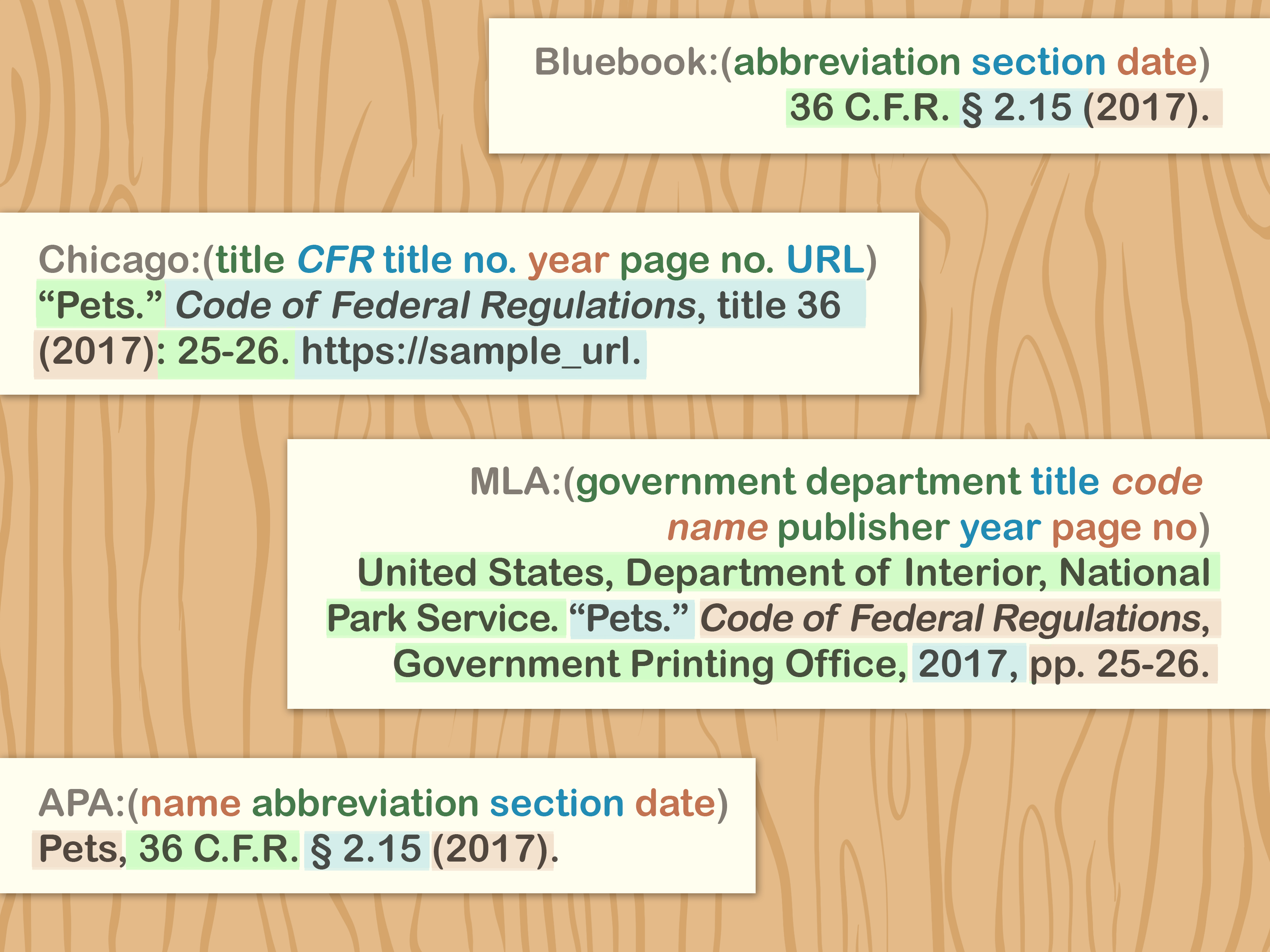
For law school papers, legal memoranda, briefs, law review notes, and court documents, the most common citation method is Bluebook style. The Bluebook is widely used in American legal writing, and it provides specific rules for citing federal regulations in the Code of Federal Regulations.
The standard legal citation format is:
Example:
This citation points to Title 29 of the CFR, section 1910.1200, in the 2024 edition. Title 29 generally relates to labor regulations, so this example would commonly appear in writing about workplace rules, employment compliance, or occupational safety.
Bluebook CFR Citation Example in a Sentence
Here is how a CFR citation might appear in legal writing:
The hazard communication standard requires employers to provide information about hazardous chemicals in the workplace. See 29 C.F.R. § 1910.1200 (2024).
In formal legal writing, signals such as see, see also, or cf. may appear before the citation depending on how the authority supports the sentence. No signal is needed when the regulation directly states the legal rule being described.
When to Include Subsections
Many CFR sections contain subsections, paragraphs, and subparagraphs. If the exact rule appears in a smaller part of the section, cite the specific subsection instead of sending the reader into the whole regulation jungle with only a flashlight.
This kind of pinpoint citation is especially useful in legal writing because courts and legal readers expect precision. If your statement depends on paragraph (b)(2), cite paragraph (b)(2), not just the main section.
Bluebook Tips for CFR Citations
Use periods in C.F.R. for traditional legal citation. Include the section symbol before the section number. Add the year in parentheses. If you are citing multiple sections, use the plural section symbol:
The plural symbol tells readers that the citation covers more than one section. Think of it as the legal citation version of saying, “Bring snacks; we are visiting more than one regulation.”
Way 2: Cite the CFR in APA Style
APA style is commonly used in social sciences, education, psychology, nursing, public health, criminal justice, and many policy-related fields. APA legal citations often borrow from legal citation conventions, but the reference list entry is formatted for academic readers.
A basic APA 7 reference list format for a codified federal regulation is:
Example:
In APA style, the regulation title usually comes first. Then comes the title number, the abbreviation C.F.R., the section symbol, the section number, the year, and a URL if the regulation is available online.
APA In-Text Citation Example
APA in-text citations usually use the name of the regulation and year:
Or in narrative form:
Nutrition Labeling of Food (2024) requires specific information to appear on packaged food labels.
APA Style Advice for CFR Sources
APA readers often care about the name of the regulation because it helps them understand the topic before the legal citation begins. For this reason, do not skip the regulation name when it is available. The name acts like a polite introduction before the citation starts throwing numbers around.
If you cite the electronic CFR, check whether your instructor or publisher prefers the official annual CFR from GovInfo or the updated eCFR. The eCFR is extremely useful for current research, but the official legal edition and the continuously updated online version are not always treated the same way in formal legal contexts.
Way 3: Cite the CFR in MLA Style
MLA style is most common in humanities courses, writing classes, literature programs, and some interdisciplinary research. MLA is not primarily a legal citation system, so government and legal documents can feel a little awkward in MLA format. Still, the goal remains the same: give enough information for readers to find the regulation.
A practical MLA Works Cited format for a CFR regulation can look like this:
If you are citing the eCFR online, you may adapt the entry like this:
MLA style often emphasizes container information, such as the website or database where the source appears. For web-based CFR citations, include the government body, the title of the source, the title and section number, the year or access information if required, and the online container.
MLA In-Text Citation Example
An MLA in-text citation might use a shortened title or government source:
For smoother prose, you can identify the regulation in the sentence:
Under Title 21, section 101.9 of the Code of Federal Regulations, packaged food labeling rules must include specific nutrition information.
MLA Tips for CFR Citations
MLA instructors may vary in how they prefer legal materials to be cited. Some will accept a legal-style citation inside the prose, while others expect a full Works Cited entry. When in doubt, use a clear Works Cited entry and include the exact title and section in your sentence. MLA rewards clarity, not mysterious abbreviation gymnastics.
Way 4: Cite the CFR from GovInfo, eCFR, or the Federal Register
The fourth way to cite the Code of Federal Regulations is not a separate school style like APA or MLA. It is a practical research method: cite the version you actually used. This matters because federal regulations live in more than one place.
The official annual CFR is available through GovInfo, a service of the U.S. Government Publishing Office. The eCFR, maintained by federal publishing authorities, is a continuously updated online version of the CFR. It is very useful for finding current regulatory text, but it is not the official legal edition. For most everyday research, the eCFR is convenient. For formal legal work, historical research, or exact edition-based citation, the annual CFR edition may be required.
Citing an Annual CFR Edition
If you rely on the annual CFR, cite the title, section, and year:
This format is compact and works well in legal writing. In academic writing, you may add a source name or URL depending on the required style.
Citing the eCFR for Current Regulations
If you use the eCFR for current regulations, make it clear that your citation is based on the current online version. A research note or informal citation may look like this:
Many style guides do not require access dates unless the source changes over time. The eCFR does change as regulations are updated, so an access date can be helpful when your reader needs to know exactly when you viewed the text.
Citing a Rule Not Yet Codified in the CFR
Sometimes a new regulation has been published in the Federal Register but has not yet appeared in the CFR. In that case, cite the Federal Register and include a parenthetical showing where the rule will be codified, if that information is available.
This format tells readers two important things: where the rule was officially published and where it is expected to appear in the CFR. It is especially useful for current regulatory research, where the law may be moving faster than the annual CFR update cycle.
Common Mistakes When Citing the CFR
1. Confusing the CFR with the U.S. Code
The United States Code contains federal statutes passed by Congress. The Code of Federal Regulations contains federal agency regulations. They are related, but they are not the same thing. A statute may authorize an agency to issue regulations, but the regulation itself belongs in the CFR.
2. Forgetting the Section Symbol
The section symbol § is small but mighty. In legal and academic citation, it points readers to the specific section. Forgetting it may not destroy civilization, but it does make your citation look unfinished.
3. Using the Wrong Year
The year in a CFR citation should reflect the edition or version you used. Because the CFR is updated on an annual cycle, the year matters. Do not automatically use the current year unless you actually checked that edition.
4. Citing Only the Part Instead of the Section
CFR parts can be large. A citation to a part may be acceptable if you are discussing a broad regulatory scheme, but if you are making a specific claim, cite the exact section or subsection. Your reader should not need a search party.
Quick Reference: CFR Citation Examples
Legal Bluebook Style
APA Style
MLA Style
Federal Register Rule to Be Codified
Practical Experience: What I Learned from Working with CFR Citations
The first real lesson about CFR citations is that the citation is not just decoration. It is a map. A bad citation is like giving someone directions by saying, “Turn left near the big tree.” That might work in a village, but it is not enough for federal regulations. A good CFR citation takes readers directly to the rule, section, and version you used.
One common experience is realizing that the eCFR and the annual CFR are not interchangeable in every situation. The eCFR is usually the easiest place to search because it is online, updated, and readable. For fast research, it is a lifesaver. However, when the assignment, court filing, or publication asks for a formal citation, you may need to cite the annual edition or identify the year carefully. This is where many beginners trip. They find a regulation online, copy the section number, and forget to ask, “Which version did I actually use?”
Another practical lesson is to cite narrowly. At first, it is tempting to cite an entire part because it feels safer. After all, if you cite the whole part, surely the rule is in there somewhere, right? Technically, yes, but that is not helpful. Readers want the exact section. If the relevant sentence is in subsection (a)(3), cite subsection (a)(3). Precision makes your work look professional and saves your reader from hunting through a regulatory maze with no snacks.
It also helps to keep a simple citation checklist. First, identify the title number. Second, confirm the section number. Third, check whether you need a subsection. Fourth, determine the correct year or access date. Fifth, format the citation according to the required style. This five-step habit prevents most citation disasters before they escape into the wild.
When writing for non-law audiences, the best practice is to introduce the regulation in plain English before dropping the citation. For example, instead of writing only “See 21 C.F.R. § 101.9,” explain that the rule concerns nutrition labeling for packaged food. Then give the citation. This makes the article readable for humans, not just attorneys, editors, and unusually ambitious filing cabinets.
Finally, do not rely blindly on citation generators. They can be useful, but federal regulations are detail-heavy sources. A generator may miss the regulation title, use the wrong year, or format the section incorrectly. Always compare the output against the style guide you are required to use. Think of citation tools as helpful interns: great when supervised, risky when left alone with punctuation.
In real-world writing, citing the Code of Federal Regulations well comes down to respect for the reader. You are saying, “Here is the rule, here is where I found it, and here is the version I relied on.” That kind of clarity builds trust, improves academic and legal credibility, and prevents your research from looking like it was assembled during a caffeine emergency.
Conclusion: CFR Citation Is a Skill, Not a Spell
Learning how to cite the Code of Federal Regulations may seem intimidating at first, but the pattern becomes familiar quickly. Most CFR citations depend on four core details: the title number, the CFR abbreviation, the section number, and the year or version. From there, you adjust the format for Bluebook, APA, MLA, or practical web-based research.
For legal writing, use the traditional Bluebook-style format such as 21 C.F.R. § 101.9 (2024). For APA, begin with the regulation name when available. For MLA, provide enough government and container information for readers to locate the source. For current online research, make clear whether you used GovInfo, the eCFR, or a Federal Register rule that has not yet been codified.
The best CFR citations are accurate, specific, and reader-friendly. They do not show off. They do not wander. They simply point to the right rule and let your research stand on solid ground. In other words, a good CFR citation is like a good GPS: quiet, precise, and deeply appreciated when everyone else is lost.

