
Beauty Unlocked
Top 10 Fantasy Worlds In Literature
May
Great fantasy worlds do more than give heroes somewhere scenic to swing a sword. They create rules, histories, languages, religions, food, weather, politics, monsters, maps, and occasionally enough family drama to make Thanksgiving look peaceful. The best fantasy worlds in literature feel as if they existed before page one and will keep breathing after the final chapter closes.
That is the magic trick behind world-building: readers do not just follow a plot; they move in. They remember the smell of pipeweed in the Shire, the chill of Narnia under the White Witch, the unstable logic of Wonderland, and the political headaches of Westeros, where a wedding invitation should probably come with life insurance. These fictional realms become emotional geography. We know where we would vacation, where we would study magic, and where we would absolutely not buy real estate.
This list ranks the top 10 fantasy worlds in literature by imagination, cultural impact, internal depth, originality, and how strongly each world shapes the story. Some are vast secondary worlds with ancient wars and invented languages. Others are smaller, stranger places built on dream logic, satire, or childhood wonder. All of them changed how readers think about fantasy fiction.
1. Middle-earth J.R.R. Tolkien
Middle-earth remains the gold standard for fantasy world-building. Created by J.R.R. Tolkien across The Hobbit, The Lord of the Rings, The Silmarillion, and related writings, it is not merely a setting. It is a layered mythology with languages, genealogies, migrations, songs, wars, ruins, and a melancholy sense that every green hill has buried history under it.
What makes Middle-earth extraordinary is its depth. Tolkien’s invented languages shaped cultures rather than decorating them. Elvish, Dwarvish, Rohirric, and the Black Speech are not fantasy confetti; they reveal identity, memory, and power. The Shire feels cozy because the wider world is dangerous. Mordor feels terrifying because beauty and freedom exist elsewhere. Every region carries moral weight.
Middle-earth also gave modern fantasy its architectural blueprint: maps at the front, ancient prophecies, reluctant heroes, dark lords, fellowship quests, and the bittersweet awareness that victory always costs something. Many later fantasy worlds borrow Tolkien’s furniture, but few match the craftsmanship of the house.
2. Narnia C.S. Lewis
Narnia is one of literature’s most beloved portal fantasy worlds, introduced in C.S. Lewis’s seven-book series The Chronicles of Narnia. It begins with a wardrobe, which is frankly a bold design choice. Most wardrobes merely hold coats; this one contains snow, prophecy, talking animals, and an alarming lack of central heating.
Narnia’s power lies in its accessibility. Children step from ordinary life into a realm where moral choices become visible and mythic. Lions speak, fauns carry umbrellas, witches freeze kingdoms, and schoolchildren become kings and queens. The world is simple enough for young readers to enter and symbolic enough for adults to debate for decades.
Unlike Middle-earth’s dense historical realism, Narnia moves like a fairy tale. Its geography is less important than its spiritual atmosphere. Forests, islands, seas, mountains, and magical doors all serve the emotional rhythm of wonder, temptation, courage, betrayal, and redemption. Narnia teaches readers that fantasy can be both imaginative adventure and moral mirror.
3. Earthsea Ursula K. Le Guin
Earthsea, created by Ursula K. Le Guin, is an archipelago of islands, names, dragons, balance, and silence. First introduced in A Wizard of Earthsea, it feels different from many fantasy worlds because its magic is philosophical before it is flashy. In Earthsea, knowing the true name of a thing gives power over it, which makes language sacred and careless speech dangerous. Basically, it is the opposite of the internet.
Le Guin’s world-building is elegant rather than crowded. The sea separates cultures while connecting them. Magic depends on balance, not domination. Dragons are not just boss-level reptiles; they are ancient, intelligent beings tied to language and mystery. The geography of islands reinforces the emotional journeys of Ged, Tenar, and later characters who must cross both physical water and inner darkness.
Earthsea earns its place among the best fantasy worlds because it asks what power is for. Many fantasy stories celebrate magical ability; Le Guin questions ambition, pride, gender, death, and responsibility. The result is a world that feels quiet, wise, and dangerous in the way deep water is dangerous.
4. Discworld Terry Pratchett
Discworld is what happens when a genius looks at fantasy clichés, grins, and builds an entire universe on the back of four elephants standing on a giant turtle. Terry Pratchett’s flat world began as parody, but across dozens of novels it became one of literature’s richest comic creations.
The brilliance of Discworld is that it can make readers laugh at dwarfs, witches, wizards, guards, gods, newspapers, banks, opera, academia, and death itselfthen quietly ambush them with sharp observations about power, prejudice, labor, belief, and human stupidity. Especially human stupidity. Discworld may be absurd, but it is rarely shallow.
Ankh-Morpork, the chaotic city at the heart of many Discworld stories, feels as alive as any fantasy capital ever written. Its guilds, criminals, civic reforms, newspapers, and suspicious sausages turn fantasy into social satire. Pratchett proved that a comic fantasy world could be emotionally serious, politically alert, and wildly inventive without losing its punchline.
5. The Wizarding World J.K. Rowling
The Wizarding World of Harry Potter is one of the most recognizable fantasy settings in modern literature. Its genius is not that it abandons the ordinary world, but that it hides magic inside it. A brick wall opens into Diagon Alley. A train platform appears between platforms. A boarding school becomes the center of danger, friendship, homework, sports, feasts, ghosts, and suspiciously frequent near-death experiences.
Hogwarts is the anchor. The moving staircases, enchanted portraits, house rivalries, Quidditch matches, forbidden corridors, and seasonal rituals make it feel lived in. Readers do not just remember the plot; they remember wanting a letter. That longing is powerful world-building.
The Wizarding World also expands through institutions: the Ministry of Magic, Gringotts, Azkaban, St. Mungo’s, the Daily Prophet, magical law, magical prejudice, and magical consumer culture. Its charm lies in the collision between wonder and bureaucracy. Even wizards, it turns out, cannot escape paperwork. Tragic, but believable.
6. Westeros George R.R. Martin
Westeros, the central continent of George R.R. Martin’s A Song of Ice and Fire, is fantasy with mud on its boots and blood on its crown. This world rejects the comfort of easy heroism. Noble houses scheme, alliances rot, winters last for years, and power often belongs to whoever is least distracted by morality.
What makes Westeros unforgettable is its political density. The Seven Kingdoms have regional identities, family histories, religious conflicts, economic pressures, and old grudges that feel older than most characters’ common sense. Martin’s world is built on consequences. A broken oath can reshape a dynasty. A marriage can start a war. A rumor can be sharper than a sword.
Westeros also succeeds because magic returns slowly. Dragons, prophecy, ice creatures, and ancient powers exist, but they emerge into a world already full of human conflict. That balance makes the fantasy elements feel ominous rather than decorative. In Westeros, the monsters beyond the Wall matterbut so do taxes, food supplies, and the person sitting too close to the throne.
7. Oz L. Frank Baum
The Land of Oz, introduced in L. Frank Baum’s The Wonderful Wizard of Oz, is one of the defining fantasy worlds of American literature. It begins as Dorothy’s colorful escape from Kansas, but Oz quickly becomes more than a dreamlike destination. It is a land of yellow brick roads, emerald illusions, witches, winged monkeys, living scarecrows, mechanical hearts, and rulers who may or may not have impressive qualifications.
Oz endures because it blends fairy-tale wonder with American directness. Dorothy is not a princess waiting for destiny; she is a practical child who wants to go home. Her companions are memorable because their quests are emotional metaphors: brains, heart, courage, belonging. The world around them turns those inner needs into external adventure.
Baum’s Oz also expanded beyond one book into a larger literary universe, proving that children’s fantasy could support sequels, maps, recurring characters, and mythology. Oz is bright, strange, theatrical, and oddly logical in its own way. It reminds readers that home matters most after you have survived a few witches and a deeply suspicious wizard.
8. Wonderland Lewis Carroll
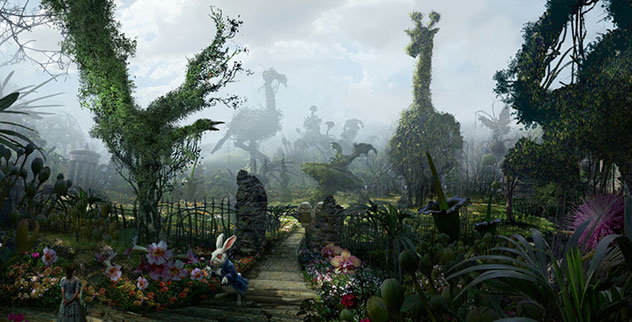
Wonderland, from Lewis Carroll’s Alice’s Adventures in Wonderland, is not a traditional fantasy world with kingdoms, histories, and maps. It is a machine for breaking logic. Alice falls down a rabbit hole and enters a place where size changes, language misbehaves, authority is ridiculous, and a tea party can become an existential crisis with snacks.
Wonderland’s importance comes from its refusal to behave. It turns childhood confusion into landscape. Adults make arbitrary rules. Words mean too much or too little. Time gets offended. Courts are nonsense. Queens shout before thinking. In other words, Wonderland is surreal fantasy and also a surprisingly accurate meeting agenda.
Carroll’s world influenced fantasy, children’s literature, surrealism, absurdist humor, and popular culture. Unlike epic fantasy realms, Wonderland does not ask readers to believe in a coherent alternate reality. It asks them to enjoy the collapse of coherence. That makes it one of literature’s boldest imaginative spaces: unstable, funny, unsettling, and endlessly quotable.
9. The Multiverse of His Dark Materials Philip Pullman
Philip Pullman’s His Dark Materials builds a fantasy multiverse where parallel worlds, armored bears, witches, daemons, theology, science, and childhood rebellion collide. The world of Lyra Belacqua begins with a version of Oxford that is familiar yet altered, then opens into an enormous structure of connected realities.
The most brilliant invention is the daemon: an external animal companion that reflects a person’s inner self. This single idea changes everything about identity, intimacy, childhood, and fear. A child’s daemon shifts forms; an adult’s daemon settles. That detail alone carries more emotional power than many entire magic systems.
Pullman’s fantasy world stands out because it fuses adventure with intellectual ambition. Questions about authority, consciousness, knowledge, free will, and spiritual control are built into the setting itself. The result is not cozy escapism but dangerous wonder. These worlds invite curiosity, and then they make curiosity revolutionary.
10. Roshar Brandon Sanderson
Roshar, the storm-swept world of Brandon Sanderson’s The Stormlight Archive, is one of the most distinctive modern fantasy settings. Its environment is not background decoration; it is the engine of civilization. Highstorms shape ecology, architecture, warfare, trade, religion, and daily survival. Even the grass has learned to hide. Honestly, relatable.
Roshar feels alien because Sanderson designs the world from the ground up. Plants retract, animals grow shells, gemstones hold magical energy, and ancient orders of Knights Radiant connect personal oaths to supernatural power. The magic system is intricate, but its emotional core is simple: broken people can still choose honor, growth, and responsibility.
Roshar’s inclusion among the top fantasy worlds in literature reflects how modern epic fantasy has evolved. Readers now expect not only maps and battles but ecological logic, cultural complexity, mental health themes, and systems that connect plot, character, and environment. Roshar delivers all of that with storms loud enough to rearrange your afternoon plans.
What Makes These Fantasy Worlds So Powerful?
They Have Rules
A great fantasy world can be magical, but it cannot be random. Middle-earth has linguistic and mythic foundations. Earthsea has true names and balance. Roshar has storms, spren, gemstones, and oaths. Even Wonderland, which seems proudly chaotic, follows the rules of nonsense. Readers trust fantasy when its impossibilities feel consistent.
They Reflect Human Problems
The best fantasy worlds are not escapes from reality; they are new angles on it. Westeros explores political violence and ambition. Discworld turns social systems into comedy. Narnia dramatizes courage and faith. His Dark Materials challenges authority and celebrates intellectual freedom. Fantasy works because dragons are rarely just dragons. Sometimes they are fear, greed, empire, trauma, or the author’s polite way of saying, “Please examine civilization.”
They Invite Readers to Belong
Readers return to fantasy worlds because they offer belonging. Hogwarts has houses. Middle-earth has fellowships. Narnia crowns children. Earthsea gives names weight. Oz gives misfits a road. These worlds make readers feel that the ordinary self could step through a door and matter.
A Reader’s Experience: Why Fantasy Worlds Stay With Us
Reading the greatest fantasy worlds in literature is not only an intellectual experience; it is a personal one. Many readers first discover fantasy at an age when the real world feels confusing, oversized, and badly explained. Then a book opens, and suddenly confusion has a map. Fear has a monster. Hope has a sword, a wand, a ship, a lion, a dragon, or at the very least a road made of yellow bricks.
One of the most powerful experiences of reading fantasy is the feeling of crossing a threshold. The wardrobe opens. The rabbit hole drops. The train leaves from a hidden platform. The ship sails into Earthsea. These moments train readers to believe that ordinary life may contain secret doors. That belief can be surprisingly durable. Years later, a reader may know perfectly well that the closet contains only winter coats and one questionable scarf, yet some small part of the imagination still checks for snow.
Fantasy worlds also help readers rehearse courage. In real life, courage is often quiet: apologizing, starting over, telling the truth, leaving a bad situation, protecting someone weaker, or continuing when no one applauds. Fantasy makes courage visible. Frodo walks toward Mordor. Ged faces the shadow he released. Lyra refuses easy obedience. Harry returns to danger because love demands it. These stories do not remove fear; they show characters moving with fear beside them.
There is also comfort in returning to a well-built fantasy world. Re-reading The Lord of the Rings can feel like visiting old friends at an inn where someone has already saved your chair. Returning to Discworld feels like walking into a joke that somehow understands politics better than the evening news. Narnia offers the clean air of childhood wonder. Earthsea offers quiet wisdom. Oz offers color after grayness. Each world becomes a room in the reader’s inner house.
Fantasy can also sharpen taste. After spending time in carefully built worlds, readers begin to notice lazy world-building elsewhere. They ask better questions: How does this economy work? Who grows the food? Why does everyone speak the same language? Who benefits from this prophecy? Why is the ancient sword always conveniently nearby? Great fantasy worlds make readers smarter because they reward curiosity.
Most importantly, these worlds stay with us because they turn imagination into memory. Nobody has actually attended Hogwarts, sailed with Ged, or survived a Small Council meeting in King’s Landing, and yet readers remember these places with emotional clarity. That is literature’s marvelous little con: invented worlds can become real experiences. They do not exist on Earth, but they exist in readers, which is sometimes the stronger address.
Conclusion: The Best Fantasy Worlds Are Built to Last
The top fantasy worlds in literature endure because they are more than impressive scenery. They create systems of meaning. Middle-earth gives us mythic depth. Narnia gives us wonder. Earthsea gives us balance. Discworld gives us laughter with teeth. The Wizarding World gives us hidden magic. Westeros gives us political consequence. Oz gives us American fairy-tale color. Wonderland gives us glorious nonsense. His Dark Materials gives us philosophical adventure. Roshar gives us modern epic design shaped by storm and oath.
Together, these worlds show the full range of fantasy literature. A fantasy world can be solemn, comic, spiritual, political, surreal, cozy, terrifying, or all of the above before breakfast. What matters is not how many kingdoms appear on the map, but whether readers feel the world pushing back. The best fantasy worlds do exactly that. They challenge heroes, seduce imaginations, and leave readers slightly disappointed that reality has fewer dragons and much worse public transportation.
Note: This ranking balances literary influence, originality, world-building depth, cultural staying power, and the lasting reader experience created by each fantasy world.
SEO Tags

