
Body Care
Universe Surprises Scientists With Rapid Expansion
Aug
The universe has a timing problem. It is not late for a meeting, and it has not misplaced its cosmic wristwatch. Instead, astronomers using different methods to measure the expansion of space keep obtaining answers that do not fit neatly together.
Observations of nearby stars and galaxies often suggest that the modern universe is expanding faster than scientists would predict from measurements of the early cosmos. This disagreement is known as the Hubble tension, and it has become one of the most closely watched mysteries in modern cosmology.
The situation became even more intriguing when the James Webb Space Telescope sharpened measurements previously made by Hubble, the Dark Energy Spectroscopic Instrument mapped millions of galaxies, and gravitational-wave observatories offered an entirely different cosmic measuring tool. Meanwhile, other researchers reported values that may reduceor possibly eliminatethe disagreement.
In other words, the universe has not handed scientists a simple surprise. It has handed them a box of surprises, removed the instruction manual, and watched everyone argue over the batteries.
What Does “Rapid Expansion” Actually Mean?
The universe is expanding because space itself is stretching. Galaxies that are not gravitationally bound generally become farther apart as the cosmic fabric grows. They are not necessarily racing through space like debris from an explosion; the distance between them increases because the geometry of space changes.
The present expansion rate is represented by the Hubble constant, commonly written as H0. Its units are kilometers per second per megaparsec. A megaparsec is roughly 3.26 million light-years.
Suppose the Hubble constant were 70 kilometers per second per megaparsec. A galaxy one megaparsec away would participate in cosmic expansion at approximately 70 kilometers per second. A galaxy 100 megaparsecs away would recede at roughly 7,000 kilometers per second, ignoring local motions and other complications.
This does not mean Earth, the solar system, or the Milky Way is stretching like warm cheese. Gravity and other forces hold smaller systems together. Cosmic expansion becomes noticeable across the enormous distances between galaxies and galaxy clusters.
Scientists also distinguish between the current expansion rate and the acceleration of expansion. The discovery that cosmic expansion is accelerating led to the concept of dark energy, which is estimated to account for about 70% of the universe’s total mass-energy content. Its true nature remains unknown, which is science-speak for “we gave it a name, but the name did not solve the problem.”
The Two Cosmic Measuring Systems That Disagree
The Hubble tension arises because researchers can calculate the expansion rate in two fundamentally different ways.
Method One: Reconstructing Expansion From the Early Universe
The first method studies the cosmic microwave background, or CMB. This ancient radiation was released when the universe was approximately 380,000 years old. By measuring tiny variations in its temperature and polarization, scientists can estimate the universe’s original ingredients and calculate how it should have evolved under the standard cosmological model.
Measurements from the Planck satellite and the Atacama Cosmology Telescope generally produce a Hubble constant near 67 to 68 kilometers per second per megaparsec. The Atacama Cosmology Telescope reported a value of approximately 67.6 and an estimated cosmic age of about 13.77 billion years, closely agreeing with Planck.
Method Two: Building a Cosmic Distance Ladder
The second method measures the modern universe more directly. Astronomers construct a cosmic distance ladder, beginning with nearby objects whose distances can be measured geometrically.
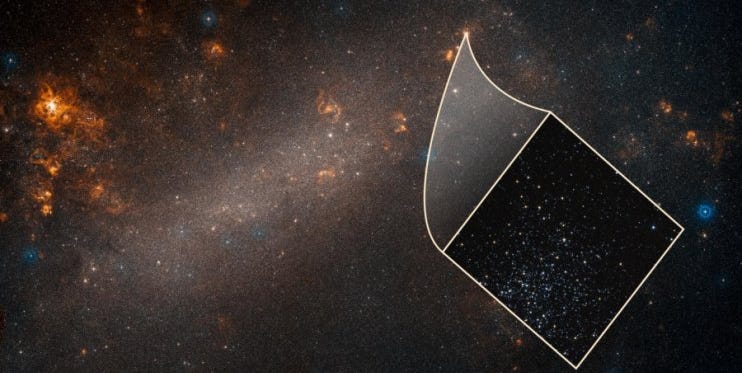
They then calibrate pulsating stars called Cepheid variables. A Cepheid’s pulsation period reveals its intrinsic brightness. By comparing that true brightness with how faint the star appears from Earth, astronomers can calculate its distance.
Cepheids are used to calibrate Type Ia supernovae, stellar explosions bright enough to be observed in far more distant galaxies. Researchers compare the distances of those galaxies with their redshiftsthe stretching of their light caused by cosmic expansionto calculate H0.
Many distance-ladder measurements fall between roughly 70 and 76 kilometers per second per megaparsec. Some of the most precise Cepheid-based analyses have clustered near 73. That may not sound dramatically different from 67 or 68, but the uncertainties have become small enough for the gap to matter.
JWST Checked Hubble’s Homework
One possible explanation for the Hubble tension was that crowded stars had confused the Hubble Space Telescope. In distant galaxies, a Cepheid can appear blended with neighboring stars. That extra light might make the Cepheid look brighter and therefore closer than it really is, potentially pushing the calculated expansion rate upward.
The James Webb Space Telescope offered a powerful test. Webb observes at infrared wavelengths, sees through much of the obscuring dust, and can separate crowded stars more effectively.
In a study announced in 2024, Webb observations covered five galaxies hosting eight Type Ia supernovae and included approximately 1,000 Cepheids. The sample extended to NGC 5468, about 130 million light-years away. Webb’s sharper images agreed with Hubble’s Cepheid measurements, strengthening the argument that stellar crowding was not creating the entire discrepancy.
That result did not automatically prove that new physics was responsible. It did, however, make one popular source of measurement error less convincing. The cosmic mystery survived its eye exam.
Not Every Measurement Finds a Crisis
Cosmology rarely provides a tidy plot twist. While one research program finds a persistent tension, another may obtain a value that sits comfortably between the competing camps.
In 2025, a team led by University of Chicago astronomer Wendy Freedman combined Hubble and Webb observations using multiple stellar distance indicators. The analysis produced a Hubble constant of approximately 70.4 kilometers per second per megaparsec, with an uncertainty of about 3%.
That value is statistically compatible with the CMB result near 67.4. Freedman’s team therefore reported no compelling evidence that the standard cosmological model fails because of H0.
The apparent contradiction reflects differences in calibration methods, stellar samples, statistical treatments, and distance indicators. Cepheids are not the only stars available. Researchers also use the tip of the red giant branch and carbon-rich J-region asymptotic giant branch stars. Each method has advantages and its own collection of small but stubborn uncertainties.
Consequently, scientists cannot yet declare either “new physics discovered” or “mystery solved.” The more accurate conclusion is that measurements have improved enough to expose disagreements that were once hidden inside large error bars.
DESI Introduces Another Cosmic Surprise
The expansion-rate debate concerns how fast the universe is growing today. DESI examines a related question: How has that expansion changed throughout cosmic history?
The Dark Energy Spectroscopic Instrument measures the spectra and redshifts of galaxies and quasars. It uses features called baryon acoustic oscillations as a cosmic ruler. These features originated as pressure waves in the young universe and later became imprinted in the distribution of matter.
DESI’s three-year analysis covered nearly 15 million galaxies and quasars and traced dark energy’s influence across approximately 11 billion years. DESI data by themselves remained compatible with the standard Lambda Cold Dark Matter model, commonly abbreviated as Lambda-CDM.
However, when researchers combined DESI with CMB measurements, supernova observations and weak gravitational lensing data, the results increasingly favored models in which dark energy changes over time. Depending on the combination of datasets, the statistical preference ranged from about 2.8 to 4.2 sigma.
That is exciting, but it does not meet physics’ traditional five-sigma discovery threshold. It is a serious hint, not a champagne-opening announcement. The universe may be changing the strength or behavior of dark energy, or researchers may be seeing subtle inconsistencies among complex datasets.
Could Dark Energy Be Evolving?
In the standard model, dark energy is represented by Einstein’s cosmological constant, Lambda. Its energy density remains constant as the universe expands. Matter becomes more diluted, but dark energy does not, allowing it to dominate the cosmos at relatively late times.
An evolving form of dark energy would behave differently. The pressure and density associated with it could change over cosmic time. Theories involving a dynamic field are often grouped under labels such as quintessence, although many specific models exist.
If dark energy is evolving, the long-term fate of the universe could differ from current expectations. Expansion might continue accelerating, acceleration might weaken, or cosmic behavior could become more complicated. Scientists are nowhere near confidently predicting a dramatic reversal or collapse, despite what an enthusiastic headline might suggest.
The DESI results are especially valuable because the project has created the largest three-dimensional map of the universe yet assembled. By April 2026, DESI reported mapping more than 47 million galaxies and quasars, exceeding its original observing target, along with millions of Milky Way stars. Continued observations are intended to improve the precision of its expansion-history measurements.
Possible Explanations for the Hubble Tension
1. Hidden Measurement Systematics
The least dramatic explanation is that one or more measurements contain a small systematic effect. Dust, stellar metallicity, detector calibration, supernova environments, crowding and sample selection can all influence distance estimates. CMB-based calculations also depend on assumptions built into the cosmological model.
Scientists take these possibilities seriously because a tiny bias can matter when the target precision is near 1%. Cosmic accounting becomes unforgiving when the decimal places start demanding legal representation.
2. Early Dark Energy
Some theories propose a temporary contribution from dark energy before the cosmic microwave background was released. This could change the inferred scale of early-universe features and allow CMB observations to support a higher modern expansion rate.
The challenge is that any new component must resolve the Hubble tension without ruining the standard model’s successful predictions for galaxy clustering, element formation and the detailed structure of the CMB.
3. New Particles or Radiation
Unknown light particles, unusual neutrino behavior or additional forms of radiation could have altered the early universe’s expansion. Such proposals are testable because they would leave signatures in the CMB, large-scale structure and primordial element abundances.
4. Modified Gravity
General relativity has passed an impressive range of tests, but researchers continue exploring whether gravity behaves differently over enormous cosmic distances. A modified theory might affect the inferred expansion history or the way structures grow.
5. Local Cosmic Environment
Another suggestion is that the Milky Way resides in a relatively underdense region. A local “void” could make nearby galaxies appear to recede faster. Most analyses indicate that a realistic local underdensity is unlikely to explain the full disagreement, but environmental effects remain part of the error budget.
Gravitational Waves Provide an Independent Ruler
Merging neutron stars and black holes generate gravitational waves whose signals reveal their distance. These events are known as standard sirens, a sonic cousin of the standard candles used in traditional astronomy.
When researchers can estimate the source’s redshifteither by identifying its host galaxy or statistically evaluating possible galaxiesthey can calculate the Hubble constant without relying on Cepheids or the conventional distance ladder.
Results released with an expanded LIGO-Virgo-KAGRA catalog in 2026 produced an independent estimate near 76 kilometers per second per megaparsec. The uncertainty remains broad, so the result cannot yet choose between the major competing values. Its power lies in independence: gravitational waves involve different instruments, assumptions and sources of error.
As the number of detected mergers increases, standard-siren measurements should become substantially more precise. The universe may eventually settle an argument about light by making space-time ring like a bell.
A New Generation of Observatories Is Taking Over
The next stage of the investigation will combine multiple surveys rather than depending on a single telescope or technique.
The Vera C. Rubin Observatory officially began its 10-year Legacy Survey of Space and Time on June 30, 2026. By repeatedly scanning the southern sky, Rubin will discover enormous numbers of supernovae and measure weak gravitational lensing, galaxy clustering and changes across the night sky.
NASA’s Nancy Grace Roman Space Telescope was targeting launch no earlier than August 30, 2026, according to NASA updates available in July 2026. Roman will combine Hubble-like infrared resolution with a field of view at least 100 times larger. Its planned surveys will find tens of thousands of Type Ia supernovae and examine expansion across a much longer stretch of cosmic history.
Roman, Rubin, DESI, Webb, gravitational-wave observatories and CMB experiments will overlap in powerful ways. A result that appears in several independent datasets will be much harder to blame on dust, calibration or one unusually temperamental family of stars.
The Experience of Following a Universe That Refuses to Be Simple
Learning about rapid cosmic expansion can be a strangely personal experience. At first, the numbers seem almost meaningless. Whether the Hubble constant is 67, 70 or 73 may appear about as consequential as debating whether an imaginary highway has a speed limit of 67 or 73 miles per hour.
Then the scale becomes clear. The number influences estimates of cosmic history, the calibration of astronomical distances and tests of the physical model used to describe the entire observable universe. A small numerical difference can signal a missing ingredient in humanity’s understanding of nature.
A useful way to experience the concept is to imagine dots drawn on the surface of an inflating balloon. As the balloon expands, every dot sees the others moving away. More distant dots separate faster because more expanding surface lies between them. There is no special dot at the center of the two-dimensional surface.
The analogy is imperfectthe real universe is not necessarily expanding into an external room, and galaxies do not live on rubberbut it creates an important mental shift. Expansion is not simply matter flying away from one explosion site. It is a change in the scale of space.
The next surprise arrives when looking at real astronomical images. A Hubble or Webb picture may contain thousands of galaxies, each appearing frozen in place. Nothing seems to be moving. Yet the wavelengths of their light preserve a history of expansion that has been accumulating for millions or billions of years.
Following the Hubble tension also teaches a valuable lesson about scientific disagreement. Researchers are not arguing because one group “believes in” a fast universe and another prefers a slow one. They are comparing calibration systems, statistical assumptions, stellar populations and physical models. Two careful analyses can reach different conclusions without either team behaving carelessly.
This can feel frustrating to readers accustomed to instant answers. One study says Webb strengthens the tension. Another says Webb helps resolve it. DESI hints that dark energy evolves, but the evidence is not yet strong enough to count as a discovery. Gravitational waves offer independence, but their current uncertainty is too large to serve as referee.
That uncertainty is not a failure. It is the experience of science operating near the edge of available precision. Researchers publish methods, test one another’s calibrations, enlarge samples and build instruments specifically designed to expose hidden errors. The disagreement becomes productive because it tells scientists where to look next.
There is also something humbling about realizing that the expansion of the universe is reconstructed from flickering stars, ancient microwave radiation, distorted galaxy shapes and ripples generated by colliding black holes. No single observer watches space expand directly. Instead, humanity assembles the story from cosmic evidence arriving across different wavelengths and messengers.
For amateur stargazers, the mystery can change the experience of looking upward. A distant fuzzy galaxy is no longer merely a decorative smudge. Its light is a timestamp. Its redshift records the growth of space, while its position contributes to maps that may reveal whether dark energy is constant.
The most memorable lesson is that improved technology does not always make nature simpler. Better telescopes sometimes remove uncertainty, but they can also reveal that an old agreement was only approximate. Precision turns small inconsistencies into major questions.
That is why the rapid expansion story remains so engaging. The universe is not surprising scientists by breaking a clearly established speed limit. It is surprising them because several excellent cosmic speedometers are producing answers that overlap imperfectlyand because the force driving accelerated expansion may be more dynamic than expected.
Conclusion: The Universe Has Not Delivered Its Final Answer
The phrase “the universe is expanding faster than expected” captures a genuine scientific puzzle, but it should not be mistaken for a final verdict. Cepheid and supernova measurements frequently favor a comparatively high present-day expansion rate. CMB observations favor a lower value derived from the early universe. Some Webb analyses reinforce the discrepancy, while other carefully calibrated programs find intermediate values that reduce its statistical importance.
DESI has added another layer by finding increasingly interesting hints that dark energy may evolve over time. Gravitational waves are introducing an independent measurement system, and the Rubin and Roman observatories will supply vast new datasets.
The outcome could be an overlooked systematic error, a refined version of the standard model or the discovery of new physics. All three possibilities would be scientifically valuable. Even finding a calibration problem would improve the cosmic distance scale and strengthen future measurements.
For now, scientists know that the universe is expanding and that this expansion is accelerating. What they do not yet know is whether today’s measurement disagreements are cracks in the foundation of cosmology or simply gaps that remain in some extraordinarily difficult observations.
Either way, the universe has succeeded in keeping the smartest people on Earth busyand it did so without sending a single calendar invitation.
Note: Cosmological measurements remain an active area of research. Numerical estimates and observatory schedules in this article reflect publicly available findings and mission updates through July 24, 2026.

