
Beauty Unlocked
This Armored Personnel Carrier Is Getting Made Over Into a Boat
Aug
Some vehicles retire quietly. Others get auctioned, forgotten, or left to rust behind a fence where weeds slowly win. And then there is the overachiever in this story: an armored personnel carrier that looked at retirement and apparently decided it would rather become a boat.
Yes, a boat. Not a metaphorical one. Not a “floating money pit” kind of boat. An actual, water-going machine built from a Cold War-era armored personnel carrier. If that sounds like the sort of fever dream you’d have after reading too many military history forums at 2 a.m., welcome aboard.
The fascination here is obvious. Big machine. Strange idea. Strong “because why not?” energy. But underneath the novelty is a surprisingly revealing story about amphibious design, wartime improvisation, military surplus culture, and the weirdly durable appeal of vehicles that refuse to stay in their original lane. Or in this case, their original battlefield.
The Viral Conversion That Made Everyone Do a Double Take
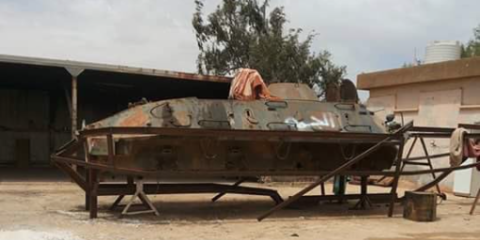
The vehicle at the center of the buzz was reported as a former Libyan Army BTR-60PB, a Soviet-designed armored personnel carrier. In the now-famous image, the machine appeared to be sitting in a work area in Derna, Libya, with its wheels removed and a new hull shape being formed around or beneath it. That was enough to trigger equal parts engineering curiosity and internet disbelief.
To be fair, disbelief is a perfectly reasonable first response. The BTR-60PB is already an amphibious armored vehicle. It was designed to move across land and water, which means the obvious question practically asks itself: if an armored personnel carrier can already swim, why go to the trouble of turning it into more of a boat?
That question is exactly what makes the story interesting. Because the answer is not “people are irrational.” Well, not only that. The real answer is that military amphibious vehicles and practical boats are not the same thing, even when both can technically float.
The BTR-60PB Was Already Amphibious, But That Doesn’t Mean It Was a Good Boat
The BTR-60PB belongs to a long line of armored vehicles built to do a compromise-heavy job: protect personnel, move over rough terrain, and cross water when necessary. It is an eight-wheeled armored personnel carrier with a fully amphibious design, a water-jet system at the rear, and a hull shaped to survive short water crossings. That makes it useful in military terms. It does not magically make it a pleasant, roomy, efficient, or stable civilian-style vessel.
Think of it this way: a military amphibious vehicle is like a man showing up to a wedding in hiking boots because he also wants to climb a mountain later. Technically prepared? Sure. Ideally dressed for either setting? Not exactly.
The BTR’s original mission was not coastal leisure cruising, cargo hauling, or improvised maritime transport. It was to move troops through dangerous terrain and survive battlefield conditions long enough to get the job done. Its shape, weight distribution, access points, internal layout, and propulsion all reflect those priorities. Even when these vehicles float, they do so as armored compromises.
Why “Amphibious” Is Not the Same as “Seaworthy”
This is where the makeover starts making more sense. A purpose-built boat usually wants buoyancy, balance, freeboard, efficiency, easier maintenance, and practical space for cargo or passengers. An armored personnel carrier wants protection, compactness, traction, and battlefield mobility. Those goals overlap only a little.
So even though the BTR-60PB can enter water under the right conditions, adding a larger hull could serve several practical goals. It might improve buoyancy. It might increase stability. It might create more usable interior or deck space. It might make loading easier. It might also be aimed at turning the vehicle into a rough patrol craft, a utility shuttle, or a strange hybrid workboat in a place where available resources matter more than elegant design.
No official spec sheet exists for this one-off conversion, so any deeper motive has to remain analysis rather than certainty. But the visible logic is clear enough: somebody looked at an available armored hull and decided it was more useful as the heart of a maritime Frankenstein than as a wheeled troop carrier.
Why Would Anyone Do This in the First Place?
There are at least four plausible reasons people repurpose military vehicles like this.
1. Availability Beats Purity
In conflict zones and unstable economies, people build with what they have, not with what a design committee in a polished conference room wishes they had. If an old APC chassis is sitting around, a workshop has metalworking capability, and there is a local need for a tough water-capable platform, the conversion starts to look less bizarre and more like practical improvisation.
2. Armor Still Has Value
Even a dated armored hull offers a degree of ruggedness. That does not mean it becomes a perfect naval craft, but it does mean the structure is durable, enclosed, and psychologically intimidating. Sometimes half the value of old military hardware is functional. The other half is that it looks like it means business.
3. The Original Running Gear May No Longer Matter
Once a vehicle’s road mobility is compromised, converting it to a different role can extend its life. Remove the wheels, change the hull, rework propulsion, and suddenly a retired land machine gets a second act instead of becoming scrap.
4. Hybrid Machines Have Always Tempted Tinkerers
Human beings have a long, well-documented weakness for machines that do too much. We love amphibious trucks, flying cars, boat-cars, and tracked things that somehow also paddle. They are inefficient in all the right romantic ways. A converted APC-boat sits squarely in that tradition.
America Knows This Obsession Very Well
This whole idea may feel wildly improvised, but the broader concept has deep historical roots. The United States has spent decades designing, testing, fielding, celebrating, and occasionally regretting amphibious military machines.
From DUKW to Duck Tours
One of the clearest examples is the famous World War II DUKW, the amphibious truck better known as the “Duck.” It was developed at speed to move troops and supplies from ship to shore, and it proved enormously useful. After the war, surplus DUKWs found civilian lives in tourism, transport, and specialty operations.
That postwar second life is important here. Military amphibians have long crossed into civilian use because they combine novelty with practical capability. They can go where normal trucks cannot. They can do jobs normal boats cannot. And they carry the undeniable charisma of a machine that looks like it escaped from a museum while still being fully prepared to splash into a river.
But history also adds a caution label. Wartime amphibious designs often carry serious safety tradeoffs when used outside their original context. A machine that can technically float is not automatically a machine that should be casually repurposed without reengineering, testing, and modern safety standards. That tension between capability and risk has followed amphibious vehicles for generations.
The Marines’ Long Love-Hate Relationship With Amphibious Armor
The U.S. Marine Corps provides another reminder that amphibious armor is one of the hardest categories in vehicle design. For decades, tracked amphibious assault vehicles served as ship-to-shore workhorses. Their mission sounded simple on paper: move Marines from sea to land, then keep supporting operations ashore. In reality, that mission demands a machine that is part armored carrier, part watercraft, and part miracle.
Modern replacements such as the Amphibious Combat Vehicle show that the concept remains strategically important. The whole point is still expeditionary mobility from ship to shore. But modern reporting and official military material also make something else clear: amphibious vehicles are difficult platforms to field, maintain, and operate safely. The history of these machines is full of lessons about surf, weight, buoyancy, maintenance, and unforgiving operating conditions.
Which brings us back to the Libyan conversion. If professional militaries with budgets, test programs, and doctrine treat amphibious armor as a highly specialized challenge, then a one-off APC-to-boat project is either reckless, ingenious, or both. My money is on “both, with a welding torch.”
Old APCs Keep Finding New Jobs
The idea of reusing armored personnel carriers is not unusual by itself. The U.S. Army’s M113, one of the most recognizable APCs ever made, has served for decades and remained relevant far longer than many expected. Variants stayed in service because the basic idea of an armored battlefield taxi was too useful to disappear overnight.
That longevity helps explain why people keep reimagining old military hardware. Armored carriers are rugged, modular-looking, and culturally powerful. Collectors want them. Enthusiasts import them. Militaries refurbish them. Workshops adapt them. Once a vehicle has a strong hull and a reputation for toughness, people start seeing possibilities everywhere.
In some cases, those possibilities are straightforward: museum restoration, parade duty, private collection use, or historical preservation. In others, they are more practical: firefighting conversions, utility roles, support vehicles, or export refurbishments. And sometimes the possibility is simply this: “What if we made it float better and did something weird with it?”
The Engineering Challenge of Turning Armor Into a Better Boat
Anyone tempted to laugh at the conversion should pause long enough to appreciate how hard the job actually is. Making a vehicle float is only the beginning. Making it usable on water is an entirely different challenge.
You have to think about center of gravity, hull sealing, propulsion, corrosion, ventilation, steering response, engine cooling, weight placement, entry and exit, and the all-important issue of whether the craft behaves like a stable vessel or like a metal bathtub with attitude. Military amphibious vehicles solve some of those problems for short crossings. A practical boat has to solve them for an actual life on the water.
There is also the matter of efficiency. Armor is heavy. Military hulls are not shaped for graceful cruising. A converted APC boat is unlikely to be elegant in the hydrodynamic sense. It may pound the water, burn fuel, and steer like a filing cabinet with momentum. Still, engineering is often about acceptable tradeoffs rather than perfection. If the platform performs the intended job well enough, that can be victory.
What the Conversion Really Says
At a glance, this story is catnip for anyone who enjoys strange machinery. Look deeper, though, and it becomes a useful symbol of how military hardware lives beyond its original doctrine.
Weapons and vehicles do not always die when armies are done with them. They drift into scrapyards, side hustles, insurgent workshops, enthusiast communities, tourist operations, museums, local transport hacks, and improvised engineering projects. They become practical again in new and often deeply unplanned ways.
That is especially true for amphibious-adjacent machines. People are naturally drawn to vehicles that cross boundaries: land and water, war and civilian life, official use and backyard improvisation. A retired APC turned into a boat is absurd, yes. But it is also a reminder that humans hate leaving a large machine with unrealized second-career potential.
Human Experience: What It Feels Like When an APC Starts Becoming a Boat
To understand why this story sticks in people’s minds, it helps to step away from specs and think about the sensory experience. Imagine walking into a dusty work yard near the coast and seeing a machine that clearly used to belong on land. The armor is thick, the lines are blunt, and the whole thing looks like it was designed to roll over bad ideas. But then the closer you get, the stranger it becomes. The wheels are gone. The stance is wrong. The silhouette has started to soften into something more nautical. Suddenly the vehicle no longer looks retired. It looks mid-transformation, like a steel animal evolving in public.
That is part of the appeal. Military vehicles usually project finality. They look finished, decisive, and purpose-built. A conversion project reveals the opposite. It shows the machine as raw material. The APC stops being a symbol of doctrine and starts looking like a giant toolbox with armor plating. Every cut mark, weld seam, support stand, and hull plate tells you that somebody looked at this machine and saw possibility rather than destiny.
There is also a kind of emotional whiplash in the idea. Armored personnel carriers are associated with dust, noise, vibration, and harsh ground movement. Boats suggest rolling water, slower motion, spray, tide, and shoreline work. Putting those two worlds together creates a mental short circuit. You can almost hear the clash of identities: one part battlefield taxi, one part improvised harbor creature.
And yet, the experience is not purely comic. There is something deeply human in the act of refusing to waste a formidable object. Around the world, people repurpose old trucks into farm machines, buses into homes, shipping containers into shops, and military equipment into tools that fit local needs. A converted APC-boat belongs to that same instinct. It says that usefulness can be rescued from obsolescence if the people doing the work are stubborn enough.
Even for someone who has never driven or ridden in an armored vehicle, the story lands because it feels tactile. You can picture the heat trapped in the metal, the oily smell of an old engine compartment, the shriek of cutting tools, and the heavy thud of steel plates being moved into place. You can imagine the first nervous launch too: the pause at the shoreline, the half-second where everyone silently reviews their life choices, and then the splashy revelation of whether the machine is a triumph, a joke, or both.
That first launch is really the emotional center of the whole idea. A normal boat launch is routine. Launching a former armored personnel carrier that has been reworked into a boat is theater. It is engineering, improvisation, vanity, and optimism all at once. Everyone watching knows the same thing: if it works, the machine earns a legend. If it fails, it still earns a story.
And that is probably why the image has such staying power. It is not just a strange vehicle. It is a visible record of human problem-solving at its most eccentric. It captures the moment when a machine built for one world gets dragged, welded, and nudged into another. In an era full of sleek technology and polished design language, there is something refreshing about a project that basically says, “We had an old APC, some metal, and an idea. Stand back.”
Conclusion
This armored personnel carrier getting made over into a boat is funny at first glance, but it also tells a bigger story. The BTR-60PB was already an amphibious machine, yet someone still saw value in reshaping it into something more water-oriented. That choice highlights the gap between “can float” and “works well as a boat,” while also showing how military hardware keeps finding strange new lives long after its original mission fades.
In that sense, the conversion is more than a meme-worthy oddity. It is a case study in improvisation, surplus culture, and the irresistible human urge to make old machines do one more impossible thing. Sometimes the result is elegant. Sometimes it is chaotic. And sometimes it is an armored personnel carrier trying out a nautical glow-up.

