
Skincare
Each Of My Mandalas Is Designed For A Particular Baby, And Here Are My Latest 38 Photographs From The Series: “The Kids Of The Sun”
Aug
Some newborn photos whisper, “Aww.” These ones sing, “Aww… with a full orchestra… and a tiny conductor who just discovered their own toes.”
In the Bored Panda feature titled “Each Of My Mandalas Is Designed For A Particular Baby… ‘The Kids Of The Sun’”, photographer and mandala-maker
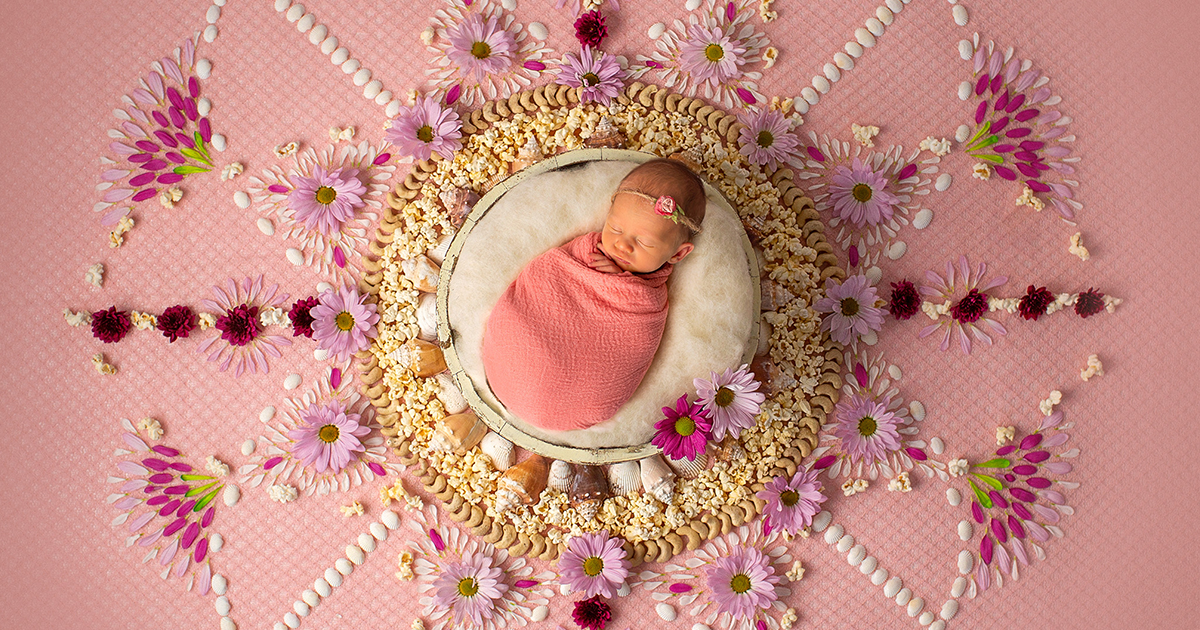
Gabriele Dabasinskaite places newborns right at the center of elaborate, handmade mandalaslike the baby is the sun and the props are the
universe politely rotating around them.
The hook isn’t just cuteness (although, yes, the cuteness is doing push-ups). It’s the idea that each mandala is custom-designed for a specific baby and family.
Every setup becomes a one-time “tiny mythology”: colors, textures, natural objects, seasonal details, and sometimes playful everyday items arranged into a precise
circlethen finished by the calmest human on set: a sleeping newborn.
Meet the artist behind “The Kids of the Sun”
In the Bored Panda post, Dabasinskaite describes herself as a professional photographer who has been creating mandalas and photographing newborns in their center
for nearly a decade. She also shares that her first exhibition was titled “The Kids Of The Sun” (2019), followed by another exhibition in 2022 called
“The Search Of The Inner Child.” She frames her process as deeply personalsomething that feels like therapy and meditationwhere the baby becomes
the centerpiece of a carefully built visual “puzzle.”
On her photography site, she expands on what the title means to her: the sun as a symbol of warmth, love, hope, protection, and the wish for a baby’s future.
The mandala-making itself is described as patient, delicate workoften built close to session time so materials stay freshand completed only after the baby is
safely placed at the center.
What’s a mandala, anyway?
“Mandala” comes from traditions where circles aren’t just shapesthey’re symbols. In Hindu and Buddhist contexts, mandalas are often described as
symbolic diagrams used in sacred rites and meditation, representing an ordered universe or a consecrated space. In other words: a mandala isn’t “just a pretty circle.”
It’s a visual way to say, “Everything belongs somewhere, and the center matters.”
Museums that work closely with Asian art explain that Tibetan Buddhist sand mandalas, for example, are created through ritual and concentration and are traditionally
dismantled after completionan intentional reminder of impermanence. That detail matters here because Dabasinskaite’s newborn mandalas also have a built-in fleetingness:
flowers wilt, colors fade, babies grow overnight (sometimes literally while you blink), and the exact arrangement can never be repeated.
Why put a newborn in the middle?
The center is where your eyes go (and your feelings follow)
Composition-wise, this is visual gravity. Radial symmetry naturally drags your gaze inward. With a newborn at the center, the image becomes instantly readable:
“This is the star. Everything else is supporting cast.” That’s why the photos feel both calm and dramaticcalm because circles and symmetry soothe, dramatic because
the subject is literally framed as the core of a universe.
There’s also a real-world, baby-brain reason
Infants’ vision develops rapidly during the first year, and early on they do best with close distances and simple, high-contrast visuals. Many pediatric vision resources
note that newborns are drawn to high-contrast patterns (think bold shapes and clear edges). A mandalaespecially one with distinct repeating shapescreates exactly
the kind of strong visual structure that’s easy for developing eyes to “grab.”
That doesn’t mean a newborn is critiquing the design like an art-school professor. It means the set’s visual clarity can feel satisfying to everyone:
baby (who likes bold patterns), parents (who like meaning), and viewers (who like symmetry plus baby cheeks).
How these mandala newborn sets come together
According to the Bored Panda description, Dabasinskaite draws heavily from nature and uses mostly natural piecesleaves, sea shells, stones, flowersto build
patterns. She also mentions adding food elements or handmade paper decorations, and incorporating seasonal details. The result is less “Pinterest prop pile” and more
“tiny ecosystem arranged with the patience of someone who has definitely learned to breathe through chaos.”
If you’re trying to imagine what “38 photographs” might look like without reposting the images, think in themes. A mandala series like this often cycles through motifs such as:
- Seasonal storytelling: autumn leaves, spring blossoms, summer brightness, winter textures.
- Nature palettes: beachy shells and sand tones; forest greens and bark textures; floral gradients.
- Family nods: subtle hints of hobbies, traditions, favorite colors, or meaningful symbols.
- Playful surprises: occasional everyday items (including foods) arranged into a pattern that still feels intentional, not random.
The key point is customization. Dabasinskaite emphasizes that each setup is unique and designed for the specific family she’s working with at the timeso the mandala isn’t a template.
It’s closer to a bespoke set design, just with more petals and fewer deadlines (okay, still deadlinesnewborns run on a schedule called “Now.”).
Safety is not optional (and it should be part of the aesthetic)
Newborn photography can be beautiful, but it’s also a space where safety standards matter more than vibes. Pediatric safe-sleep guidance emphasizes firm, flat surfaces,
placing babies on their backs for sleep, and keeping soft objects out of the sleep spaceprinciples that should influence any newborn setup, even when the baby is awake
and supervised. U.S. consumer safety guidance has also reinforced how risky angled or cushioned surfaces can be for infants.
Health experts have repeatedly warned that amateur newborn photography can introduce hazards if babies are posed without proper support, supervision, or training.
Responsible newborn photographers often rely on a “spotter” (an adult within arm’s reach) and may use composite images for any pose that would be unsafe if attempted in a single shot.
Bottom line: the goal is a peaceful-looking photo, not a baby doing advanced yoga.
If you’re a parent booking a session, it’s completely fair to ask:
- How is the baby supported at all times?
- Is a spotter present for every setup?
- Which poses are composites (and which are avoided entirely)?
- How are props sanitized and kept away from the baby’s face/airway?
- What’s the plan if baby shows discomfort or stress cues?
Why the internet loves “The Kids of the Sun” (and why it works)
Bored Panda readers tend to reward work that’s both skillful and instantly understandable. This project hits a rare combo:
artistry (hand-built mandalas), craftsmanship (materials and symmetry), emotional punch (newborns), and novelty (the baby-as-center-of-the-universe concept made literal).
It also doesn’t require insider knowledge. You don’t have to know the history of mandalas to feel what the images communicate:
“This baby is precious. This moment is brief. Someone cared enough to build a whole world for it.”
How to plan a mandala-inspired newborn session
1) Pick a story that actually belongs to your family
The best custom setups aren’t “trendy”they’re specific. A color palette from a nursery mural. A season you waited for. A quiet symbol that matters to grandparents.
Even a simple theme (ocean, garden, sunrise) can become deeply personal when it’s connected to a real memory.
2) Keep the design readable
Mandalas work because they’re organized. Too many tiny items can turn “sacred geometry” into “craft-store explosion.”
A strong design usually has a clear center, repeating shapes, and a limited palette with one or two accent colors.
3) Plan around baby reality, not adult ambition
Newborn sessions typically include feeding breaks, soothing, and plenty of time for settling. A good photographer expects pauses and builds the workflow around them.
If the baby is awake, the photographer adapts. If the baby won’t tolerate a setup, the setup losespolitely.
4) Prioritize safety questions early
Ask about surfaces, spotting, sanitation, temperature control, and whether any complex poses are done as composites (or not offered).
A professional will welcome these questions. If someone gets defensive, that’s your cue to choose someone else.
DIY: Mandala vibes without a full photoshoot
Want the spirit of the project without recreating a professional newborn setup? Here are safer, simpler options:
- Memory mandala art: make a mandala collage using printed photos, nursery colors, or symbolic paper elementsno baby in the middle required.
- High-contrast “mandala cards”: bold, simple circular patterns (black/white or strong contrast) as a visual stimulation activityused safely and supervised.
- Photo book storytelling: pair a newborn portrait with a mandala illustration inspired by your family’s story.
Frequently asked questions
Is it okay to use mandala imagery if you’re not from the originating cultures?
Respect matters. Mandalas have deep roots in spiritual traditions. If you’re borrowing the visual language, it helps to acknowledge the origins,
avoid trivializing sacred symbols, and focus on appreciation rather than costume-like imitation. Many modern artists also use “mandala-inspired” geometry in a secular way;
the difference is care, context, and credit.
Do babies need to be asleep?
Not necessarily. A sleeping newborn can make posing and timing easier, but awake images can be wonderful too (and rarer).
The goal isn’t “perfect stillness.” It’s comfort and safetyeverything else is a bonus.
Can I try this at home?
If “this” means “a complex prop-heavy setup with tiny items,” no. If “this” means “a simple overhead photo of baby on a firm, flat surface with a caregiver within reach,”
you can do a minimal versionkeeping everything away from the baby’s face, skipping loose items, and stopping the moment baby shows distress.
When in doubt, choose simpler and safer.
Final thoughts
“The Kids of the Sun” isn’t just a collection of pretty newborn photos. It’s a reminder that art can be both playful and serious at the same time:
playful in color and texture, serious in intentionbecause building a one-time universe around a new life is basically what families do anyway.
Dabasinskaite simply makes that idea visible, one mandala at a time.
Extra: Real-world experiences from mandala-style newborn shoots (about )
People who book highly customized newborn sessions often describe the same surprising thing afterward: the photos are wonderful, but the process becomes part of the memory.
With mandala-style setups, that feeling tends to intensify, because there’s a visible “before” and “after.” Before: a carefully arranged circle of materials that looks like a still life.
After: the baby is placed at the center and the whole design suddenly reads as a story.
Parents frequently say the most emotional moment is seeing the set completedespecially when the photographer has woven in small personal details. It might be a color that matches a nursery wall,
a seasonal nod (first autumn baby, first spring baby), or a symbolic touch that reflects a family’s hope for the child. Even when those details look subtle on camera,
they feel huge in the room. That’s the quiet magic of customization: it doesn’t shout; it lands.
Photographers who create this kind of work often talk about the “two-speed” nature of a session. The set-building is slow and methodicalplacing petals, balancing symmetry, stepping back,
adjusting a pattern by a quarter-inch because the circle knows when you’re lying. Then the baby portion is fast in short bursts: a careful placement, a few frames,
a check for comfort, a pause. The shoot becomes a rhythm of focus and flexibility. If baby needs feeding, the plan pauses. If baby is awake, the photographer adapts. If baby hates the vibe,
the vibe changes. Everyone learns humility very quickly.
Another common experience: the session can feel strangely calming for parents who arrive anxious. The visual order of a mandalathe repetition, the symmetry, the predictable structurecan be soothing,
especially when combined with a warm room, gentle sound, and a professional who treats the baby’s comfort as the real priority. Parents often report that once they realize the photographer isn’t rushing
(and isn’t forcing a pose), their own shoulders drop. The “perfect photo” becomes less important than the baby staying content.
And then there’s the after-effect: you get the gallery back and realize the mandala didn’t just frame your babyit framed a moment in your life you’ll never revisit. Newborn features change quickly,
and the tiny size that felt so normal in week one becomes unbelievable by week eight. That’s why many parents end up printing these images larger than planned. The circular composition reads beautifully on a wall,
and the symbolism of “center of the universe” hits harder over timeespecially on the days when parenting feels like chaos and you need proof that you once had a moment that looked like harmony.
Finally, a practical experience that comes up a lot: the best sessions are the ones where expectations stay realistic. A mandala setup can be breathtaking, but it shouldn’t be a marathon.
Parents who enjoy the experience most typically arrive fed, patient, and open to improvisation. They leave with photos, yesbut also with the comforting knowledge that their baby doesn’t need to “perform”
to be the main character. The baby just needs to be safe, supported, and loved. The circle does the rest.

