
Body Care
How to Make Scaffolding in Minecraft: Easy Crafting Guide
Jul
Building in Minecraft is fun until your dream castle turns into a dirt staircase museum. You climb, place a block, climb again, misclick, fall, sigh dramatically, and wonder why your medieval tower has more temporary dirt than actual stone. That is exactly where scaffolding saves the day. If you want to learn how to make scaffolding in Minecraft, the recipe is simple, the materials are renewable, and the block is one of the most useful tools for survival builders.
Scaffolding is a temporary, climbable construction block made from bamboo and string. It lets you move upward, descend safely, create short horizontal platforms, and remove an entire tower by breaking the bottom block. In other words, it is Minecraft’s polite way of saying, “Please stop ruining your builds with emergency cobblestone pillars.”
This easy crafting guide explains the Minecraft scaffolding recipe, where to find bamboo and string, how to place scaffolding correctly, how it works in Java and Bedrock Edition, and how to use it for smarter building. Whether you are making a starter house roof, a giant statue, a mob farm, or a suspiciously ambitious floating base, scaffolding deserves a spot in your hotbar.
What Is Scaffolding in Minecraft?
Scaffolding is a utility block designed for construction. Unlike ladders, dirt pillars, or random towers of netherrack you promise to clean up later, scaffolding is made to be temporary. You can climb through it, stack it quickly, and break it down without leaving a blocky mess behind.
The block was introduced in the Village & Pillage era of Minecraft and has remained a favorite among players who enjoy building tall structures. It behaves differently from most blocks because it has support rules. A vertical tower can rise from a supported base, and horizontal scaffolding can only extend a limited distance from that support before it falls.
Why Players Use Scaffolding
Players use scaffolding because it makes building faster and safer. Instead of placing blocks under your feet one at a time, you can create a climbable tower in seconds. Instead of falling off your roof while trying to add one last stair block, you can stand on a stable temporary platform. Instead of leaving behind ugly dirt columns, you can break the bottom scaffolding block and watch the whole structure drop like it just remembered gravity exists.
Minecraft Scaffolding Recipe
The crafting recipe for scaffolding is refreshingly simple. You need only two ingredients:
- 6 bamboo
- 1 string
This recipe produces 6 scaffolding blocks. That makes scaffolding fairly affordable, especially once you start farming bamboo. The one ingredient that may slow beginners down is string, but even that becomes easy to collect after a few spider encounters or a quick visit to cobweb-heavy locations.
Crafting Pattern for Scaffolding
To craft scaffolding, open a crafting table and arrange the materials in the 3×3 grid like this:
Place bamboo in the entire left column and entire right column. Then place one string in the top-middle slot. If the pattern is correct, you will receive six scaffolding blocks. Do not try to craft it in your personal 2×2 inventory grid; scaffolding requires a crafting table because the recipe needs the full 3×3 layout.
How to Get Bamboo for Scaffolding
Bamboo is the backbone of scaffolding, both literally and spiritually. It is a fast-growing plant found mainly in jungle biomes, especially bamboo jungles. Once you find even a small amount, you can bring it home and start a farm. Congratulations, you are now the proud owner of a renewable scaffolding factory.
Best Ways to Find Bamboo
The most direct way to find bamboo is to explore jungle biomes. Bamboo can grow naturally in tall green stalks, and breaking it gives you bamboo items. You can also find bamboo in some loot sources, depending on your version and world generation. In survival gameplay, however, jungle exploration is usually the most reliable method.
After you get bamboo, plant it near your base. Bamboo grows quickly and can be harvested by hand, with tools, or with automated redstone farms. If you plan to build large towers, mega bases, or farms, it is smart to set up a bamboo farm early. A few planted stalks can become stacks of bamboo faster than you can say, “I was only going to build a small starter house.”
Simple Bamboo Farm Tip
For a beginner-friendly bamboo farm, plant bamboo in rows on dirt, grass, sand, or similar valid blocks. Leave space to walk between rows. When the bamboo grows tall, break the stalks above the bottom block so they keep growing back. This gives you a steady supply without replanting every time.
How to Get String for Scaffolding
String is the second ingredient in the Minecraft scaffolding recipe. You only need one string per six scaffolding blocks, but if you plan to craft several stacks, you will want a dependable supply.
Common Sources of String
The easiest way to get string is by defeating spiders or cave spiders. Spiders often appear at night, so a basic sword and shield can turn a scary nighttime problem into useful crafting material. You can also collect string by breaking cobwebs with the correct tool, finding it in certain chests, fishing it up occasionally, receiving it as a cat gift, or bartering with piglins.
For early-game players, hunting spiders is usually the fastest method. For mid-game players, abandoned mineshafts and cobweb areas can provide a generous supply. If you already have a mob farm, string may become so common that you start using it like pocket lint with extra steps.
How to Make Scaffolding in Minecraft Step by Step
Step 1: Gather 6 Bamboo
Find bamboo in a jungle biome or grow your own at base. You need six bamboo for one crafting batch. More bamboo means more scaffolding, and more scaffolding means fewer tragic roof accidents.
Step 2: Gather 1 String
Defeat spiders, break cobwebs, loot chests, fish, barter, or let your cat surprise you. One string is enough for six scaffolding blocks.
Step 3: Open a Crafting Table
Place a crafting table and open the 3×3 crafting grid. Scaffolding cannot be crafted in the small inventory crafting grid.
Step 4: Place the Ingredients Correctly
Put bamboo in all three slots of the left column and all three slots of the right column. Place one string in the top-middle slot. Leave the center and bottom-middle slots empty.
Step 5: Move Scaffolding to Your Inventory
Once the scaffolding appears in the result slot, drag it into your inventory. Each successful craft gives you six scaffolding blocks.
How to Use Scaffolding in Minecraft
Using scaffolding is where the block becomes truly useful. Place a scaffolding block on the ground, then place more scaffolding against it to build upward quickly. You can climb through it by jumping and move down by sneaking or crouching. It feels similar to a ladder, but it is much easier to place in bulk and remove afterward.
Building Upward
To build a vertical tower, place the first scaffolding block on a solid surface. Then keep placing scaffolding on the existing scaffold. Minecraft will stack it upward, allowing you to create a tall climbable column without constantly looking at the top. This is perfect for roofs, towers, walls, trees, statues, and large decorative builds.
Moving Down Safely
Scaffolding is also excellent for descending. Instead of jumping down and hoping your armor forgives you, move down through the scaffold carefully. This makes it useful for caves, cliff builds, and high platforms.
Breaking Scaffolding Quickly
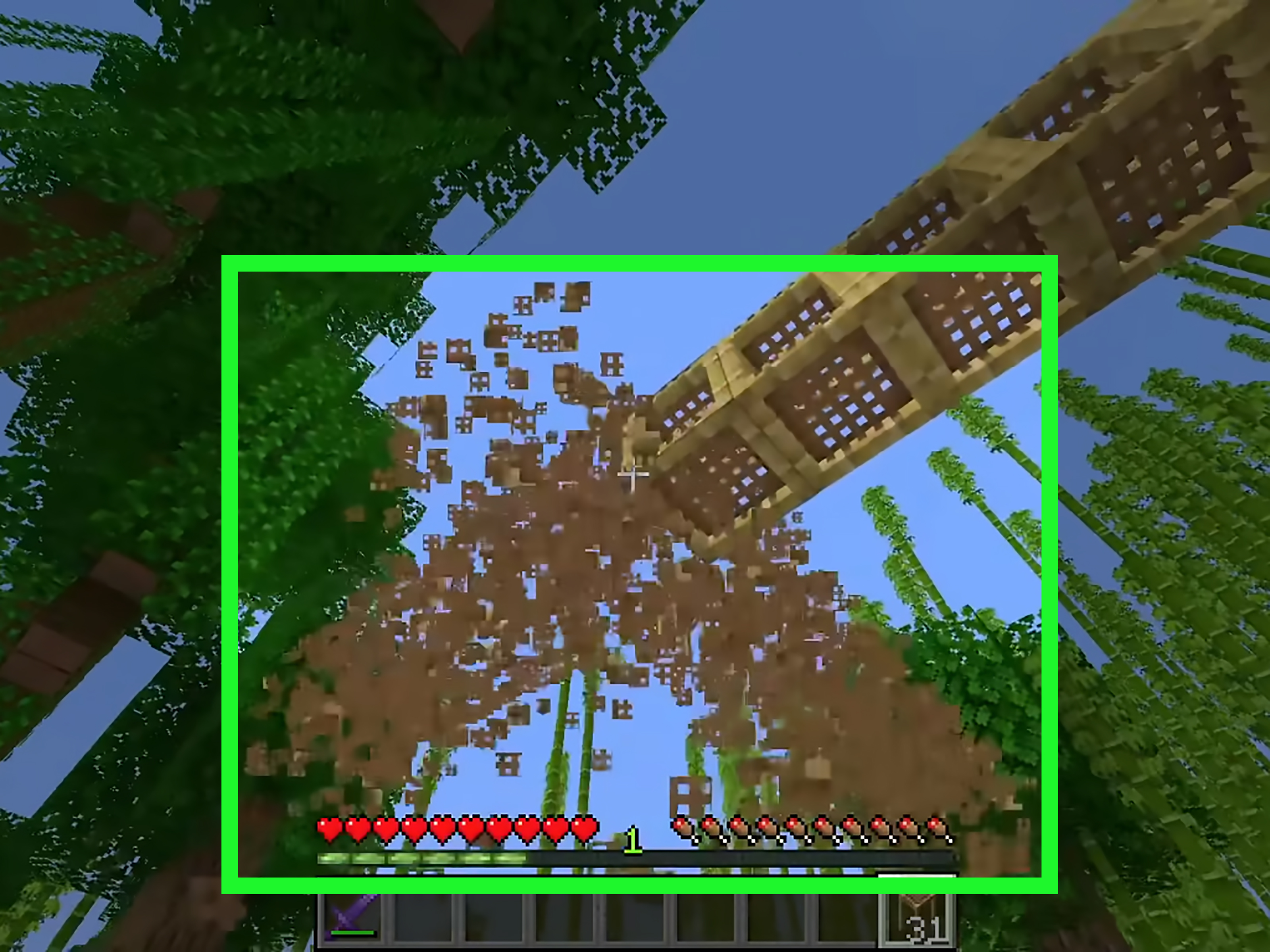
One of the best features of scaffolding is easy cleanup. Break the bottom block of a scaffolding tower, and the blocks above it break too. This is why builders love it. A temporary support system that cleans itself up? That is the dream. Dirt pillars could never.
Scaffolding Support Rules Explained
Scaffolding is not just a normal block wearing a bamboo costume. It has support behavior. A scaffolding structure needs a supported base, and horizontal scaffolding can only extend a limited distance from support before it falls.
In practical terms, you can extend scaffolding outward from a supported tower, but only up to a certain range. If you go too far without adding another support, the next scaffolding block falls like sand or gravel. This limit matters when you are creating bridges, temporary platforms, or working around wide walls.
Builder-Friendly Example
Imagine you are building a tall castle wall. Place a scaffolding tower beside the wall, climb to the height you need, then extend scaffolding along the side to create a temporary walkway. As you move, add new supports when necessary. This gives you a safe working ledge without permanently changing the wall design.
Best Uses for Scaffolding
1. Building Roofs
Roofs are where many Minecraft players discover the true pain of gravity. Scaffolding gives you a stable platform around your house so you can place stairs, slabs, trapdoors, and decorative blocks without balancing on the edge like a nervous goat.
2. Constructing Towers
For towers, lighthouses, wizard spires, and skyscrapers, scaffolding is a must-have. Build a central scaffold column, climb up, place blocks, and remove the scaffold when finished.
3. Working on Mob Farms
Mob farms often require precise block placement high in the air. Scaffolding helps you reach the correct height and safely move around while placing platforms, trapdoors, water channels, and redstone components.
4. Exploring Caves and Cliffs
If you find a tall cave chamber or cliff face, scaffolding can act as a portable elevator. It is especially helpful when you need repeated access to the same vertical area.
5. Temporary Bridges and Platforms
Scaffolding can extend horizontally, making it useful for short temporary bridges. Just remember the support limit. If your bridge suddenly collapses, the block is not broken; it is simply enforcing workplace safety regulations in its own dramatic way.
Common Mistakes When Crafting or Using Scaffolding
Using the Wrong Crafting Grid
The recipe requires a crafting table. If you try to make scaffolding in your inventory grid, nothing will happen. Minecraft is not being rude; it is just asking for more workspace.
Putting String in the Wrong Slot
The string goes in the top-middle slot, not the center. The bamboo fills the left and right columns. If the output does not appear, check the pattern first.
Forgetting the Horizontal Limit
Scaffolding can extend outward, but not forever. Add supports when building wide platforms. This is especially important for mega builds, floating bases, and long walls.
Breaking the Bottom Block Too Early
Breaking the bottom block is great for cleanup, but terrible if you are still standing on the structure. Always make sure you are safe before removing the base. Gravity is patient, but it is not merciful.
Scaffolding vs. Ladders: Which Is Better?
Ladders are excellent for permanent vertical movement. They are cheap, simple, and look natural in houses, mines, and towers. Scaffolding is better for temporary construction because it is easier to place in tall stacks and easier to remove.
Use ladders when you want a finished access point. Use scaffolding when you are actively building, repairing, exploring, or experimenting. Many players keep both on hand: ladders for the final design, scaffolding for the construction chaos that happens before the final design looks presentable.
Quick Tips for Better Scaffolding Builds
- Keep at least one stack of scaffolding in your building shulker box.
- Start a bamboo farm as soon as you find bamboo.
- Use scaffolding instead of dirt pillars to keep builds clean.
- Add extra support columns when making wide temporary platforms.
- Break the base only after you are safely off the scaffold.
- Use scaffolding for tall redstone builds, farms, roofs, and exterior walls.
Extra Experience: What Using Scaffolding Teaches You About Building Smarter
After spending enough time building in Minecraft, you begin to realize that the hardest part is not always choosing the right block palette. Sometimes the hardest part is simply getting your character into the right position without turning the entire project into a parkour course. Scaffolding changes that experience because it gives you control over your workspace. Instead of fighting the build, you can move around it.
One of the best lessons scaffolding teaches is planning. When you build with dirt, cobblestone, or random blocks, you often place temporary supports wherever panic demands. Later, you have to remove them one by one. Scaffolding encourages cleaner habits. You start thinking in work zones: one tower here, one platform there, a temporary walkway along the roofline, and a safe way down. The build feels less like a wrestling match and more like an actual construction project.
Scaffolding is especially useful when working on roofs. Roofs require awkward angles, repeated stair placement, and lots of edge work. Without scaffolding, you may place blocks from below, climb onto the roof, fall off, climb again, and question every life choice that led to building in survival mode. With scaffolding, you can surround the structure with a temporary frame. That lets you test roof shapes, adjust overhangs, and add details like chimneys or dormers without constantly rebuilding access points.
For large projects, scaffolding also improves your inventory management. Dirt, stone, and wood can work as temporary blocks, but they often mix with your real building materials. Then you accidentally leave a dirt block inside a wall or a cobblestone pillar behind a tower. Scaffolding is visually distinct and obviously temporary. When you see it, you know it is meant to come down. That makes cleanup faster and reduces hidden mistakes.
Another experience-based tip is to carry more scaffolding than you think you need. A small build may only require a few blocks, but a large wall, farm, or statue can consume stacks quickly. The good news is that bamboo farming makes this easy. Once your bamboo farm is running, scaffolding becomes one of the most renewable building aids in the game. It feels good to use a temporary block without worrying that you are wasting valuable materials.
Finally, scaffolding makes experimentation less annoying. Want to test a different roof height? Build a temporary scaffold. Need to compare two window designs on the second floor? Scaffold up and swap blocks quickly. Want to decorate the underside of a bridge? Use scaffolding as a safe work platform. The more you use it, the more you stop seeing it as a niche item and start seeing it as a builder’s best friend. It may not be flashy, but it quietly saves time, prevents falls, and keeps your world looking cleaner. That is a pretty heroic job for a block made from bamboo and string.
Conclusion
Learning how to make scaffolding in Minecraft is simple: gather six bamboo and one string, place them in the correct crafting table pattern, and collect six scaffolding blocks. The real magic comes from using scaffolding well. It helps you build upward, descend safely, create temporary platforms, clean up quickly, and avoid turning every project into a mountain of dirt pillars.
If you enjoy building in survival mode, scaffolding is one of those blocks that feels optional until you actually use it. Then it becomes hard to live without. Start a bamboo farm, collect string whenever you can, and keep scaffolding ready for your next house, tower, bridge, farm, castle, or wildly oversized frog statue. Your future builder self will thank you.
SEO Tags

