
Beauty Unlocked
Lord Kelvin’s Contraption Turns Drips Into Sparks
Jun
Note: This article is for educational reading only. Lord Kelvin’s water-dropper involves high voltage with very small current, so it is best understood as a physics demonstration rather than a home project.
Introduction: When Water Decides to Become a Lightning Intern
Most of us look at a dripping faucet and think, “Someone should fix that.” Lord Kelvin looked at dripping water and thought, “What if this could make electricity?” That is the difference between ordinary irritation and Victorian genius.
The device now known as the Kelvin water dropper, Kelvin electrostatic generator, or the wonderfully dramatic Lord Kelvin’s thunderstorm, is one of the strangest and most elegant machines in classical physics. It uses falling water droplets to build up opposite electric charges until the system can produce a visible spark. No battery. No spinning turbine. No tiny gremlin pedaling inside a copper box. Just gravity, water, metal, and electrostatic induction doing a surprisingly theatrical dance.
Invented by William Thomsonlater Lord Kelvinin the 1860s, the contraption demonstrates how small charge imbalances can be amplified through feedback. At first glance, it seems almost impossible: water falls, charge separates, voltage rises, and thensnap!a spark leaps across a gap. It is a miniature thunderstorm on a tabletop, and it remains a favorite example for explaining static electricity, electric potential, induction, and energy conversion.
Who Was Lord Kelvin?
William Thomson, better known as Lord Kelvin, was one of the giants of nineteenth-century science. Born in 1824, he became a professor of natural philosophy at the University of Glasgow at a remarkably young age and spent decades working across thermodynamics, electricity, magnetism, navigation, telegraphy, and measurement. His name lives on in the kelvin temperature scale, but reducing him to “the temperature guy” is like calling Leonardo da Vinci “that sketchbook fellow.”
Kelvin had a talent for connecting theory to instruments. He was not content to admire equations from a safe distance. He wanted devices that measured, tested, and revealed hidden forces. That practical streak made him influential in submarine telegraphy, electrical measurement, and atmospheric electricity. The water dropper fits perfectly into that personality: it is clever, physical, slightly eccentric, and deeply revealing.
What Is the Kelvin Water Dropper?
The Kelvin water dropper is an electrostatic generator. That means it produces high voltage by separating electric charges, not by delivering large amounts of power. This distinction matters. A power plant is a buffet; the Kelvin water dropper is a dramatic appetizer with a tiny fork.
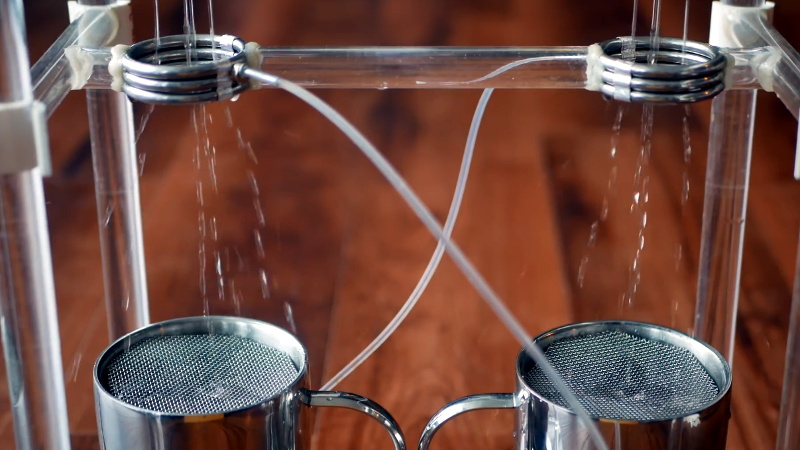
Conceptually, the device has two streams of water falling through nearby metal conductors and into separate collectors. The conductors and collectors are cross-connected so that each side influences the opposite water stream. A tiny initial imbalance in chargesomething that naturally exists in the real worldgets amplified. One side becomes more positive, the other more negative. As the electric potential difference grows, the air between conductors can eventually break down, creating a spark.
Kelvin originally described the device as a self-acting apparatus for multiplying and maintaining electric charges. That phrase sounds like it belongs on the business card of a very ambitious lightning bolt, but it is accurate. The machine does not create charge from nothing. Instead, it separates charge and increases voltage through a feedback process.
How Falling Drops Become Electric Sparks
The Tiny Imbalance That Starts Everything
The Kelvin water dropper begins with a small charge difference. In the real world, perfect electrical balance is rare. Dust, humidity, dissolved ions, nearby objects, and previous contact can leave one conductor with a slight excess of positive or negative charge. That small difference is enough to start the show.
Imagine one collector has a tiny positive charge. Because of the cross-connected design, a nearby conductor on the opposite side becomes positive too. As water passes through that region, charges inside the water respond. Water is electrically neutral overall, but it contains molecules and often ions that can shift under an electric field. Opposite charges are attracted; like charges are repelled. This is electrostatic induction.
The Moment a Drop Breaks Away
The magic happens when the water stream breaks into individual droplets. While a continuous stream can conduct charge back toward its source, a detached droplet carries its charge away like a tiny courier with no return address. Once the drop separates, it transports charge into the collector below.
That charged drop makes its receiving collector even more charged. Because the system is cross-connected, the increased charge strengthens the electric influence on the opposite stream. That stream then produces droplets with the opposite charge, which further charges the opposite collector. The result is positive feedback. The machine, in effect, whispers to itself: “More. More. More.”
Why the Spark Appears
As charge separation increases, the voltage difference between the two sides rises. Air usually acts as an insulator, but only up to a point. When the electric field becomes strong enough, air molecules can become ionized, and a brief conductive path forms. The stored charge rushes across the gap as a spark.
That spark is the device’s punchline. It is also a reminder that lightning is not magic; it is charge separation looking for a shortcut. The Kelvin water dropper is not the same as a thundercloud, but it offers a beautifully compact analogy: droplets move, charges separate, voltage builds, and the atmosphere eventually says, “Fine, I’ll conduct.”
The Physics Behind the Contraption
Electrostatic Induction
Electrostatic induction is the redistribution of electric charge caused by a nearby electric field. In conductors, charges can move relatively freely. In water, especially water containing ions, charges can shift and respond to nearby charged objects. The Kelvin water dropper uses this principle repeatedly and cleverly.
The important point is that the water does not need to be “born charged.” The field near the falling stream influences the distribution of charge in the water. When droplets detach, they carry some of that induced charge away. Each droplet is small, but many small events can produce a large voltage.
Positive Feedback
The Kelvin water dropper is a physics lesson wearing a feedback-loop costume. A small charge causes a larger charge separation. That larger separation causes an even stronger electric field. The stronger field produces more charged droplets. More charged droplets produce still more voltage. The process continues until leakage, splashing, imperfect insulation, air breakdown, or a spark limits the buildup.
This is why the device feels almost alive. It starts quietly, then seems to organize itself into two opposing electrical camps. One side becomes increasingly positive; the other becomes increasingly negative. The machine is not thinking, of course, but feedback can look suspiciously purposeful.
Energy Conservation
Where does the energy come from? Not from nowhere. The answer is gravity. As water falls, it loses gravitational potential energy. A tiny portion of that energy becomes electrical potential energy as droplets carry charge against an electric field. Much of the rest becomes motion, sound, splashing, and heat.
This is why the Kelvin water dropper is sometimes called a hydroelectric generator, though it is not practical as a power source. It can generate impressive voltage, but the current is tiny. In everyday terms, it is great at making sparks and terrible at charging your phone. Your phone would grow old waiting, and frankly, it would judge you.
Why High Voltage Does Not Mean High Power
One of the most useful lessons from Lord Kelvin’s contraption is the difference between voltage and power. Voltage is electric potential differencean electrical “push.” Current is the flow of charge. Power depends on both. The Kelvin water dropper can produce thousands of volts under the right conditions, but the amount of charge stored is small, so the available energy is limited.
This is similar to the static shock you may feel after walking across carpet. The voltage can be surprisingly high, but the charge transfer is brief. That does not make all sparks harmless, and high-voltage demonstrations should be treated with respect, but it explains why the Kelvin water dropper belongs more to the world of teaching and curiosity than industrial energy production.
Why the Device Still Matters
It Makes Invisible Physics Visible
Electric fields are invisible. Charge separation is invisible. Potential difference is invisible. A spark, however, is extremely visible. It is also audible, memorable, and emotionally persuasive. Students may forget a diagram, but they rarely forget water making a spark like it has been secretly attending wizard school.
The Kelvin water dropper turns abstract electrostatics into something physical. It shows that water can carry charge, that induction can create separation without direct contact, and that feedback can amplify tiny effects into dramatic outcomes.
It Connects to Atmospheric Electricity
Kelvin’s interest in atmospheric electricity was not a side hobby. Scientists in the nineteenth century were trying to measure and understand the electric state of the air. Kelvin developed instruments related to water dropping and electrical measurement, helping turn atmospheric electricity into a more quantitative field.
The Kelvin water dropper echoes natural processes in clouds, where moving droplets, ice particles, collisions, and separation processes contribute to large-scale electric fields. The details of thunderstorms are more complex, but the broad theme is familiar: motion plus charge separation can produce startling electrical consequences.
It Inspires Modern Research
The idea has not stayed frozen in a Victorian cabinet. Modern researchers have explored microfluidic versions of the Kelvin water dropper, where tiny droplets in small channels can acquire charge and interact with electric fields. These studies connect an old demonstration to contemporary interests in lab-on-a-chip systems, droplet control, electrowetting, and energy harvesting.
That does not mean Kelvin accidentally invented tomorrow’s power grid in a faucet. It means the underlying physics remains useful. Small droplets, surfaces, charge transfer, and electric fields matter in fields ranging from printing to atmospheric science to microfluidics.
Common Misconceptions About Lord Kelvin’s Thunderstorm
Misconception 1: The Water Itself Is a Battery
The water is not a battery in the usual chemical sense. It is part of a system that separates charge. The falling droplets carry charge from one region to another, and the device stores electric potential between opposite sides. The energy source is the falling motion of the water, not some secret electrical ingredient hiding in the tap.
Misconception 2: More Water Always Means More Spark
More flow is not automatically better. The timing of droplet formation matters. If the stream does not break into drops at the right region, the effect weakens. If droplets touch the wrong conductors or splatter too much, charge can leak away. The device rewards balance, not brute force. In other words, it has the temperament of a violin, not a garden hose.
Misconception 3: It Produces Useful Household Electricity
The Kelvin water dropper is fascinating, but it is not a practical generator for everyday energy use. It produces high voltage at very low current. That makes it excellent for demonstrating electrostatics and poor for powering appliances. If your refrigerator is running on a Kelvin water dropper, something has gone terribly wrong in both physics and meal planning.
Lord Kelvin’s Contraption as a Teaching Tool
Science education often struggles with scale. Atoms are too small, fields are invisible, and equations can feel like locked doors. The Kelvin water dropper opens one of those doors with a surprisingly simple message: tiny effects can accumulate. A barely noticeable charge difference can grow into a spark when the system is arranged to reinforce it.
That lesson goes beyond electrostatics. Feedback appears in climate systems, microphones, finance, population growth, engineering controls, and even social media trends. The Kelvin water dropper is a polite little machine that says, “Be careful what you amplify.” Then it makes a spark for emphasis.
Experience Section: Watching Drips Become Sparks
The most memorable thing about the Kelvin water dropper is not just that it works. It is the delay before it works. In a classroom demonstration, museum exhibit, or carefully supervised lab setup, people often stare at the falling water with mild suspicion. At first, nothing seems to happen. The droplets fall. The collectors wait. The air remains boring. Someone in the back may begin wondering whether the real experiment is testing patience.
Then small signs appear. A thin stream may tremble. Droplets may seem to curve slightly instead of falling with perfect obedience. The apparatus has not become haunted; it is responding to electric forces. Charges are accumulating, and the water is beginning to feel the field it helped create. This is the wonderful part: the system becomes its own storyteller. You do not need to see electrons marching in formation. You can see the consequences of their separation.
The first spark is usually tiny, but it changes the mood instantly. There is a snap, a brief flash, and suddenly the humble drip machine has everyone’s attention. The reaction is often half science, half comedy. People lean forward, then lean back. Someone laughs. Someone says, “Do it again,” as if the machine is a trained dolphin. In that moment, the Kelvin water dropper succeeds as education because it makes curiosity physical.
What makes the experience especially satisfying is the contrast between ordinary materials and extraordinary behavior. Water is familiar. Gravity is familiar. Metal containers are familiar. But arranged in Kelvin’s clever feedback loop, these everyday things produce something that feels almost theatrical. It is a reminder that physics is not hidden only in particle accelerators, observatories, or billion-dollar laboratories. Sometimes it is hiding in a drip.
The demonstration also teaches humility. A small misalignment, too much moisture in the air, poor insulation, or unstable droplet formation can reduce the effect. That can be frustrating, but it is also honest science. Real experiments are not magic tricks with guaranteed applause. They are negotiations with nature. Kelvin’s contraption rewards patience, careful observation, and respect for details.
For students, the experience can shift static electricity from a textbook topic to a lived event. Terms like “induction,” “potential difference,” and “charge separation” stop sounding like vocabulary assigned by a committee of sleepy professors. They become explanations for something seen and heard. That is powerful. A spark is brief, but the memory can last for years.
The best takeaway is not “water makes electricity,” although that is the headline-friendly version. The deeper takeaway is that systems matter. The same water, falling without Kelvin’s arrangement, is just water falling. Add the right geometry, conductors, isolation, and feedback, and the system begins separating charge. The contraption shows that nature often reveals its secrets not through exotic materials but through clever arrangements.
Lord Kelvin’s water dropper remains delightful because it is both simple and subtle. It looks like a puzzle, behaves like a storm, and teaches like a great professor: patiently, dramatically, and with a tiny spark at exactly the right moment.
Conclusion: A Victorian Spark That Still Feels Fresh
Lord Kelvin’s contraption turns drips into sparks by using electrostatic induction, falling droplets, and positive feedback. It begins with a small charge imbalance and amplifies it until opposite sides of the apparatus hold enough electric potential to discharge through the air. The result is a miniature lightning show powered by gravity and guided by clever design.
The Kelvin water dropper is not important because it can replace modern generators. It cannot. Its value lies in how clearly it demonstrates big ideas: charge separation, electric fields, voltage, feedback, and energy conservation. It also captures something joyful about science. The world is full of ordinary objects doing extraordinary things under the right conditions. Lord Kelvin noticed, arranged, tested, and explained. More than 150 years later, the sparks still make people smile.

